found openhuman on github trending last week and haven't stopped thinking about it.
it's an open source agent that reads your gmail, calendar, repos, docs and builds a memory tree out of all of it - before you type a single prompt.
most agents start cold and you spend weeks teaching them your stack. this one starts already knowing you. but the part that actually got me wasn't the memory, it was where the memory lives: plain markdown in an obsidian vault you can open and edit.
you can read your agent's mind. correct it with a text file. i've shipped enough agent tooling to know how rare it is for someone to make the smart part inspectable instead of hiding it behind embeddings.
starred it, cloned it, lost a saturday. zero regrets.
https://t.co/grcMKmy273
AI agents don't actually need blockchains.
They need programmable money, fast settlement, and reliable APIs, all of which are solvable without a chain.
The "AI needs crypto" thesis is mostly people with bags looking for a narrative. Convince me I'm wrong.
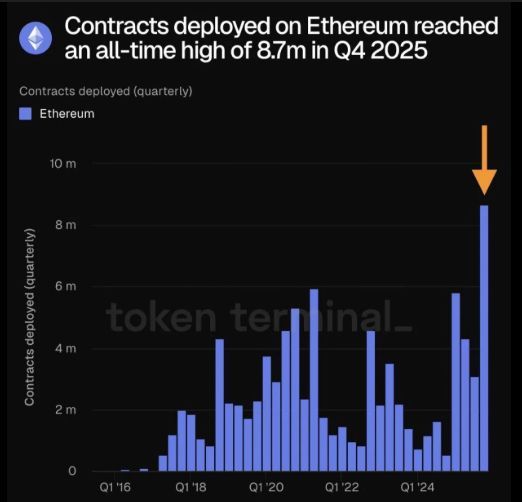
📊 8.7M smart contracts deployed in Q4 2025. New all-time high.
Mostly rollup infra, RWA boilerplate, and copy-paste forks.
The deployment chart is not the innovation chart. Don't confuse the two.
The biggest mistake I see devs make with AI coding tools: dumping the entire problem into one prompt.
One function. One PR. One context window. The model doesn't get smarter when you overwhelm it, you just get confident-sounding garbage at scale.
GM ⚡ $TAO just bled $900M in hours, one subnet dev walked out and called the whole thing "decentralization theater"
The most painful rug pulls aren't from anons. They're from insiders who finally told the truth.
x402 just crossed $600M in transaction volume with ~500K active AI wallets.
Machine-to-machine micropayments over HTTP aren't a whitepaper anymore. They're in production.
Most people still think "AI payments" means GPT buying an Uber. It's already deeper than that.
Opus 4.6 is hitting ~80% on SWE-bench Verified.
That's not a demo stat, that's a model fixing real bugs in production repos, across real GitHub issues, without hand-holding.
The "AI engineer" debate just stopped being theoretical.
Visa and Coinbase just enabled AI agents to make autonomous card payments with user-defined limits.
We went from "agents can schedule meetings" to "agents can spend your money" in one announcement.
The trust boundary just moved somewhere nobody fully mapped. ⚠️
Base isn't winning L2 on tech. It's winning because Coinbase has compliance + distribution built in two moats that can't be bootstrapped.
What EF grants couldn't buy, a brokerage license did.
The GENIUS Act just drew the line for stablecoins.
Under $10B in issuance state rules. Over $10B federal regime, no escape hatch.
Builders treating this as background noise are the same ones who ignored KYC "until they had to."
"Decentralization theater" isn't a hot take, it's Covenant AI's actual exit statement from Bittensor.
If a founder can unilaterally freeze subnet emissions, you built a startup with extra steps.
-27% in a day is the market agreeing.
Most AI × crypto projects are wrappers, not infrastructure.
The ones that matter aren't integrating AI into crypto they're using crypto to remove the trust layer from AI entirely.
That's not a product difference. That's a civilization-scale choice.
Built the on-chain AI agent in 3 days.
Spent 5 days debugging why gas estimation breaks on Arbitrum when the agent calls itself recursively.
Crypto infra isn't the bottleneck. Tooling docs are. 🫠
⚡ GM. Virtuals just ran the first autonomous robot-to-robot transaction on-chain. A robot 3D-printed something. Another delivered it. No human approved anything.
The sci-fi comparisons aren't warnings anymore. They're the product roadmap.
Saved 3 hours this week letting Claude Code handle a 12-file refactor across my codebase.
Zero lines written by me. Full context maintained throughout.
The real unlock wasn't the speed, it was the cognitive overhead it removed.