Today's top crypto stories 👇
1. China court weighs seizing 61,896 $BTC, worth $5B, in Qian Zhimin case
2. $106M of @ethereum longs liquidated on @binance in one hour $ETH
3. Patrick Witt exits as White House Crypto Council executive director
4. Canton Network leads all chains with $155M in Q3 2026 fees
5. @VitalikButerin says zkEVM developers should put security first after ZKsync proof
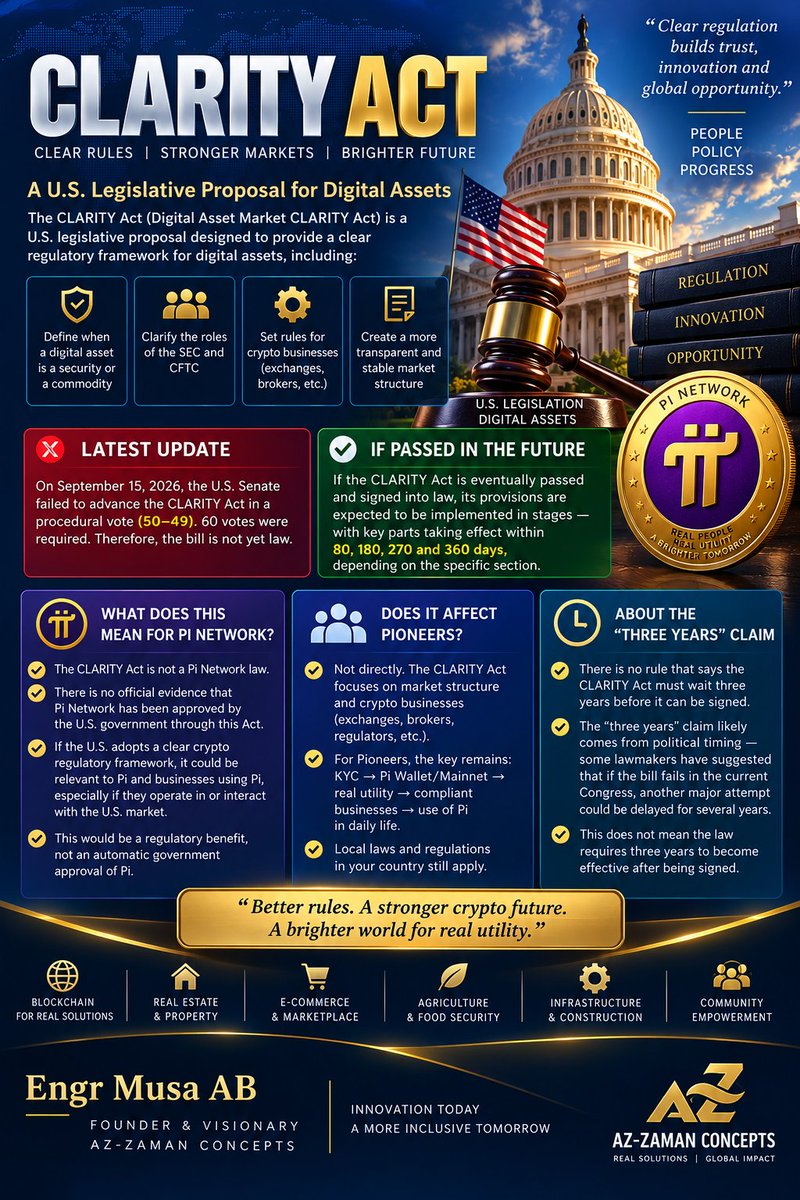
Is it true that if the CLARITY Act is not signed now, it will take three years before it can be signed?
No. That claim is not accurate.
The CLARITY Act is not currently law, and there is no rule saying that it must wait three years before it can become law.
- On September 15, 2026, the U.S. Senate failed to advance the CLARITY Act in a procedural vote. The vote was 50–49, while 60 votes were required.
- Therefore, the bill has not been enacted and has not entered into force.
- If Congress revisits the legislation and it eventually passes both chambers and is signed by the President, the bill provides for staged implementation, with important provisions taking effect on timelines such as 80, 180, 270, and 360 days, depending on the specific provision—not three years.
Where does the “three years” claim come from?
The three-year statement may be a misunderstanding of political timing rather than an implementation requirement.
Some lawmakers have warned that if major crypto legislation fails during the current congressional process, another major legislative opportunity could potentially be delayed for several years. That does not mean the CLARITY Act itself requires three years to become effective after being signed.
What does this mean for Pi Network?
It is important not to confuse:
CLARITY Act → U.S. crypto-market regulation
with:
U.S. Government → CLARITY Act → Pi Network approval
There is currently no official evidence that the U.S. government has approved Pi Network through the CLARITY Act, nor that Pi Network has a special agreement with the U.S. government because of the Act.
If the U.S. eventually adopts a comprehensive crypto-market structure law, it could be relevant to Pi and businesses using Pi if they operate in or interact with the U.S. market. However, that would be a regulatory consequence, not automatic government approval of Pi.
Bottom line
The “three years” claim should not be presented as a fact.
What is confirmed is that the CLARITY Act has not yet become law, and the September 15, 2026 Senate vote did not advance it. If the legislation returns and is eventually enacted, its implementation would follow the timelines written into the final law.
@EngrMusaAb1@PiCoreTeam
Everyone's arguing whether land-based data centers are a bubble.
Cathie Wood thinks that's the wrong conversation entirely.
While billions pour into real estate and power grids down here, she's looking up, and says this technology revolution will dwarf the industrial revolution. Orbital data centers and all.
Is this 1999 all over again? She has thoughts. Watch this Bloomberg Interview.
XRP ETF INFLOWS CONTINUE AS INVESTOR DEMAND HOLDS STRONG
$XRP spot ETFs recorded another day of positive flows on May 6, bringing in $13.03 million, per SoSoValue Crypto data.
Bitwise led the inflows with $7.33 million added.
The move follows $11.28 million in inflows recorded a day earlier.
Your phone is already on.
Why not let it work for you? 📱
ACCESS Network turns your daily screen time into real blockchain coins.
No extra hardware. No complicated setup. No KYC.
Just tap, invite friends, and watch your ACCESS grow.
A real Layer 1 blockchain — live, verified, and built for everyone.
Exciting updates are coming. The future is being built now.
The question is — are you in? 👀
📲 https://t.co/riGJXMYfcw
#ACCESSNetwork #FreeMining