Physician & Co-founder/CEO @SeamlessMD Digital Care Journeys for health systems ⚡️ Previous: Chair, Innovation Council, CMA | @uoftmedicine | @NEXT_Canada
Health Tech purchases used to be “straightforward” - the vendor had a price tag. Healthcare AI? Health systems have NO idea what budget they actually need. Even vendors don’t know what their costs will be - even EHRs keep changing their AI pricing models. Yesterday it was usage based. Today it’s a license again. Tomorrow it’s a license with a usage cost.
A couple of weeks ago, my CTO reviewed our internal AI costs (Claude, ChatGPT, etc.). Claude is by far our highest expense, about 8x our ChatGPT spend. Gemini is essentially “$0” because we’re a Google Workspace customer.
Should we axe Claude and force everyone to do as much with Gemini instead?
This is the exercise every CIO and CMIO is going through, except instead of Claude and Gemini, it’s “AI scribe startup” vs “EHR AI scribe” or “AI operations startup” vs “EHR AI operations features”.
Right now our Claude spend is nominal compared to our company budget and I’m a power user, so it’s pretty safe. But what if I went away tomorrow and the next CEO wasn’t a believer? I also used to be the big Zoom champion at my company, and then even I succumbed to the beauty of the Office 365 bundle for Teams and churned Zoom.
All of this works for now because we’re mostly paying flat, per-user license fees for these tools. But the CFO brain in my head is seeing the warning signs. 20%+ of our team already has monthly “overage” charges from Claude.
We already know some EHRs have moved off license pricing to hybrid license + usage costs. AI scribe startups have committed to license-based fees, but perhaps they can afford to because they’re heavily subsidized by VC money. What happens when that model breaks and they have to start introducing usage costs? Will CIOs/CMIOs just understand or will that be what breaks the camel’s back?
Which means increasingly it’s not enough as a Healthcare AI startup that your product is good. You have to nail:
1/ Reporting on ROI, or at least leading indicators of ROI. E.g. AI Scribes took off before they helped with billing/coding, before any proof of reducing staff attrition, because the leading indicators were compelling (great staff comments, reduced burnout/cognitive load scores)
2/ Continuous champion engagement. Do you have a backup champion? And a backup for that backup? And are they senior and influential enough so the C-suite wants to keep them happy? Sorry, but ROI alone isn’t good enough - healthcare is ultimately a people business.
3/ Transparent, ongoing dialogue with health systems about your business model. CIOs and CMIOs know no one has a great handle on the cost to serve AI products - they understand you’re figuring it out. What they won’t like is not being part of the dialogue and getting smacked in the face with an unexpected business model change.
Miss even one of these, and you shouldn’t be surprised if your Healthcare AI product is shown the door at the next renewal cycle.
Elsevier is providing the ultimate test on what matters most for CDS AI adoption at health systems - vertically integrated product or “vibe marketing”? My 5 thoughts:
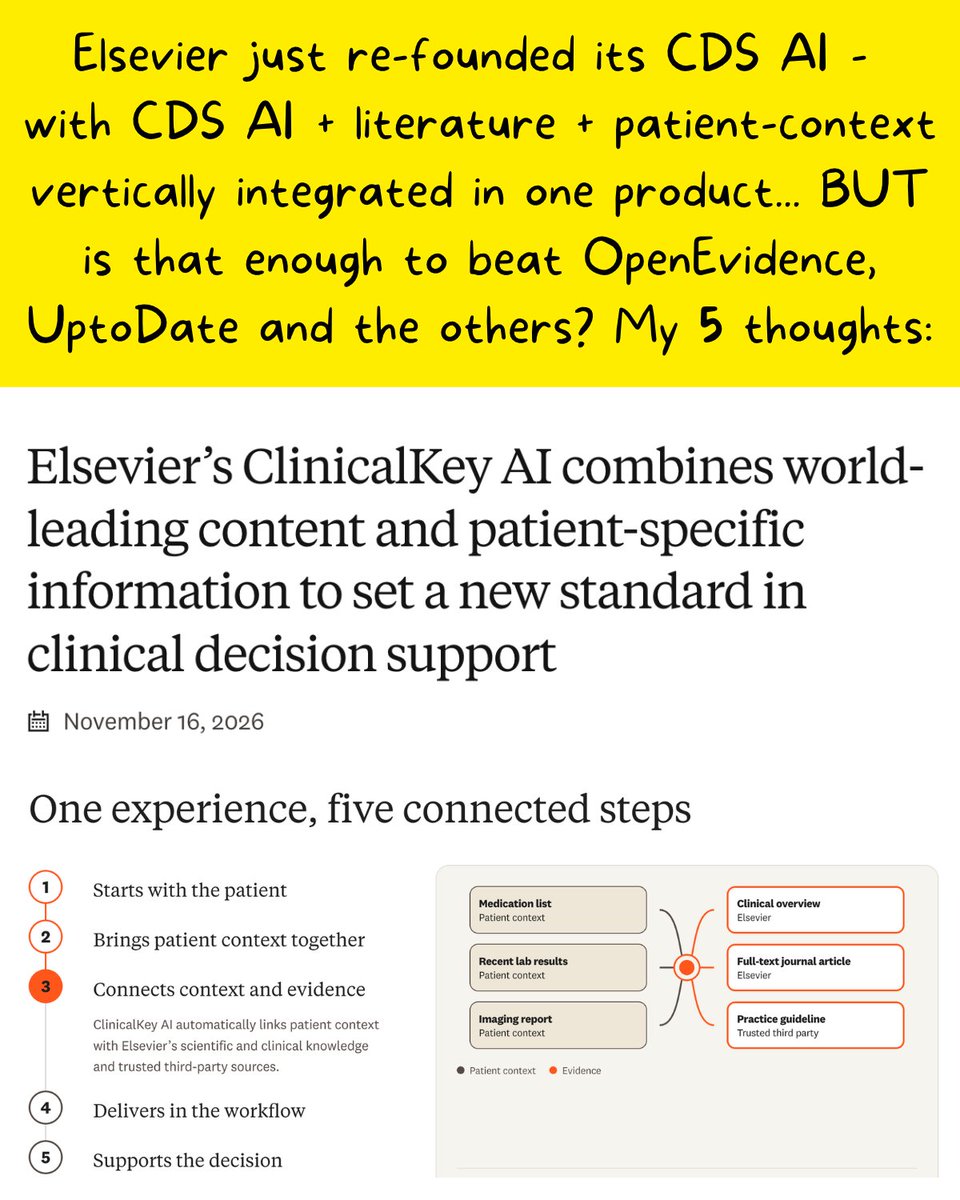
First, Elsevier made a BIG announcement last week with ClinicalKey AI. Here’s what we know:
→ ClinicalKey AI was already like UpToDate AI but without the same brand recognition. Elsevier owns 1,000+ journals (e.g. Lancet) and put an AI on top for clinicians to ask questions.
→ In June 2026, Elsevier acquired Wellsheet - an EHR-embedded CDS AI tool that accesses meds, lab trends, imaging reports and notes to enable chart summarization, answer questions about the chart and guide care teams through evidence-based clinical pathways. Founded 10+ years ago, it was one of the original companies in the CDS AI space. It gave Elsevier a way to tap into EHR patient-context. (Congrats again to Wellsheet founders Craig Limoli and John Paul Patrizio)
→ The combined product - the “new” ClinicalKey AI - is essentially if UpToDate AI married Evidently: a vertically integrated CDS AI + Medical Literature knowledgebase.
→ ClinicalKey AI is already available in 1,200 healthcare organizations given its prior distribution
Alright my 5 thoughts:
1/ The big challenge for ClinicalKey AI is clinician mindshare. UpToDate had clinician loyalty and lost it to OpenEvidence within a couple of years. Now, UpToDate made the smart pivot to become knowledgebase infrastructure for other platforms. I doubt ClinicalKey AI can supplant the OE brand within a clinician’s mind - the question is whether it can offer something compelling to the enterprise (i.e. health systems).
2/ In 2026, it’s no longer just about having the best product - it’s whether everyone knows about you. For Elsevier, it’s a pure marketing task now. The good news? They have distribution already in 1,200 healthcare organizations. The bad news? With an EHR-integration for patient-context, “turning it on” is a lot more complex than “ask it a question”. It’s like making a new sale at an organization, even if no new dollars are needed.
3/ So if you’re Elsevier what do you do? You need to turn all of Wellsheet’s pre-existing customers into raving fans of ClinicalKey AI. If you can’t, turning on the marketing taps is pointless - you’ll burn tons of cash and have a leaky bucket. But if you CAN… those champions will be all the marketing you need - you just need to amplify their voices.
4/ You also need to be willing to build your customer base where no one’s looking. UpToDate, Abridge, OpenEvidence, Epic - they’re all competing for the mindshare of the big AMCs on Epic. There may be value in focusing on Oracle and MEDITECH customers, which may be more likely to adopt ClinicalKey AI right now.
5/ Do what a lot of the other big companies won’t do: put out a bunch of public demos. Encourage your best clinician champions to write what they’re learning in public on LinkedIn. Yes, that might mean some flaws are exposed - but the downside of someone stealing some secret from your product is far lower than the upside of exposure.
The biggest learning going from clinician to Health Tech entrepreneur is the humbling realization: “if the innovation loses money, if it can’t scale profitably - we HAVE to kill it. It doesn’t matter how much it helps patients or care teams.”
I don’t think this is unique to Health Tech innovators either. This is the same tough reality many folks face on the health system administration side of the table.
We all went into healthcare to make a difference, to help patients heal. Yet as I get older, as much as I like to think I run a Health Tech innovation shop, the reality is I’m running a business. If the business isn’t profitable, then all those readmissions avoided, the shorter hospital stays - none of it will be sustained long-term. It’ll just one day disappear.
For many years, our startup was unprofitable. We were living off of grants and investor capital. We were producing fantastic clinical evidence, measurably improving patient outcomes and even saving lives - yet the unit economics of our solution were bad. Every patient we helped, every health system we served, meant more money down the drain. Unfortunately there’s no premium for improving clinical outcomes.
So several years ago we swallowed tough medicine and fixed things. Improved our business model. Got way more efficient. Became one of the few companies in our space that is actually sustainable.
Now that we’re in a much better financial position, we have room to explore. New problem areas, new markets, new products… the problem?
My instinct now is to look at everything through the older, wiser lens of: can we actually build a sustainable business out of this new product? Will it be too niche? Is the market too small? Will the sales cycle be too long because it’s just a nice-to-have? Will the margins be good enough?
On the one hand, you could argue this is the right way to go. I still remember the stress of building this company while worrying about whether we’d need another round of financing just to survive. I don’t want to worry about that ever again.
At the same time, obsessing over the unit economics first and foremost means we lose some of the idealism that got us to launch @SeamlessMD in the first place. So maybe we still gotta make some of these bets every now and then. Not because they are the most profitable innovations, but because they are the most impactful to patients. Because if we say no to everything that’s not revenue cycle management (sorry, easy cheap shot), what’s the point of all this?
Which is why when I meet other Health Tech innovators who ask me for advice - even when my gut is “there’s no real market for this” or “I really don’t get why a health system would pay for this” - unless they truly want my complete take on what they’re building, I keep my cynical thoughts to myself.
Because if I met myself 14 years ago, I would’ve thought @SeamlessMD was a horrible idea. That no one would buy this. But thank the heavens, I never go to meet my future self.
Everyone keeps talking about Abridge… but what if it’s the AI scribe startups who pursued non-Epic health systems that outlast the rest? Would be quite the reversal of fortunes.
When Abridge and Epic first partnered via Workshop, outsiders assumed it explained why Abridge kept winning health system after health system… and it did. Whether deservedly or not, CMIOs and CIOs repeatedly told me: “Well of course we only truly considered Abridge and Nuance DAX - that Workshop designation suggests they are the most integrated with Epic, right?”
It didn’t matter how good the rest of the product was. Epic had unintentionally crowned Abridge and Nuance temporarily as the frontrunners - and most health systems gravitated towards those two. And because Abridge had the better product, they won the vast majority of the Epic market.
Abridge put all their eggs in the Epic basket. And why shouldn’t they? It’s called focus. It’s called clarity on your “ideal customer profile”.
Which meant Nabla and Suki had to diversify beyond Epic. We’re not just talking about Oracle or MEDITECH customers - we’re talking about practices and even other health tech companies. According to a STAT News article (c/o Brittany Trang), in 2026, Nabla’s revenue is “20-30% Epic, 20% non-Epic hospitals, 30% partnerships, 20% mid-market self-service”. Suki’s is even more diverse - besides smaller hospitals and practices, Suki powers the AI scribe for 15 smaller EHRs (e.g. WellSky) and even Zoom’s telehealth solution - 30% of Suki’s revenue comes from these platform plays.
Menlo Ventures reported that AI scribe startups dropped from 67% to 54% market share in 2026, with incumbents (EHRs, Microsoft) rising from 33% to 46%. With most health systems able to try their EHR’s AI scribe first, incumbent share will likely rise near term.
This doesn’t mean the startups are screwed - incumbent products commonly “freeze” startup adoption until the market determines which product is good enough. Sometimes the EHR product freezes the market for 2-3 years, and then the market decides it prefers the startup’s product.
The issue is whether the startups can survive 2-3 years of flat or declining growth. With the crazy valuations VCs have given some AI startups, flat or declining growth is a big problem. It’ll be hard to raise capital at a higher valuation. Which probably explains the high profile AI scribe layoffs we’ve seen in the past month - they must extend their runway.
Revenue concentration in a single customer is risky. Revenue concentration on a single EHR platform is less risky, but still risky. I suspect companies like Abridge are figuring out how to diversify their revenue streams - with payers, pharma/life sciences, etc - as they should. The issue is those are very different customer segments and needs. But nothing breeds innovation like existential risks. The good news? Abridge has raised $780M+ and can afford to make a bunch of bets - they probably can’t afford not to.
14 years into building our Health Tech startup, this is still the BEST, timeless advice: just get on the darn plane and visit your health system customers. How much? How often? Probably more than whatever you’re doing now. Doesn’t matter if you’re the CEO with 1,000 employees. If you think you can delegate spending time with customers in-person just because you have a huge team, you’re less successful than you could be. You’re missing out on first-hand learnings, context and insight.
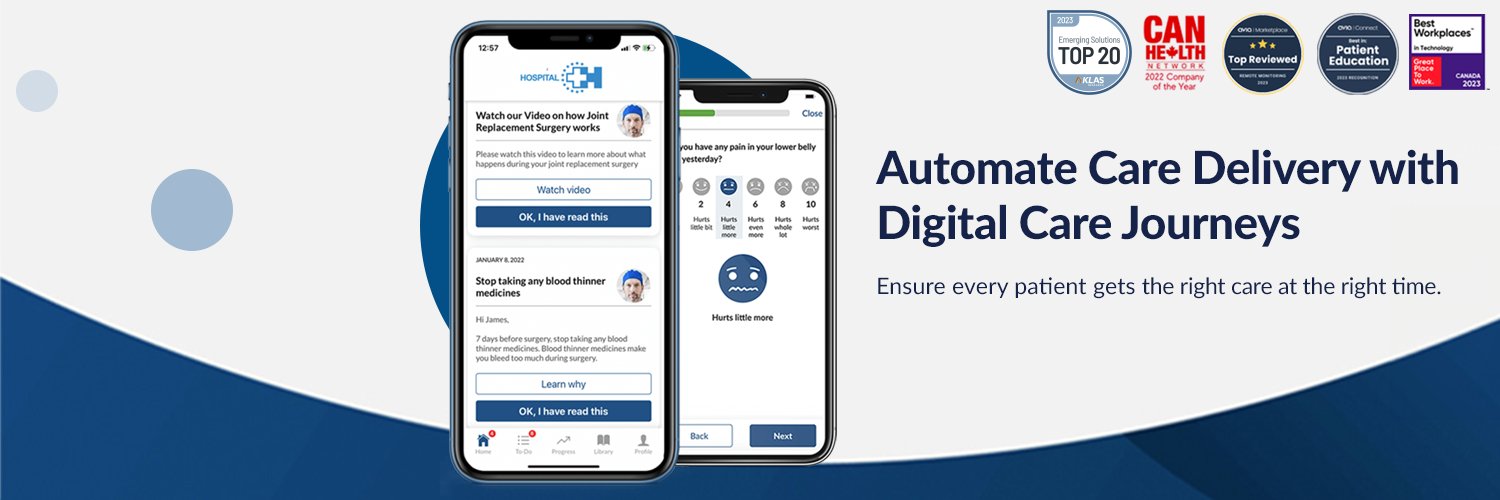
Case in point, I recently visited a U.S. health system customer that is using our Epic/MyChart integrated digital care journeys (@SeamlessMD) enterprise-wide, and I came back with a head full of ideas and lessons learned.
Here’s a small sample of what I took home from that customer visit:
1/ Access, access, access is what matters to most right now. Everyone cares to improve clinical outcomes, BUT reducing procedure cancellations to increase case completion rate (e.g. colonoscopies) and closing the loop on patient referrals (e.g. does the patient still want one? If Yes, how do we make it happen? If No, can we document why?) aligns with more strategic priorities.
2/ A bad change management experience with a previous vendor can give a health system cold feet with letting a new vendor be more hands-on with change management, so they try to do more on their own. But when they realize you know what you’re doing, they want you to take the wheel more. Subject matter expertise is a bigger differentiator than folks realize - but it has to be proven and earned. So check in every now and then on whether the current change management approach still makes sense.
3/ As much as you try to engage every frontline stakeholder group with an enterprise rollout, sometimes you’ll miss some folks at the beginning - which can understandably create confusion and frustration: “why wasn’t I involved earlier? My patients are asking me what this is and I had no idea.” So what do you do? Don’t get defensive - own the oversight, agree it shouldn’t have happened, and commit to involving them better going forward. It’s a great sign that they WANT to be engaged! Would you rather they didn’t care?
4/ Nimbleness matters way more than the Tech. If another Tech has the capabilities but it takes months and tons of IT and clinical resources to implement a new pathway/workflow, but YOU could stand it up in weeks, that’s still highly, highly valued. When an important job has to be done, features matter less, and “who can help me get the job done NOW” matters way more.
5/ Adaptability and willingness to change agendas on the fly is important. When you get time in-person, what REALLY matters to a health system is more likely to pop up out of nowhere - which means it may take your meeting in a different direction. If that happens, embrace it and be intellectually curious. Your customer’s agenda matters MORE than yours. If you as a vendor are rigid and try to force your agenda just because you spent dozens of hours on your slides, you’re missing the point.
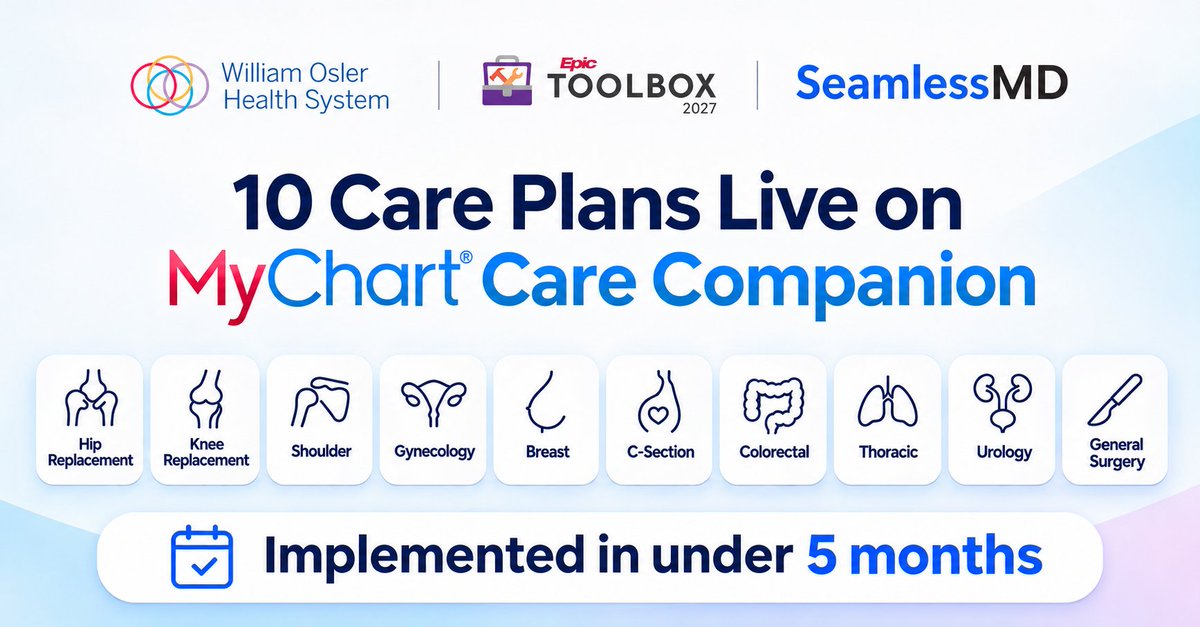
Imagine going live on Epic in October and already having 10 MyChart Care Companion plans live on Nov 1. Sounds impossible? Except that’s what William Osler Health System just did - and I’m thrilled to say @SeamlessMD helped make it happen! 🙌
Here are 5 key takeaways from a Care Companion rollout William Osler pulled off in under 5 months:
1/ Osler went-live with Care Companion care plans for 10 different pathways: hip replacement, knee replacement, shoulder, gynecology, breast, C-section, colorectal, thoracic, urology, or general surgery recovery.
2/ If you’re unfamiliar, through Care Companion in MyChart, patients can access education, reminders, tasks and symptom monitoring on a smartphone, tablet or computer - guiding them through what’s typically a complex process with surgery.
3/ The whole 10 care plan implementation process took less than 5 months - something that often takes other health systems YEARS. How did they pull this off? Osler partnered with @SeamlessMD to access care plan content (tasks, questionnaires, education) already in Care Companion format. All they had to do was import the content into Epic via Turbocharger and customize it further as needed.
4/ The neat thing is that @SeamlessMD adds a whole customized patient education library connected to the native tasks and questionnaires that come with MyChart Care Companion - meaning patients get a more enhanced education experience than they normally get with Care Companion alone.
5/ A point I’m especially proud of as CEO of @SeamlessMD: we remain the 1st and only company to earn Epic Toolbox designation for Care Companion content. Seeing that content reach patients across two hospitals so soon after an Epic go-live shows what’s possible through amazing collaboration.
Huge thank you to David Stankiewicz, Eugene Contella, Raja Ravi and all the Osler team members involved for making patient care journeys a priority. and the clinical and digital health teams at William Osler Health System for making surgical patients a priority from the start. Grateful that you chose SeamlessMD to be part of this journey!
@nikillinit There’s some implication that AI being involved means the evaluation process will be meaningfully different
I would argue that it won’t be
The way stuff gets bought even in complex enterprises is less technical than ppl think
Maybe it depends on categories
I talk to CIOs/CMIOs all the time about AI scribes, CDS, AI assistants - not once I have heard of formal AI type benchmark evals being done. Just normal bake-offs like any Tech pilot - which ends up being which product do clinicians prefer based on personal use. Definitely no one using consultants for this
Who says no?
Health systems because they don’t trust it?
I mean Abridge has 300+ health system customers - someone WILL try it - question is whether adoption will be material among their customer base and how long that takes - we will learn a lot in the next 12 months for market appetite
Agree practices (SMBs) far easier
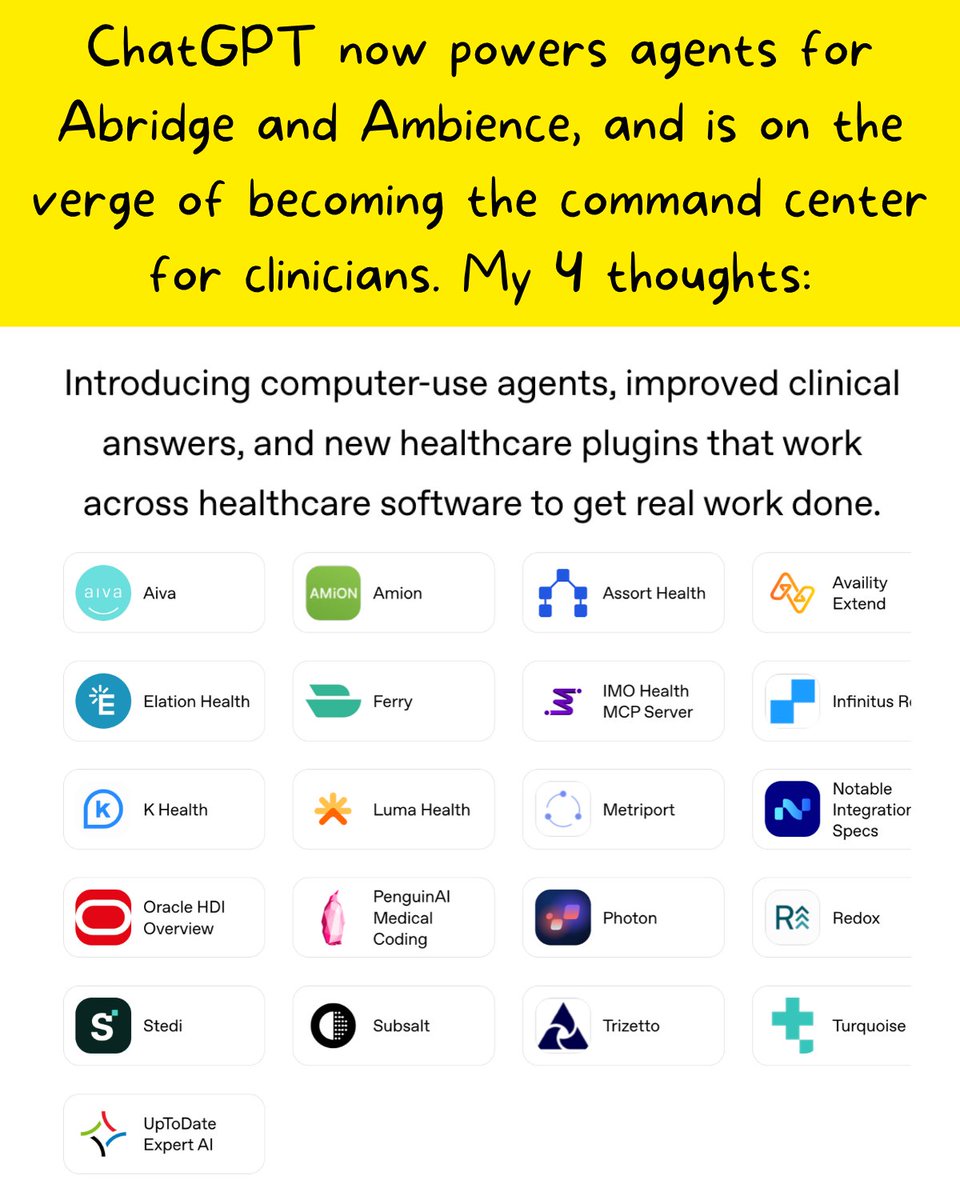
Will OpenAI enable Abridge and Ambience to leapfrog EHRs on AI Agents? Is ChatGPT on the verge of becoming the command center for all clinicians? My 4 thoughts on yesterday’s big OpenAI announcements:
First, what we know:
→ OpenAI announced two major healthcare expansions: (1) powering agents in other companies’ products and (2) bringing more healthcare tools directly into ChatGPT
→ Abridge is developing agents powered by OpenAI to better coordinate care, such as resolving a patient’s barriers to discharge by having an agent coordinate access to medications and home-health services - including doing phone calls and sending messages.
→ Ambience is building an agent powered by OpenAI that reads a patient’s chart, prepares a prior authorization on an insurer’s website, and waits for clinician approval before submitting
→ ChatGPT for Healthcare is adding more than 20 healthcare plugins, improved clinical search, and computer-use agents so teams can find information and carry out tasks from ChatGPT as the main work interface. E.g. You can use UpToDate Expert AI right within ChatGPT
Alright, my 4 thoughts:
1/ I continue to preach that UpToDate is making the right strategic move from clinician app to back-end CDS infrastructure. They conceded UpToDate being the front door to clinicians and have swiftly moved to being the back-end that powers every single CDS AI interface (except OpenEvidence of course). First they powered Abridge’s CDS, then Epic, then even Doximity (which didn’t technically need them), and now ChatGPT itself. It doesn’t matter who wins the AI assistant race as long as UpToDate powers all of them!
2/ What happens if the EHRs disallow the Abridges and Ambience’s of the world from using AI agents to access their interfaces? I’m assuming EHRs have already prohibited AI agent access on the grounds of security, but my CMIO/CIO friends please educate me. If that’s true, would clinicians be willing to open up Abridge/Ambience in a separate window to use its agentic capabilities? Although Abridge/Ambience could still retrieve patient context through approved integrations, how much of the promised workflow automation depends on an agent interacting directly with the EHR?
3/ If ChatGPT can become the “command center” interface for healthcare staff, I could increasingly see third party companies be expected by health systems to integrate - mostly to streamline reporting and analysis. For example, at @SeamlessMD, we’ve hooked up our sales CRM to Claude - if I want to run a report on our sales pipeline and go back-and-forth with Claude on an analysis, it’s super easy to do so. I could imagine a world where a health system connects our SeamlessMD reporting back-end to ChatGPT so they could immediately generate reports and analyses, without having to access our dashboard. In fact, this actually makes the third party products more sticky because it’s easier for your health systems to understand usage and ROI (or maybe it’s bad if you’re actually not generating ROI and will get exposed faster!)
4/ Claude has become my “workspace” for many workflows and scenarios, but it certainly hasn’t made Outlook, Slack, PowerPoint, obsolete for me - despite all the integrations. If that remains true for the clinician workflow, should the EHRs also really care to give up some user surface area to ChatGPT? Sure, if I’m an EHR, I’d rather natively build in every single desired AI agent use case and every AI assistant use case. But if I’m worried about the speed of R&D with the Abridges and Ambience’s of the world, maybe it’s time to just let ChatGPT take some of the surface area - at least they’re unlikely to have the ambition to directly compete with the EHR.
We sat down with J.D. Whitlock, CIO at Dayton Children's, for the latest episode of The Digital Patient! The refreshingly candid conversation covered AI vendor pricing, governance and what AI looks like in pediatrics. The 10 most thought-provoking ideas we dug into:
1/ Why the usual playbook of waiting for Epic to build a 90% version of a best-of-breed tool may not apply to ambient AI (and what this means for your AI scribe contracts)
2/ What the health systems that moved early to Epic’s own AI scribe tool at UGM had in common - and which health systems were not among them (and why)
3/ Why 20 clinical governance committees in a single hospital might not be too many, and the business school lesson he uses to explain it.
4/ How he thinks about AI pricing when the hospital runs on a 1% margin, and how have leading vendors like Epic and Workday evolved their pricing between fixed and variable models.
5/ Why doctors overestimate how loyal their patients are, and what a find-a-doctor tool (which matches patients to the right specialist even when they misspell their diagnosis) has to do with it.
6/ How JD decides whether an AI tool is ready for pediatrics without a 10x budget.
7/ Where he stands on voice bots talking to patients, whether it's Epic’s Emmie, a healthcare-only vendor, or a Silicon Valley startup. Hint: the first question he asks is a cultural one, not a technical one.
8/ What a 97th percentile KLAS Arch Collaborative score (the clinician EHR experience survey) does NOT tell us about how happy clinicians are.
9/ Where pediatrics lags behind adult care in AI, and the bone age tool he’d love to deploy but can’t yet.