Unfortunately, there is a hack related to @gnosispay and the "delay module".
Please be patient while we try to contain the damage. Rest assured, Gnosis will cover all user losses.
What issuers can now do, live today:
🚫 Act on one address, not the whole contract
⏱ Spending limits on autopilot
↩️ Clawbacks when legally required
🔑 Safe-native, multisig-ready out the box
🔓 Permissionless to set up
Targeted, not total. Compliance without surveillance.
5/6
@0xhalloc@XBToshi@zama Coins that can freeze have 10x more adoption than any decentralized stablecoin - even the no-jurisdiction stablecoin tether will freeze assets. This is a core feature of these coins.
If you fiddle with them prepare to be frozen.
Fair point.
With centralized stablecoins you have to assume the kill switch can be pulled. That risk is real.
So there are two honest options:
give issuers tools to freeze one address instead of the whole pool, or use decentralized stablecoins in the pool.
We built @bermudabayzk to support both.
Since Kohaku and privacy are finally all over my feed again:
@bermudabayzk already prepared an integration into Kohaku, plus a few more surfaces coming 👀
We've already built testnet demos on @base Sepolia & @gnosis_ inside @MetaMask Snaps, the @safe UI and more to make sure Bermuda runs natively in the environments users are already in.
Bermuda lets you transfer, swap, lend, earn yield, pay with x402, and run agents. All private, all compliant, all on a public chain.
🌴🛡️
#Kohaku #Privacy
Anything you can do in web3 - one SDK - all private.
We've built a demo with our SDK and @privy. Create a new passkey-based wallet for your users & give them access to anything on the EVM. Including @Morpho or @Uniswap.
After the hack: Can @aave still compete with traditional banks? We are joined by @bankofcanada co-author @FurkanDanismann.
Before the incident, Aave V3 had a 0% non-performing loan ratio.
A perfect record, better than that of Canada’s biggest banks.
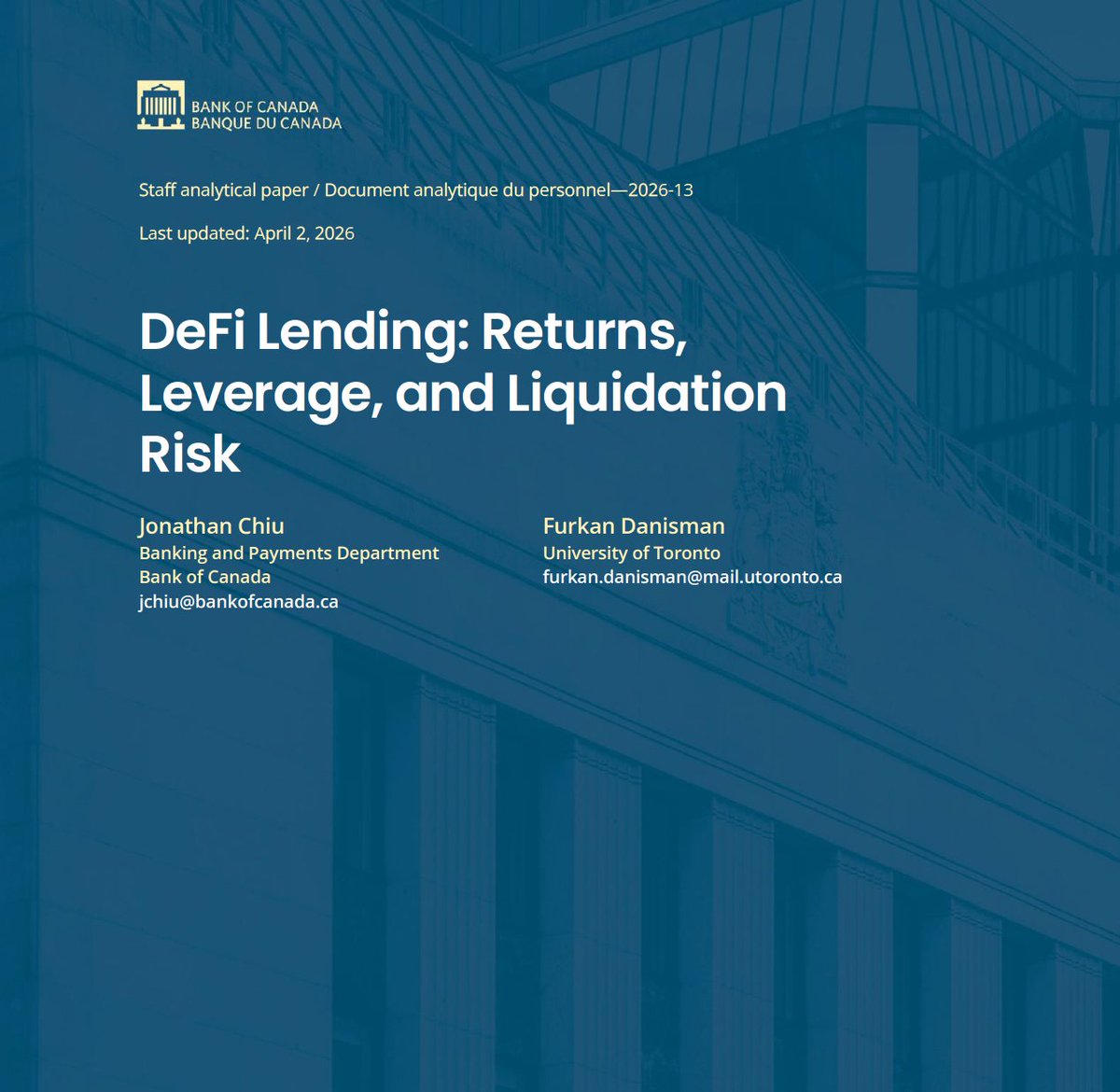
BREAKING: The Bank of Canada published a report on Aave.
It concludes that lending without traditional intermediaries is technically and operationally viable, with the system running continuously, transparently, and at minimal overhead.
It is important to get the most out of the paper without falling into propaganda. Also, reminding of the first page of the paper:
"The views expressed in this paper are solely those of the authors and may differ from official Bank of Canada positions."
After the largest DEFI hack of 2026, @arbitrum decided to freeze the funds. @griffgreen framed it as "Hacking North Korea."
Is this the fall of decentralization and the beginning of institutional crypto?
https://t.co/JzwujdD7Y4
The Arbitrum Security Council has taken emergency action to freeze the 30,766 ETH being held in the address on Arbitrum One that is connected to the KelpDAO exploit. The Security Council acted with input from law enforcement as to the exploiter’s identity, and, at all times, weighed its commitment to the security and integrity of the Arbitrum community without impacting any Arbitrum users or applications.
After significant technical diligence and deliberation, the Security Council identified and executed a technical approach to move funds to safety without affecting any other chain state or Arbitrum users.
As of April 20 11:26pm ET the funds have been successfully transferred to an intermediary frozen wallet. They are no longer accessible to the address that originally held the funds, and can only be moved by further action by Arbitrum governance, which will be coordinated with relevant parties.
After the panel and cocktail hour, @JphFritsche ushered us to a lovely private dinner with @oh_sum, the other panelists, and close friends of @SecurityOak, including @bermudabayzk, @turtledotxyz, and others!
Lots more good connections were made, plus two new @zodl_app downloads!
Assume exploits will happen. Design so they don’t matter.
On Cyphertalk (Ep. 1: Security & Privacy in 2026), @pumpkinGMI and @beyer_st discuss zero trust architecture and why real security isn’t paranoia, it’s limiting impact when humans make mistakes.
@bermudabayzk and @CantonNetwork are at opposite ends of a spectrum.
Canton is a new ecosystem. Bermuda provides invisible enterprise-grade privacy on the EVM.
@jon_helgi@monerium and I dug into what institutions actually need from privacy on our podcast.
We also discussed @aztecnetwork, the privacy OG chain, @fhenix, the FHE heroes, and @SecretNetwork, the private AI maximalists.