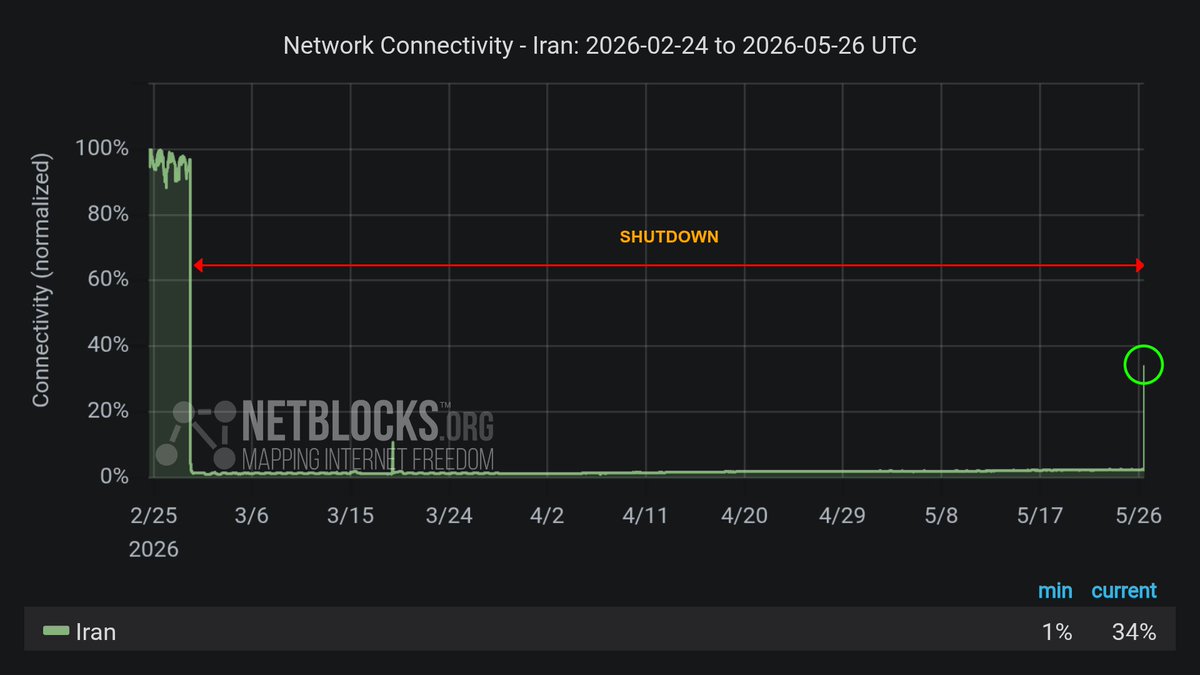
📈 Confirmed: Live metrics show a partial restoration to internet connectivity in #Iran on day 88, after 2093 hours of near-total isolation from international networks, the longest nationwide internet shutdown in modern history. It is unclear if the restoration will be sustained.
This incident is unrelated to Squid’s core protocol and contracts. All Squid users and integrators are unaffected and no action is needed.
A third-party Gnosis Safe module was exploited today across Base and Ethereum, resulting in approximately $3.2M in losses. The vulnerable contract is verified on Basescan under the name “SquidRouterModule” but this contract was not built, deployed, or operated by Squid. It is a third-party smart-wallet product that chose to integrate with Squid, among other protocols, but has not been in contact with us.
The exploit worked because the third-party module accepted a caller-supplied constant string as proof that a message was secure. If you pass in this string (which is publicly available in the verified contract’s code), then you can execute an array of arbitrary calldata, stealing funds at will. The victims’ Safes had added this faulty contract as a trusted Safe Module, which gives the contract the ability to spend any tokens in the Safe without signatures. Squid’s own router (0xce16F69375520ab01377ce7B88f5BA8C48F8D666) is architecturally different and was not touched. Squid user funds, approvals, and integrations are fully secure.
Early public reporting may reference “SquidRouter” due to the contract’s verified name on Basescan. The accurate framing is: a third-party SquidRouterModule was exploited, not Squid’s Router contract. The contract shares our name but is not our code. We are monitoring the situation and will share updates if anything changes materially.
There are 134 projects GREAT projects in this QF round... which makes it REALLY hard to pick your faves.
So @giveth made a cheat sheet for your LLM!
It will update every 2 hours:
https://t.co/3cvJbcXmmj
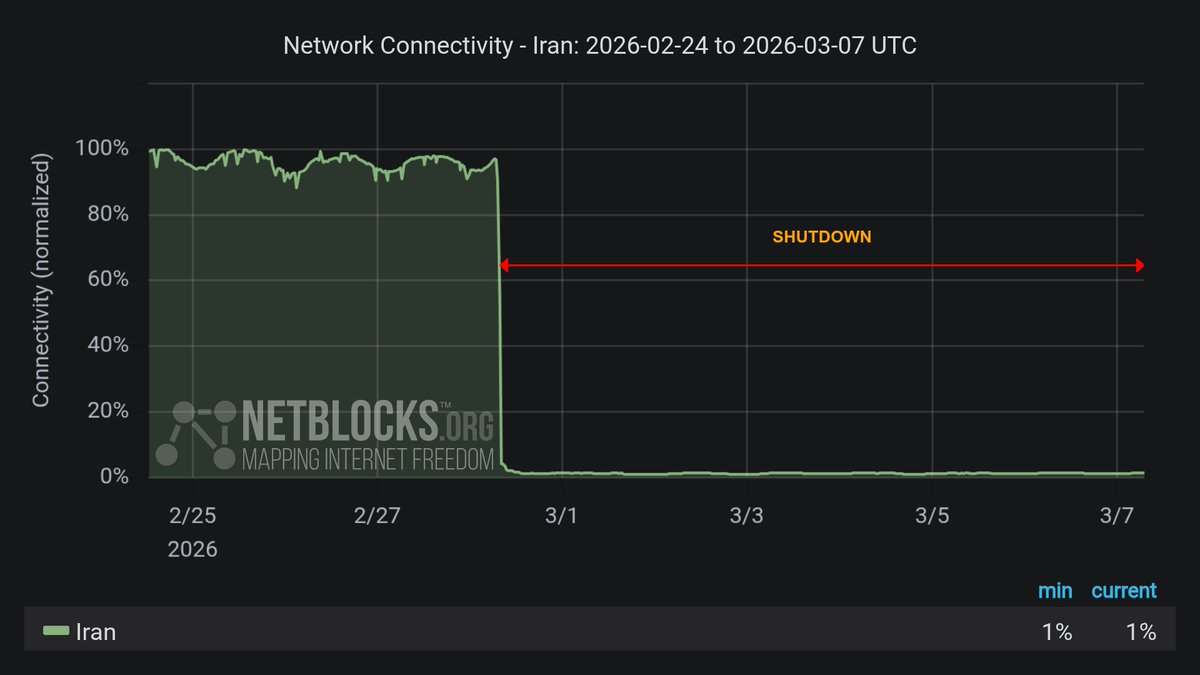
🗓️ Exactly eight weeks have passed since 28 February when #Iran was placed under a regime-imposed internet blackout.
The disruption, now entering its 57th day after 1344 hours, stifles the voices of Iranians, leaves friends and family out of touch and damages the economy.
🤔 Should @arbitrum have frozen the Kelp hack funds?
Was it putting users first?
Or putting decentralization last?
We'll settle this in THE GREAT ARBITRUM DEBATE
w/ @griffgreen and @lex_node
LIVE today @ 12pm EST https://t.co/jjSNot9vLn
90 million Iranians with no Internet 🤐
Regime propagandists : The government is very popular!
Western media : Well there you've heard it from Iranians, they really support the government
“Programmers should be creating technologies to live a free life and prosper in a hostile society of surveillance and control, and decentralization is the only way these technologies will survive against the inevitable repression.”
Because I get asked a lot.
Why we must fight Palantir, in brief.
1. Programmers working on the Internet have a moral responsibility to the entire world, not a single country. The Internet has been designed since its inception as a universal system for the sharing of knowledge without censorship. The Internet is not the property of any one government or nation.
2. The Internet enables mass surveillance at a scale unimaginable to the Gestapo and the Cheka. Far too many programmers have wasted their lives at building surveillance systems under the guise of Web advertising. Today, these web tracking systems are being used to monitor, control, and even kill humans by companies like Palantir that seek to combine state violence with corporate efficiency, and thus create a new form of technofascism.
3. Surveillance justified by external national security threats will be turned against citizens inside the nation-state. Mass surveillance was once the exclusive domain of the NSA, but today it has been privatized to corporations like Palantir that are unaccountable to any democratic process. What begins as fear of external foreign nation-states turns inwards to focus on immigrants, dissidents, and eventually to anyone that might challenge the status quo or try to exit an increasingly dysfunctional society.
4. Everyone is a target. The “enemy within” continually expands until it encompasses the entire population of a nation regardless of their status and beliefs, justifying evermore paranoid and totalizing surveillance. The line between policing and military operations blurs, with legal frameworks being replaced by technological violence operating with total impunity.
5. Surveillance can only be defeated by building software and hardware to defend ourselves. Meek calls for regulation or moralizing demands for human rights are useless in this era. Any rights must be enforced by the hard power of code. Code, not laws, can be used to uphold the right to privacy by making surveillance difficult, if not impossible, even by nation-state adversaries.
6. We are ruled by a senile gerontocracy. Unlike the generations that fought in the world wars, most of our current rulers are degenerate pedophiles who would sacrifice the well-being of the youth and the entire planet due to their infantile desire for wealth and power. Technology of surveillance and automated warfare reflects their increasingly desperate attempts to maintain archaic forms of domination.
7. The American Empire is unraveling. Once, the United States of America presided over a globe where it could enforce its rule via the status of the dollar as a global reserve currency and a network of equally global military bases, but new regional powers now directly challenge the United States as its empire dissolves in the face of internal economic stagnation, political corruption, and the inflation of the dollar.
8. In a real war, fantasies of total technological dominance always backfire. When a faceless drone kills a child’s father, that child will one day take revenge regardless of the cost, something forgotten by those raised in comfortable suburbs. Going beyond zero-sum games, one can only truly win a battle against a people by demonstrating your victory provides a better way of life, increased prosperity, and an inspiring philosophy.
9. Oddly enough, proponents of fully automated warfare support a universal draft. Deep-down, these keyboard warriors know that their technofascist fantasies are a paper tiger when up against determined opponents that engage in asymmetric warfare. They also know none of their children will fight in a war for their state but they would be happy to see other people’s children come home in body-bags.
10. The problem is not whether AI weapons will be built; we must hold responsible those who are building them. No matter which country is deploying automated killing machines, no one is absolved from the murder of civilians and the destruction of infrastructure due to the parlour-trick of shifting the blame to AI.
11. Atomic war is on the horizon. As various states descend into wars over increasingly scarce natural resources, the possibility of tactical nuclear strikes over Teheran, Kyiv, and other areas of conflict has returned to the historical stage. Increasingly geriatric and authoritarian rulers face less guardrails than before to deploying nuclear weapons, and may even be willing to sacrifice the survival of humanity to appease their own petty egos.
12. Our goal is a world of peace where every person can be empowered by the Internet. Modern war is the quintessential game of sending young people to the meat-grinder. Why die for the profit of corrupt rulers when one could build real wealth and power for yourself using the Internet?
13. We should fight for the world we want, and build the tools needed by future generations. Pacifism would be suicidal in this period of global turbulence and resource wars, but real hard power lies in technology: Programmers should be creating technologies to live a free life and prosper in a hostile society of surveillance and control, and decentralization is the only way these technologies will survive against the inevitable repression.
14. The State will not help us. The state is a dying pre-Internet institution that increasingly resembles nothing but a Ponzi scheme fueled by taxes and debt. None of the youth alive today will likely inherit any benefits, such as welfare and health care.
15. Centralized and opaque algorithms are a danger to free speech. Propaganda is the flip-side of surveillance, as continual propaganda prevents anyone from even thinking of challenging the system. Social media monopolies promote propaganda to create a generalized idiocy while silencing those that would dare to criticize the reigning order before they can organize against it.
16. Building new forms of social organization with each other is vital to survival. The traditional mediascape of politics and entertainment exists to distract us from building networked solidarity and distributed autonomous organizations across borders. The hierarchical state is as relevant to us as the medieval church and kings were to the formation of the joint-stock corporation and the labour union.
17. Digital identity is the next step in their system of control. Within the next few years, access to the Internet–including in Europe and the United States–will require biometric national identity cards, using the flimsy excuse of “protecting children.” The real goal is to gatekeep free access to subversive political content and halt cross-border communication in order to prevent new forms of self-organization and resistance from emerging.
18. Only when one can be anonymous is one truly free. The freedom to express oneself without censorship and surveillance is a vital precondition for both the autonomous use of reason and the democratic evolution of society. Technology must enable the freedom to selectively reveal ourselves to the world–so that we can become who we want to be–by preserving the right to privacy over the Internet, including not just individual privacy but the right to transact and form contracts privately.
19. America created the first global surveillance state, but it will not be the last. Too many have forgotten or perhaps taken for granted the revelations of Wikileaks and Snowden. States across the world from China to Russia are creating even more powerful global surveillance systems and propaganda machines. Leveraging private defense contracts in countries across the world, Palantir seeks to make itself the operating system of a cross-border global secret state while it pushes its own farcical version of ethno-nationalism.
20. Culture wars are a psyop. It is ironic that “Epstein class” virtue-signals about traditional morality and the superiority of forms of ethno-nationalism, while trying to return to the rule of hereditary elites, even in the United States. Rather than reverse the gains of the Enlightenment, we take the side of our ancestors who fought a centuries-long battle for individual liberty, scientific progress, decentralized markets, bottom-up democracy and the emancipation of humanity from feudal monarchs and their make-believe mythologies.
21. New forms of technology can reshape the world. Technology is not just a tool, but the world we live in and an extension of our cognitive capabilities. The co-operation of humans with the collective intelligence embedded in AI could accelerate human progress and overcome planetary crises such as climate change and atomic war that threatens the survival of our species.
22. Live free or die trying. We must bear eternal vigilance in the struggle against fascism, and the battlefield is technology. There is no middle ground: Technologists must choose whether to work for the enslavement of humanity or to create new spaces for freedom.
These are my personal beliefs, not those of @nym. Yet as a philosopher that founded a tech startup, I have a responsibility to respond to this manifesto of Palantir and it's so-called "philosopher-CEO" Alex Karp.
What were the first few hours of the DAO hack like?
@griffgreen, founder of @Giveth and @thedaofund, was there on the frontlines when 14% of the ETH in circulation was hacked.
He tells us exactly what happened, how the team responded, and how this event impacted Ethereum.
This panel went really, REALLY well, by the way. ☺️
Once again, thank you to @oh_sum, @JphFritsche, and the rest of the @SecurityOak team for inviting me to participate.
The conversation went beyond just the how of privacy and into some very personal territory for the why, too!
Day 3: @SecurityOak invited @rollergirlVi to join a panel with Lauren from @fhenix and @jbaylina from @ziskvm. Over 90 attendees showed up!
We had so many good conversations about @Zcash and handed out so many branded condoms!
With Zcash, we protect your physical layer, too! 😉
Alpha is live.
After nearly a decade, the first feature-complete privacy stack on Ethereum is here.
Developers can now build apps and contracts with ground-up customizable privacy, from execution to settlement.
https://t.co/ITasZpe0yM
Rome in May should be on your list:
May 4: FarCon Builders Day
May 5: FarCon Summit Day
May 7: ZK Summit
May 9–10: ZK Proof
May 10–14: EuroCrypt
And many more events and side events to come
And remember, there is also an official @ethereumfndn Community Hub in the city👀
It would be nice to see the US drop Starlinks in Iran instead of bombs.
According to Grok, the US could drop over 2000 Starlinks for the cost of 1 bomb.
⚠️ Update: A full week has now passed since #Iran fell into digital darkness under a regime-imposed national internet blackout.
The measure remains in place at hour 168, leaving the public isolated without vital updates and alerts while officials and state media retain access.