Check out our new study in @ScienceMagazine, where we take on a 100-year-old debate: what’s the role of aneuploidy in cancer?
We discovered that genetically removing extra chromosomes blocks cancer growth - a phenomenon we call “aneuploidy addiction”. https://t.co/K5ny7Ureph
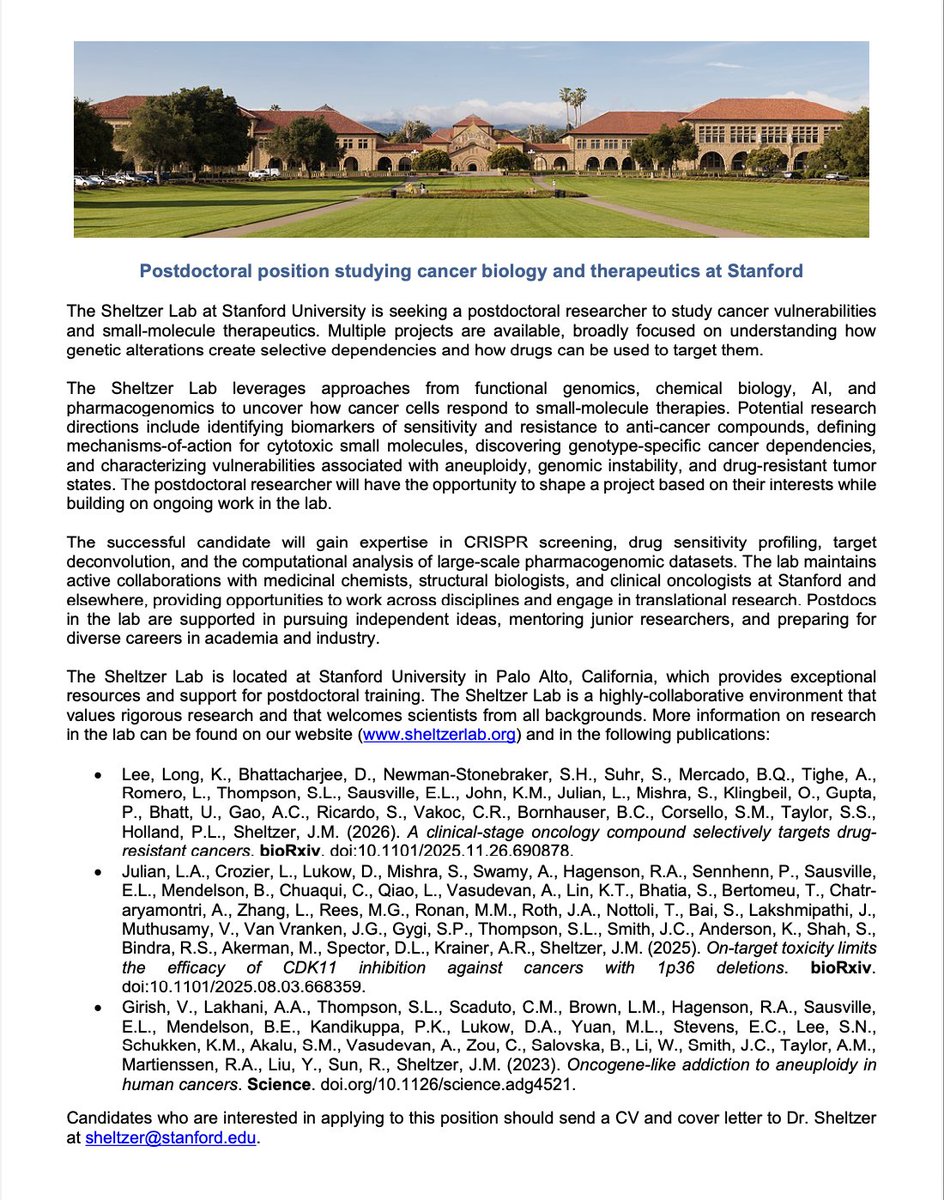
My lab at @Stanford is looking to hire postdocs for multiple projects on cancer biology and therapeutics. Our recent work has uncovered some truly remarkable mechanisms for cytotoxic small molecules and we're looking to build on this research. If interested, see below:
Diabetes researchers ejected from conference after criticizing White House. The editor of ADA journal Steve Kahn was nondisruptivedly handing out his recent editorial in ADA journal that criticized Trump NIH policies. Big mistake by @AmDiabetesAssn https://t.co/BcRCS793PY
NSF-supported graduate students created a tool in the early 1990s to map links between webpages, helping people navigate the growing internet. That prototype laid the groundwork for what would become one of the world's largest companies: Google. https://t.co/dwUutFqMfO
📸:CQIM
Challenges in Drug Discovery: Biology—
Paul Workman and Jason M. Sheltzer will address this topic in a special session at the AACR D3 Conference on Drug Discovery and Development (July 21-24; Boston). Learn more:
https://t.co/Bkr0o51IMc
#AACRdrugdev26@JSheltzer
My lab at @Stanford is looking to hire postdocs for multiple projects on cancer biology and therapeutics. Our recent work has uncovered some truly remarkable mechanisms for cytotoxic small molecules and we're looking to build on this research. If interested, see below:
Thrilled to share my lab’s new preprint describing our discovery of the E2 ubiquitin conjugating enzyme UBE2H as a widely-shared dependency in aneuploid cancer cells. @biorxivpreprint@biorxiv_cancer
Moving forward, we’re excited to identify UBE2H’s targets in diploid vs. aneuploid cells and to examine the consequences of acutely eliminating UBE2H in various therapeutic settings.
GLP-1 drugs are the ultimate validation of the techno-solutionist approach to society's most challenging problems.
The obesity crisis seemed liked it would just get worse and worse forever. Scolding from public health officials didn't work. Proposals to completely overhaul our food systems were dead on arrival.
Instead, we invented a weekly shot (based on Gila monster venom!) that fixes obesity directly.
And now, thanks to the economic incentives in our biomedical industry, we have follow-on drugs that will be cheaper, even more effective, and easier to administer (by taking a pill instead of a shot).
Policymakers should be focused on figuring out how we can get more breakthrough drugs like GLP-1s (and faster). They also should think hard about which slopulist ideas might inadvertently kill the goose that lays the golden eggs.
Not sure how many people have noticed this: In the latest (Mar 4) release of 24 new research papers from Nature (top science journal), 8 came from the US and 8 came from China. https://t.co/m2HmJIBiJL Among the 29 new research papers in Cell (top journal in biomedical sciences) released this year, 8 came from the US while 10 came from China. https://t.co/BBury80mjO Meanwhile US labs are suffering from the aftermath of the NIH/NSF funding disruptions - including drastically reduced funding rates and as a result diminishing lab sizes and competitiveness in #STEM research.