CHART OF THE DAY: Perhaps the most important story in global markets / geopolitics right now.
China's oil imports plunged to ~6.6m b/d in May, according to @Vortexa data, down ~38% vs 2025 average (or ~4m b/d).
I wrote this @Opinion column in early May: https://t.co/XK71uh81m1
🚨 THE AI COST CRISIS HAS STARTED.
Microsoft reportedly told engineers to stop using Claude because AI bills were exploding, while Uber says its entire yearly AI budget was already destroyed by April.
Strait of Hormuz | Vessel Crossings
Confirmed Strait of Hormuz transits rose to 10 on 20 May from four the previous day, while the IRGC Navy stated that 26 vessels were underway following coordination and approval procedures with Iranian authorities.
Most movements involved commercial west to east traffic, with no new Iranian export loadings observed. Although activity remained broadly low risk, it included two sanctioned vessels and one shadow vessel, while opaque routing patterns picked up d/d. Reports suggest Tehran is preparing a permit based transit framework to present in negotiations, potentially involving vessel vetting, state coordination and safe passage fees.
The emerging structure points to a more formalised IRGC managed clearance regime. Mobility is improving incrementally, but access remains conditional, politically controlled and exposed to rapid disruption.
MUST READ: The cost of a real-world oil cargo is dropping fast as buyers back away.
The sharp retreat provides a counterintuitive backdrop to warnings the oil market is barreling toward a crisis point. Still, traders cautioned the calm may be shortlived.
https://t.co/dN2bRQ4GEM
Aramco just confirmed what the data already showed.
Even if Hormuz opens tomorrow — rebalancing takes months.
And if the closure extends a few more weeks?
Normalization pushed to 2027.
This means:
▸ June → Operational Stress Level (7.6B barrels)
▸ September → Operational Floor (6.8B barrels)
▸ 2027 → earliest possible normalization
The market is not pricing a 2027 recovery timeline.
It’s pricing a quick fix that Aramco just said won’t happen.
This changes everything.
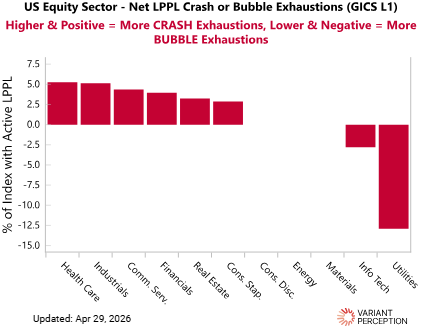
The bubble isn't where you think it is.
Despite the semi/dot com bubble headlines, we aren't seeing that many LPPL exhaustion signals in Information Technology yet. The latest data actually shows active funds are still underweight tech.
Instead, Utilities are flashing the most aggressive bubble exhaustion signals at present. This looks similar to the LPPL setups in Consumer Staples and Materials back in February—right before they rolled over.
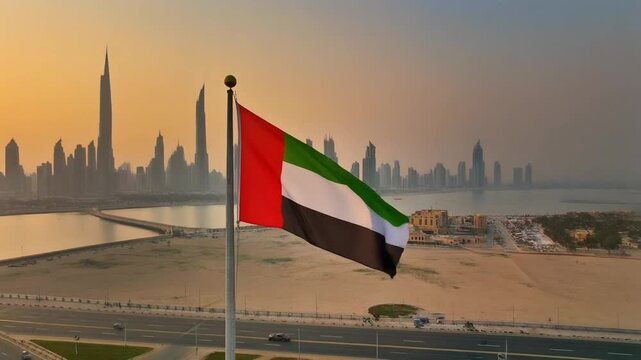
BREAKING: The UAE announces it will be leaving OPEC effective May 1st.
This will officially end the UAE's 59-year membership in the organization.
The Iran War is redefining the global energy industry forever.
BREAKING: Germany will reduce energy tax on diesel and petrol by approximately 0.17 euros ($0.20) per litre for two months to cushion the increase in prices due to the war in Iran, Chancellor Friedrich Merz said.
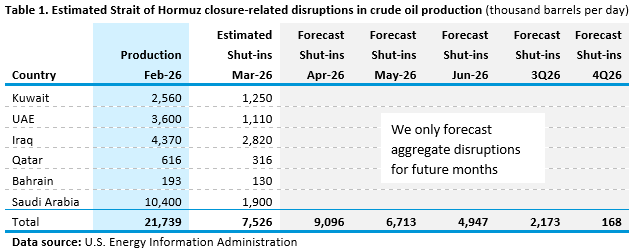
The US Energy Information Administration (@EIAgov) is now forecasting a rather long disruption to crude oil production in the Persian Gulf.
(Note this is wellhead production rather than flows via Strait of Hormuz. It doesn't appear to include natural gas liquids, so just crude)
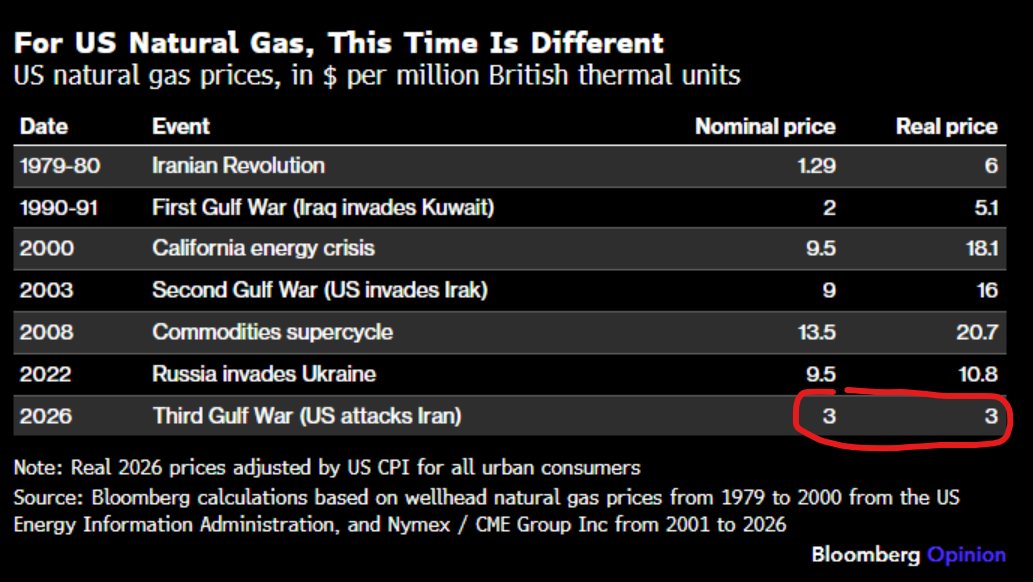
For the American economy, the key different between the current energy shock and previous ones is the (lack of) impact in US natural gas prices.
That's crucial for industrial activity and electricity prices (and thus inflation). Far less reported than oil, but as significant.
COSCO vessels abort Strait of Hormuz transit attempt amid ongoing instability
Following COSCO’s announcement to resume booking acceptance to Gulf destinations, new developments overnight suggest the situation in the Strait of Hormuz remains highly unstable.
According to #MarineTraffic data, two of its Ultra Large Container Vessels, CSCL Indian Ocean and CSCL Arctic Ocean, attempted to transit the strait but turned back at approximately 03:20 and 03:50 UTC, indicating that safe passage could not be guaranteed. This marks the first attempted crossing by a major container carrier since the start of the conflict.
Both vessels operate on COSCO’s MEX service, part of the Ocean Alliance network linking the Middle East with the Far East. COSCO, a Chinese carrier, is currently the world’s fourth-largest container shipping line by capacity.