@karpathy Isn’t it a democratic duty for the people with frontier access to document publicly what they see and increase awareness of the other categories of people?
With OpenAI claiming to have solved the Navier-Stokes Millennium Prize Problem, the future of mathematics feels like a very immediate question.
A few weeks ago, Terence Tao published "Mathematics in the age of AI": https://t.co/HH8quSQhVr
He explores what happens if AI becomes capable of doing a substantial share of mathematical research. In that world, proofs become abundant, therefore the bottleneck moves. We know that peer review is already under strain. Tao highlights that formal verification can help, but the work does not end there.
I call what follows "absorption", merging the different boxes from Tao's paper: simplifying, deeply understanding, and integrating results into the shared knowledge that makes its way into textbooks and courses, and on which future research can build.
This raises two questions I would like to discuss.
First, the likely proliferation of "useless theorems". Research has historically been constrained by human time and funding, imperfect proxies for human interest. Cheap abundance could produce vast amounts of mathematics in directions we care little about, while making relevant connections harder to find in a crowded noisy space.
To me, filters for quality and interest will be necessary in any case.
Second, do we actually need humans in the loop of knowledge production?
If not, mathematics could continue as a sport or a craft, with human virtuosity still admired, much as we admire Kasparov despite machines being better at chess.
I however see two reasons why humans might remain necessary, at least for some time.
One is that we may want to remain involved: deciding what is worth exploring is also a question of governance, especially when compute and energy remain finite and mathematics does not.
The other is that extrapolating current progress does not establish with 100% certainty that human input will become redundant.
a) Can AI reliably develop useful intermediate concepts (lemmas, abstractions, theories) that transfer to other contexts? Outside mathematics, this would be a little like inventing new words that are meaningful and reusable, which we don't see AI doing. Some very famous researchers believe llm cannot create meaningful intermediate symbolic representations.
b) And how much does progress still depend on expert human intuition, through post-training (labs still pay top 0.1% field expert a lot, see Mercor) or direct guidance? I do not know what the latest internal models can do. But if that intuition still matters, it depends on humans understanding the mathematics well enough to guide the work.
Even if human understanding eventually becomes unnecessary for producing new results, some communities will still want to pursue it, possibly at the margin of actual progress.
This is a more involved post than I usually write here, but I am curious to hear your thoughts.
PS: this post was handwritten in French then translated and shortened using AI. All ideas are as original as I can be.
La France et les pays occidentaux s'effondrent en maths au classement PISA et décrochent face à l'Asie. Les résultats sont tombés ce matin.
Qu'est-ce que PISA ?
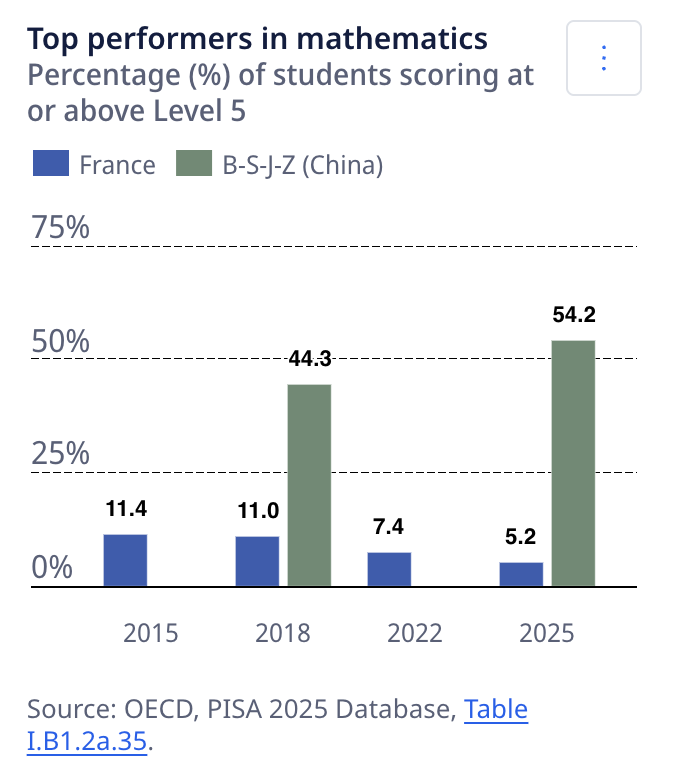
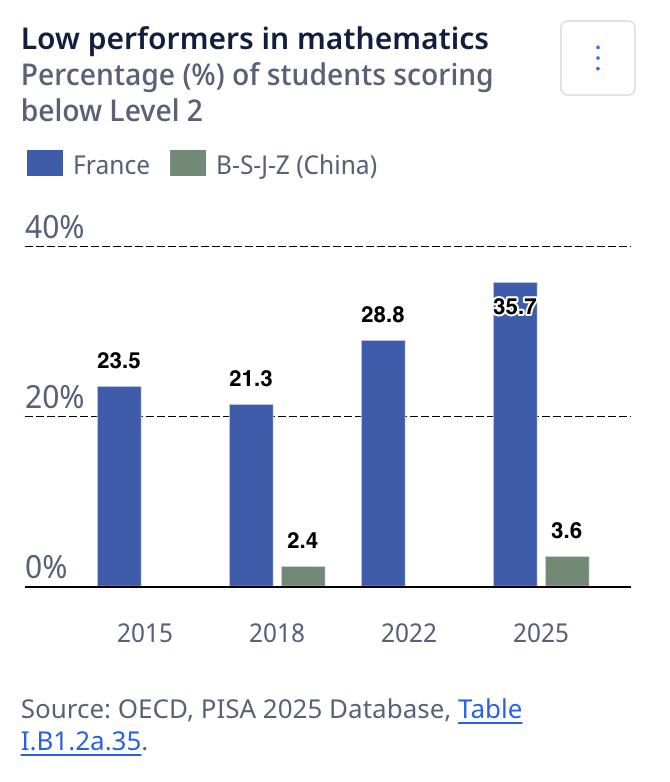
Il s'agit du test de l'OCDE passé tous les trois ans par 760 000 élèves de 15 ans dans 91 pays et qui permet d'obtenir une photographie de comparaison entre les pays sur des problèmes à résoudre en maths, en lecture et en sciences. En maths par exemple, un élève sous le niveau 2 est en difficulté ; tandis qu'un élève aux niveaux 5 et 6 est considéré "top performer".
La France connaît en 2025 ses pires résultats depuis la création du test en 2000.
Le plus troublant, c'est la comparaison avec Singapour et les provinces chinoises évaluées (Pékin, Shanghai, Jiangsu, Zhejiang).
Élèves excellents en maths (niveaux 5 et 6) :
→ France : 5 %
→ Moyenne OCDE : 8 %
→ Singapour : 37 %
→ Pékin, Shanghai, Jiangsu, Zhejiang : 54 %
Élèves en difficulté (sous le niveau 2) :
→ France : 36 %
→ Chine (mêmes provinces) : 4 %
Là où 54 % des élèves chinois excellent et 4 % sont largués, en France 5 % sont excellents, soit 1 ou 2 par classe de 30, et plus d'1 élève sur 3 est largué.
Les enfants français ne sont pas plus bêtes qu'ailleurs. C'est une faillite collective de notre système éducatif, et le rapport lui-même suggère plusieurs causes :
→ 45 % des élèves français sont dans un établissement où le manque de profs gêne l'enseignement.
→ 47 % décrivent du bruit et du désordre dans la plupart des cours. En Chine : 8 %.
→ 27 % sont dans un établissement qui interdit le téléphone. En Chine : 83 %.
→ 54 % disent que leur prof s'intéresse à chaque élève. En Chine : 89 %. À rapprocher du manque de profs, et de leur capacité à personnaliser l'accompagnement.
Ajoutez-y l'attention capturée par les shorts TikTok, et un usage de l'IA qui dégrade l'apprentissage au lieu de le servir. Le décrochage n'est peut-être pas si mystérieux.
Mais ce n'est pas qu'une histoire de classement. La question posée est celle de la place de la France et de ses élèves dans l'économie qui vient. La France veut-elle prendre l'éducation de ses enfants au sérieux ?
Je coache l'équipe de France aux olympiades d'informatique depuis 13 ans, et depuis 2025 celle des olympiades d'IA. Je sais que derrière chaque élève il y a un génie potentiel qui ne demande qu'à être correctement accompagné, de façon encourageante, positive et motivante, jusqu'à l'excellence. Il leur manque une boucle d'apprentissage : des problèmes au bon niveau et un travail sur les lacunes, un retour immédiat, de la pratique délibérée, le droit de se tromper.
Chez Artix Technologies, notre mission est de réinventer l'éducation en profondeur, en la rendant ludique et efficace. Nous commençons par les maths du lycée et de la prépa.
Nous ouvrons les pré-inscriptions au parcours lycée de MathLevel, première brique pour remettre chaque élève à niveau et l'emmener au plus haut de son potentiel.
Pré-inscriptions ici : https://t.co/Wk8nbjenTE
@edthorp_eph Bonjour EdThorp, je travaille effectivement sur un tel outil ; il ne sera toutefois pas gratuit pour diverses raisons de coûts, sauf nouvelle idée de financement. Merci pour votre retour !
Tu rentres en prépa scientifique ? Tu veux avoir autant de chances de réussir ta prépa et tes concours que les élèves de LLG / H4 / Ginette ?
Voici pour toi le poly de transition lycée->prépa de Louis-le-Grand (aka "poly LLG"), mais interactif : tu rédiges tes preuves, une IA les corrige à la volée. Et tu peux même te comparer aux élèves de ta prépa / des autres prépas.
Gratuit pour tous les futurs MPSI / PCSI / MP2I / PTSI.
👇
https://t.co/Eq7SQgVc6a
Ouverture des olympiades françaises d'IA
La première épreuve "Où est Spy-C ?" est ouverte aujourd'hui et jusqu'au 28 février
Collégiens, lycéens : tentez de remporter le challenge et de vous qualifier pour les olympiades internationales à Abu Dhabi !
Et pour les autres, participation officieuse bienvenue, lisez bien les règles et précisez [unofficial] dans votre équipe.
Bonne chance !
(French version below)
The French AI Olympiads 2026 are launching today!
The official competition is open to French middle and high school students.
If you don't fit that category, unofficial participation is still welcome! Just make sure to read the rules and include [unofficial] in your team name.
The challenge:
1) Build an AI to classify spies using tabular data.
2) Build an AI to find them in images (we were *for sure* inspired by "Where is Waldo?" :)).
Can your model spot Eli0tt the Raccoon on this image?
The competition is individual and is open until Feb 28th 11:59pm (Paris time). Good luck to everyone!
Answer and link to the Kaggle competition in comment
[French Version]
Les Olympiades Françaises d'IA 2026 commencent aujourd'hui et jusqu'au 28 février 23h59 !
La compétition officielle est ouverte aux collégiens et lycéens français. Si vous n'entrez pas dans cette catégorie, la participation non officielle est tout de même la bienvenue ! Assurez-vous simplement de lire le règlement et d'inclure [unofficial] dans le nom de votre équipe.
Le défi :
1) Construire une IA pour classifier des espions à l'aide de données tabulaires.
2) Construire une IA pour les trouver dans des images (nous avons clairement été inspirés par « Où est Charlie ? » :)).
Votre modèle saura-t-il repérer Eli0tt le Raton Laveur sur cette image ?
La compétition est individuelle, et ouverte jusqu'au 28 février à 23h59. Bonne chance à toutes et à tous !
Solution et lien vers la compétition Kaggle en commentaire
Vibe coding has unleashed a torrent of new iOS apps in the app store.
After basically zero growth for the past three years, new app releases surged 60% yoy in December (and 24% on a trailing twelve month basis).
Charts of the Week: https://t.co/by6074JwZG
Vibe coding now allows motivated builders to launch an app in a few weeks of work, sometimes even days...
I even taught my lawyer girlfriend how to create an app.
She had never coded before, and basically just asked Claude to give her instructions to follow. She made a working MVP in about four hours for Android, and honestly it looks good.
Open questions:
- How many people are responsible for this surge? Is it only a few people launching many apps?
- What proportion of these new launched apps are garbage? Are the current recommendation algorithms (eg. the App Store's one) well-suited for filtering numerous low quality content?
- What are the next bottlenecks for democratizing the creation of apps in your opinion?
Vibe coding has unleashed a torrent of new iOS apps in the app store.
After basically zero growth for the past three years, new app releases surged 60% yoy in December (and 24% on a trailing twelve month basis).
Charts of the Week: https://t.co/by6074JwZG
It’s bold and potentially huge.
And it raises the same question every platform shift does:
Will developers embrace it - or will it flop? What do you think? (10/10)
After yesterday’s OpenAI DevDay, one question keeps coming back:
👉 Is ChatGPT becoming the new web browser?
A small step for OpenAI, a big step toward a new centralization of the web?
A thread👇🧵
(1/x)
https://t.co/zPMoIp69ds
If attention keeps shifting from search -> social -> chat,
then OpenAI is quietly positioning ChatGPT as the next “entry point” to the web - where you search, act, and pay without ever leaving the conversation. (9/x)