Our paper on #wellbeing after the outbreak of war in #Ukraine is out today with #openaccess@NatureComms! https://t.co/fJKGwvxqZA
This paper represents a collaborative effort of >50 authors to unveil the psychological implications of the war. For a summary, read the thread! 🧵1/9
New Study🔔 If you *were* happy and you know it… read this Experience Sampling Methods study, finding that retrospective well-being judgments were disproportionately influenced by the peak and end experiences from the assessment period.
https://t.co/o0TXObS0CA
💡The amazing @drsmillie has written an excellent summary of our recent paper on #wellbeing in the wake of the outbreak of war in #Ukraine for @ConversationEDU 👏 Check it out below!
Pleased to share my short summary of this multinational study into effects of the 2022 Russian invasion of Ukraine on wellbeing, and the role personality played in people’s recovery from the shock.
https://t.co/RAi9SkJTXx
@UniMelb @UniMelbMDHS @Psychunimelb@EWB_Hub
Our paper on #wellbeing after the outbreak of war in #Ukraine is out today with #openaccess@NatureComms! https://t.co/fJKGwvxqZA
This paper represents a collaborative effort of >50 authors to unveil the psychological implications of the war. For a summary, read the thread! 🧵1/9
In summary, our analyses show that the psychological dimension of the ongoing Russo-Ukrainian war should not be neglected. In particular, individuals living in Europe with existing vulnerabilities (i.e., low trait Stability) might be struggling to cope with the crisis. 8/9
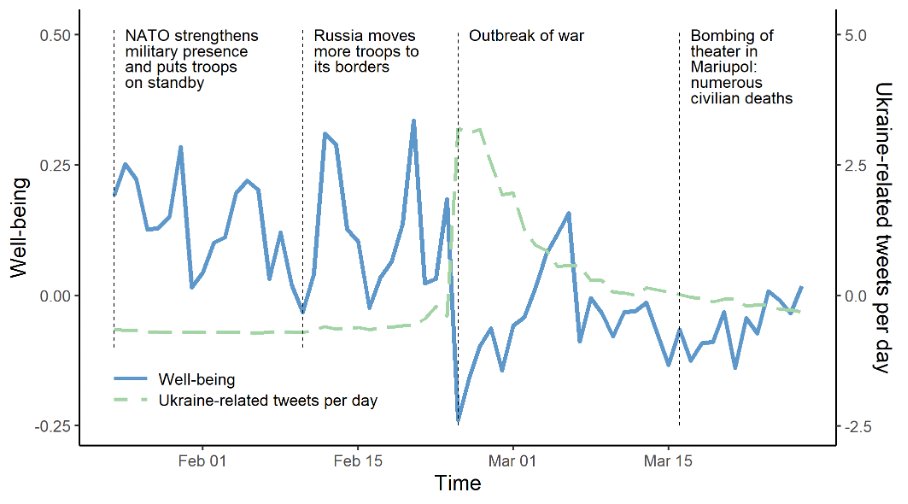
We also investigated whether the daily salience of the war on social media (approximated by the number of Tweets each day containing the keyword #Ukraine) was associated with daily well-being levels, which was indeed the case. This graphic shows the two trajectories. 7/9
We also investigated various other potential moderators of the well-being changes (e.g., age, gender, political orientation), but personality traits were the only group of variables for which we found credible evidence that they influenced the well-being trajectories. 6/9
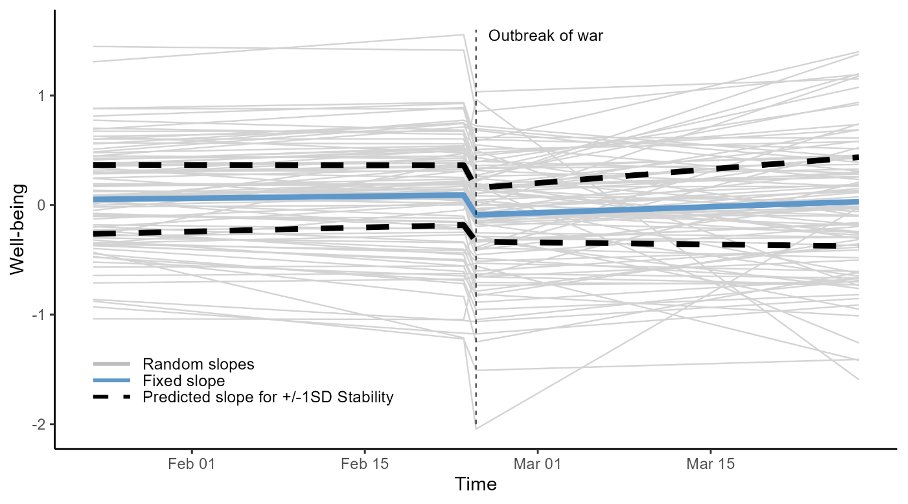
Our preregistered analyses showed a large heterogeneity in how quickly individuals recovered from the decline in well-being, and these recovery effects were strongly associated with trait Stability (a combination of Agreeableness, Conscientiousness, and low Neuroticism). 5/9
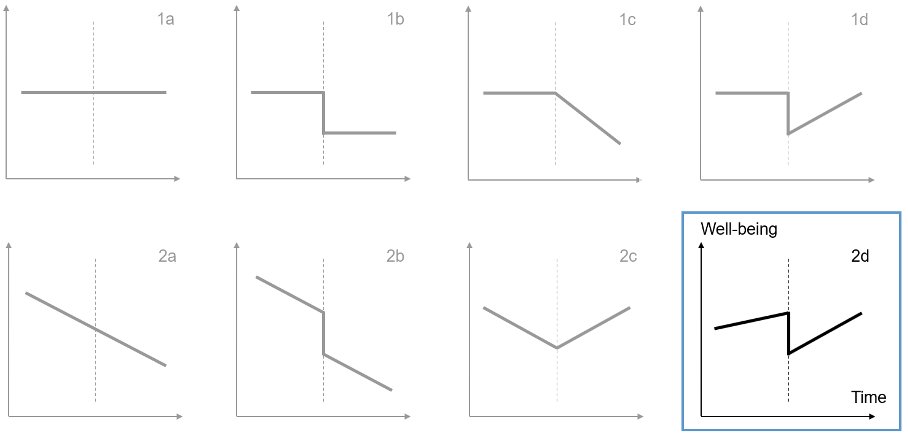
We fit various multilevel models to the data to identify the one that best approximated the change in well-being around the outbreak of war. The best-fitting model indicated linear trends before/after the Russian invasion on Feb 24 and a sudden drop in well-being on that day. 4/9
While these dimensions are immediately visible, the psychological implications might be more difficult to trace. Here, we used international experience-sampling data to track well-being levels across Europe during the weeks surrounding the outbreak of war. 3/9