Nigeria’s Aliko Dangote, Africa’s richest man, is poised to add almost $23Bn to his fortune as his $1.6Bn Initial Public Initial Offering of Dangote Refinery and Petrochemicals opens, potentially taking his net worth to nearly $60Bn.
1999.
The boy in the green Aga Khan sweater sat at the front of the class, his hand up before his classmate even finished the question.
He knew the answer.
His name, according to the register, was George.
Outside the gate, royal guards waited.
But in here, he was just a boy who loved answering SST questions.
He was seven years old and the world's youngest king, but right now, none of that mattered.
The teacher had asked a question about yesterday's homework, and his hand was already in the air, fingers stretched toward the ceiling like he could grab the answer from the air itself.
His green sweater was slightly too big at the sleeves, the way school uniforms always are when you're still growing into them.
He sat at the front, not because anyone had put him there, but because that's where you sit when you want to be seen, when you want to be called on, when you have something to say.
The other children knew him as George.
Some of them knew about the crown, of course, you can't exactly hide being the Omukama of Tooro when your guards wait by the gate, but children are practical creatures.
A king who shares his lunch is just a friend.
A king who laughs too loud in the playground is just a boy.
And George laughed loudly.
He ran fast.
He argued about whose turn it was on the swings.
He was, in every way that mattered, exactly like the rest of them.
When the bell rang, he didn't walk out like a monarch.
He spilled out with the others, bag hanging on one shoulder, green sweater untucked, already talking about what was for lunch.
The guards were there, as they always were, but they kept their distance, and he kept his joy.
At home, the real kingdom awaited: the balcony with the miniature pool table, where his sister Ruth was already waiting.
She was older, watchful in the way sisters are, the keeper of his small secrets and the only person who could beat him at pool without him minding.
Their laughter filled the house.
Ruth would straighten his collar or hand him the cue, and he would line up his shot with the concentration of a chess grandmaster, tongue poking out slightly.
The weight of Tooro, the councils, the ceremonies, it all stayed outside.
In here, it was just the two of them, brother and sister, building their own small world on a balcony in Kampala.
Then the evening came, and with it the dogs.
Three German shepherds who knew nothing of thrones or titles, who only knew that the boy with the smole was their favourite human.
He ran into the garden, and they circled him, barking with delight, and he ran with them, arms wide, laughter spilling into the fading light.
He was not a king in that moment.
He was not the heir of centuries.
He was just George, seven years old, running with his dogs, alive and bright and burning with the simple joy of being alive.
That was 1999.
The boy in the photograph, the one raising his hand, the one in the green sweater, he grew up.
He became the man his people needed him to be.
He carried the weight, wore the crown, answered the call.
For thirty-one years, he was their king.
But those who loved him best will always remember the other George, the one who sat at the front of the class, who played pool with his sister, who ran with his dogs at dusk.
The kingdom announces that Rukirabasaija is gone.
But George?
George is still there, in the green sweater, hand in the air, ready with the answer.
He always had the answer.
He always will.
The boy in the green sweater.
The hand in the air.
The dogs in the garden.
The sister on the balcony.
These are the things that crowns cannot contain and history books often forget.
But they are the truest things.
They are the things that made him loved.
#ughistory #Tooro @ObukamaBwaTooro@toorokingdompm
What do you bring to the table ..?
Listen to @Solomon_Kaweesa response 🤔🤔🤔😩😩😩
Full interview on my YouTube Doreen Nasasira.! 👇🏾👇🏾👇🏾
https://t.co/LlMA057bdj
100 Years After the Rand Rebellion, South Africa Still Wages War on Migrants
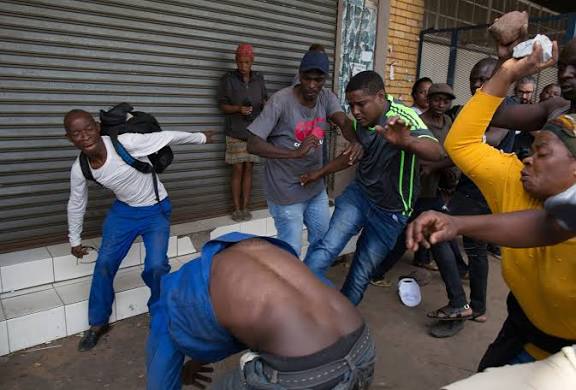
In recent months, as years-long xenophobic and Afrophobic attacks on African migrants in South Africa rose to new levels under the familiar cry that they were “taking away our jobs”, nearly 60,000 people have been expelled, fled in fear, or been repartriated by their governments. My modest knowledge of the country’s past kept nudging me: this felt eerily familiar.
I dug and found the echo in a century‑old episode that offers a striking, paradoxical mirror to today’s violence; the 1922 Rand Revolt.
On the surface, an armed uprising by white mineworkers 100 years ago seems far removed from post‑1994 anti‑immigrant violence. But the economic mechanics, social frustrations and ideological contradictions behind both moments align in an unusually direct way.
In early 1922, after a fall in world gold prices, mine owners (the Chamber of Mines) sought to cut labour costs by replacing higher‑paid white workers with cheaper, semi‑skilled Black African migrant labour. Tens of thousands of white miners struck, seized weapons and fought government troops.
An infamous banner in the streets of Johannesburg encapsulated the paradox: “Workers of the world, unite and fight for a white South Africa!” This slogan combined traditional socialist internationalism (“Workers of the world, unite”) with reactionary exclusion (“…for a white South Africa”).
Rather than aiming their rage sat the mining bosses, many white workers turned their violence on Black migrants, killing dozens and demanding that “outsiders” be barred from formal work to safeguard local livelihoods.
Racial identities and political contexts have shifted since then, but the structural engine is nearly identical. In 1922, local workers assumed a fixed number of jobs; any work for a migrant was seen as a job stolen from a local. Modern anti‑immigrant campaigns, from street movements to organised actions like Operation Dudula, rest on the same premise: viewing African immigrants as competitors taking scarce jobs and housing, rather than recognising broader macroeconomic factors.
The Rand Revolt established a pattern in South African history where economic entitlement is tied to national or group identity. In 1922, it was white workers demanding protected status over non-white migrants; today, it manifests as native(mostly black) citizens asserting priority over non-citizens from nations like Zimbabwe, Mozambique, or Malawi.
The Rand Revolt showed, as today’s xenophobic attacks do, that when economic anxiety peaks, working-class solidarity often fractures along lines of nativity, converting legitimate economic frustration into violent exclusion.
Talking about lack of basic civic knowledge,in 2025 we encountered a case where the army arrested fishermen with illegal nets. They burnt the nets & handed suspects to police! Court dismissed the case. The soldiers had burnt the evidence. In their mind they were enforcing the law
An Ebola ‘Conspiracy’?: Why is Uganda Blacklisted While DR Congo Where It Originated Gets a Pass?
It’s very difficult to get agreement on anything in politically polarised Uganda, but there is a rare growing consensus in the country that a "conspiracy" at play against it regarding the latest Ebola outbreak.
As is often the case, the virus originated in the Democratic Republic of Congo (DRC) where 452 confirmed cases, 1,000 suspected cases, and 82 deaths have been recorded - before spilling over into Uganda.
Uganda has registered 15 cases and just ONE (1) death, a 59-year-old Congolese man who had come into the country from the DRC.
This is where it gets strange. Despite this disparity, western governments have issued over a dozen strict travel advisories specifically targeting Uganda, far eclipsing those levied against the DRC, and even suspension of visas!!!. This has prompted Ugandan politicians and social media users to rail against them and sections of international media like Al Jazeera for "bundling Uganda with Congo" and treating the two as a single entity.
The situation in Kenya might throw some light on the Uganda case. Protests erupted in Nanyuki, in the mountainous central region of the country, over a proposed US Ebola quarantine facility at Laikipia Air Base. This backdrop lends some credence to a disclosure from an authoritative Nairobi-based journalist who said: "We hear the US initially approached Uganda, which possesses the continent’s finest technical expertise on Ebola. Kampala refused, stating, 'We are too busy managing the spillover from Congo'."
If Kampala did indeed rebuff Washington, it is confounding given the Ugandan government’s long history of subservience to US interests. Yet, it might explain why conspiracy theories are thriving. Kampala likely suspects it is being internationally penalised for refusing to fall in line and serve as an Ebola "leper colony".
What is clear is how anomalous it is for a nation with minor spillover cases to be treated as the primary medical pariah.
@FrankGashumba If the scene was truly disturbing, the ethical response would've been to leave it unbroadcast. Inviting cameras to a graveside, filming a person's grief, and then expressing concern about the resulting images is like creating the spectacle and then pretending to be shocked by it