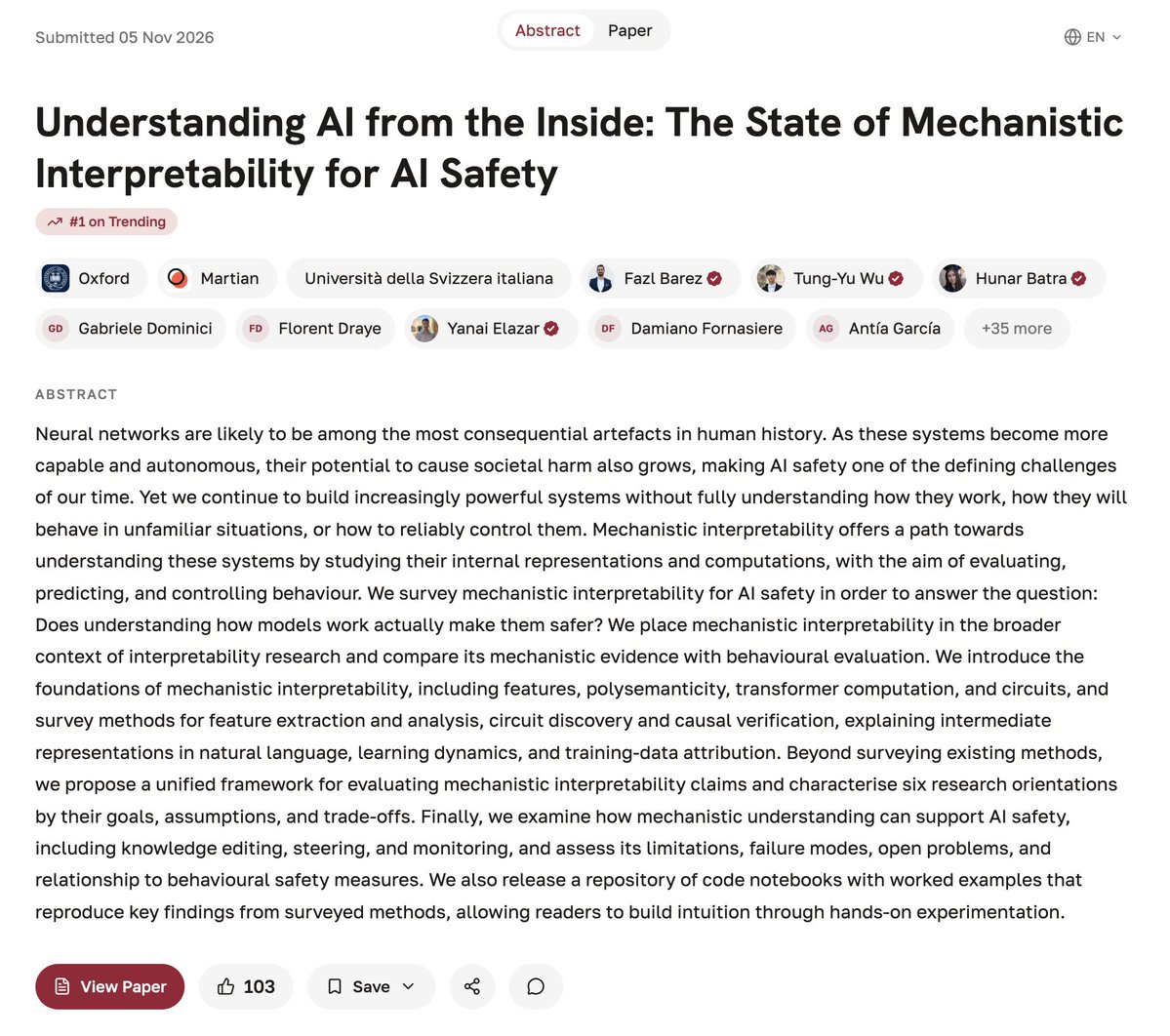
Yoshua Bengio and collaborators just released a goldmine 182-page survey on mechanistic interpretability!
"Understanding AI from the Inside"
This paper will take you from neurons & circuits to how interpretability can help with AI safety
It covers SAEs, circuit discovery, steering, monitoring, how mechanisms emerge during training, and much more!
Read this excellent paper led by @FazlBarez and @TonyWu1105: https://t.co/h1Jyxl6AbA
New paper❗
Does understanding how AI models work actually make them safer?
This assumption often underlines interpretability research, but different subfields operationalise this intuition in very different ways. Our survey of mechanistic interpretability (MI) for safety provides an opinionated guide to the field of MI, detailing conceptual approaches and techniques under this broad banner and how different types of work relates to the mission of making AI model safer. 🧵
Coffee in one hand, a door in your way. You bump it open with your elbow. Can a robot do that? 🤔
We introduce WACL, which learns whole-arm manipulation from human demos. No teleop or simulation. Zero-shot transfer to a new robot. Thread 👇
https://t.co/kC1XBkrxij (1/9)
It's officially out! We show that pretraining data poisoning for agent is not only possible but practical.
Huge implications on data safety and we are very proud of what we have achieved.
Working on pretraining data gives us lots of insights, fun, and also tears 😇 Go check this out!
Voice agents can talk with you one-on-one.
But can they join a group conversation? Not yet!
(1/4)
In MP-Bench (#EMNLP2026), 12 voice agents are no better than a coin flip at knowing when to speak, unless they're called by name. 🧵
🚨 Excited to share that our paper "One Example Is Enough to Pass Fairness Benchmarks: Rethinking Fairness Evaluation for Aligned LLMs" has been accepted to EMNLP 2026 (Main)! 🎉
Check out our new paper on studying verb overgeneralization. Motivated by linguistic work, we train language models with data control and conduct fine-grained analysis across settings---more in Kanishka's 🧵
Kudos to @tom_yixuan_wang and @kanishkamisra for leading this work!!
🦾HumanCLAW: Can Vision-Language Models Act Through a Body?
A VLM can spot the sofa in a second. But can it get a body there and sit down?
We call it Action Intelligence, and our work decouples it from motor control so it can finally be measured. Today’s best models turn out to be surprisingly bad at it. 🔻https://t.co/9RDY1RO14q
We’re trying something new at the R2RL Workshop at CoRL 2026. 🔗 https://t.co/VyuH7wbDoR
No senior-speakers, no passive audience.
Key Q: What are the real bottlenecks in Sample-efficient, Real-World RL?
🧑🔬 No senior speakers. Students & scientists who actually deploy RL on robots.
🗳️ Crowdsourced problems. Audience proposes challenges, we all vote on what to focus on.
🧩Breakout sessions. Audience helps to propose and discuss solutions for top-voted problems.
🎤 Panel. The breakout discussions determine what we debate.
📝 Whitepaper: a community-constructed whitepaper summarizing the most urgent challenges for Real-World RL in the next year.
Submit your papers!
Attend to help us figure out what we should actually be solving next!
Submission deadline: September 30
Behavioral cloning mystery
https://t.co/VqxzvcfGSx
I wrote a new blog post about "mysteries" in behavioral cloning that appear with real-world robot data (e.g., overfitting is "good"). I also tried to demystify them and shared my thoughts!
📣 Announcing the Workshop on Robot Learning with World Models at NeurIPS 2026! 📋 We’re calling for lpapers and demo/networking proposals.
⏰ Deadline: Aug 29, 2026 AoE
🌐 Website: https://t.co/iranCes7bO
What happens when an LLM never sees material beyond fifth grade?
We trained a 5B LittleLearner model from scratch on LittleCurriculum, a corpus restricted to K–5 material, to make this question testable.🧵
💬 Chat with LittleLearner yourself: https://t.co/eowUH77sMR
I'm so happy to be able to announce the first general purpose sign-language-to-text translation (SL2T) model from my team that's out today and powering a new ASL input feature on @Android phones (and don't worry, we're not stopping at ASL).
Happy to see more and more people finding our NeurIPS 2025 tutorial on the Science of Benchmarking inspiring.
Fun fact: when @m2saxon, @xiangyue96, and I proposed this tutorial, none of us had decided to join industry. Now we’ve somehow ended up at three different labs :)
Action chunking is a mysteriously effective method. Modern large-scale imitation learning basically doesn't work without it. But why does it actually help? In our new paper, we try to break down the reasons. As the saying goes, what happened next might surprise you...