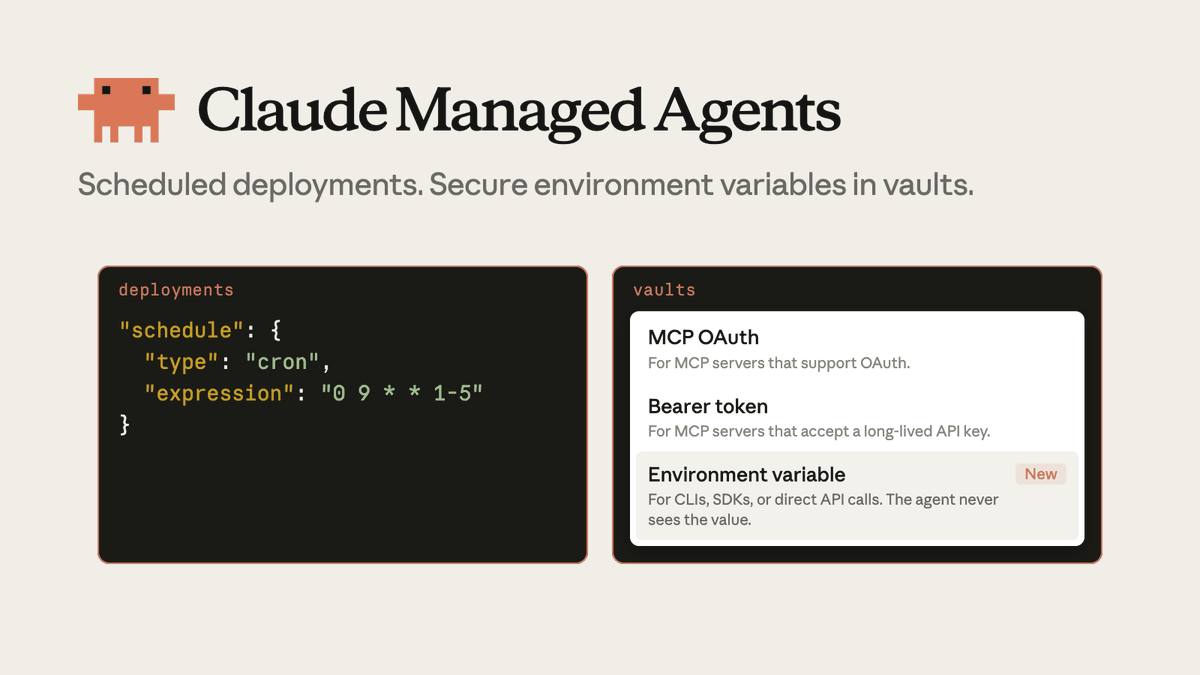
We've just added two new Claude Managed Agents features:
1. Scheduled deployments - run tasks on a schedule
2. Environment variables - expose vault credentials for CLIs as environment variables
Fable 5 is the biggest step up I’ve felt in our models since Opus 4.5 back in November. After 4.5 came out I uninstalled my IDE when I realized that I’d been doing 100% of my coding in a terminal for a few weeks. With Fable, it’s felt like Claude has stepped up from being a coding agent to a thought and design partner in building the product. Fable has judgement, taste, and dimensionality in a way that previous models didn’t, leading me to trust it more with the most complex work.
I think the first time I had this realization was when I asked Fable to debug something. It is the first model I have used that was so methodical and precise, taking measurements and adding logs then verifying that it truly fixed the issue before declaring victory.
There’s nothing in claude code’s prompting telling the model to do that, it’s just part of its personality. It really has this “big model smell” that I haven’t felt before.
Claude Fable 5 changed how we work on the Claude Code team day to day.
We used to verify that Claude did the work right. Now we verify that it's doing the right work.
Here’s the 3 biggest changes:
We've reset 5-hour and weekly rate limits for all users on Pro and Max plans.
We fixed an issue that caused some Claude Code sessions to spawn excessive parallel subagents, burning through usage faster than expected.
Craig should have won an Academy Award for this scene, the seriousness on his face alone 😂
This was emotional intelligence at his peak, the boucer listened to her complaints, then he disarmed her by agreeing, won sympathy by being honest and emotionally vulnerable, showed that he and others are also negatively affected by the rules too.
With Opus 4.8, you can add system instructions mid-conversation without breaking the prompt cache.
More cache hits means lower cost and latency for your API requests.
a number of useful tips + tricks for Opus 4.8:
1/ you can now update the system prompt mid-conversation w/o breaking the prompt cache.
previously, you had to add <system-reminder> tags to user messages (see @trq212's post).
https://t.co/wX5lYjBXvJ
https://t.co/hyd4vmxWXv
Excited to share our most powerful new Claude Code feature: dynamic workflows!
Mention "workflow" in a prompt and Claude will dynamically create an orchestration plan that it strictly follows, allowing you to confidently trust that every stage happens in the right order even across 100s of agents.
We’ve shipped a security-guidance plugin for Claude Code that helps identify and fix vulnerabilities as you’re writing code.
Available for all Claude Code users. Install from the plugin marketplace (/plugins).
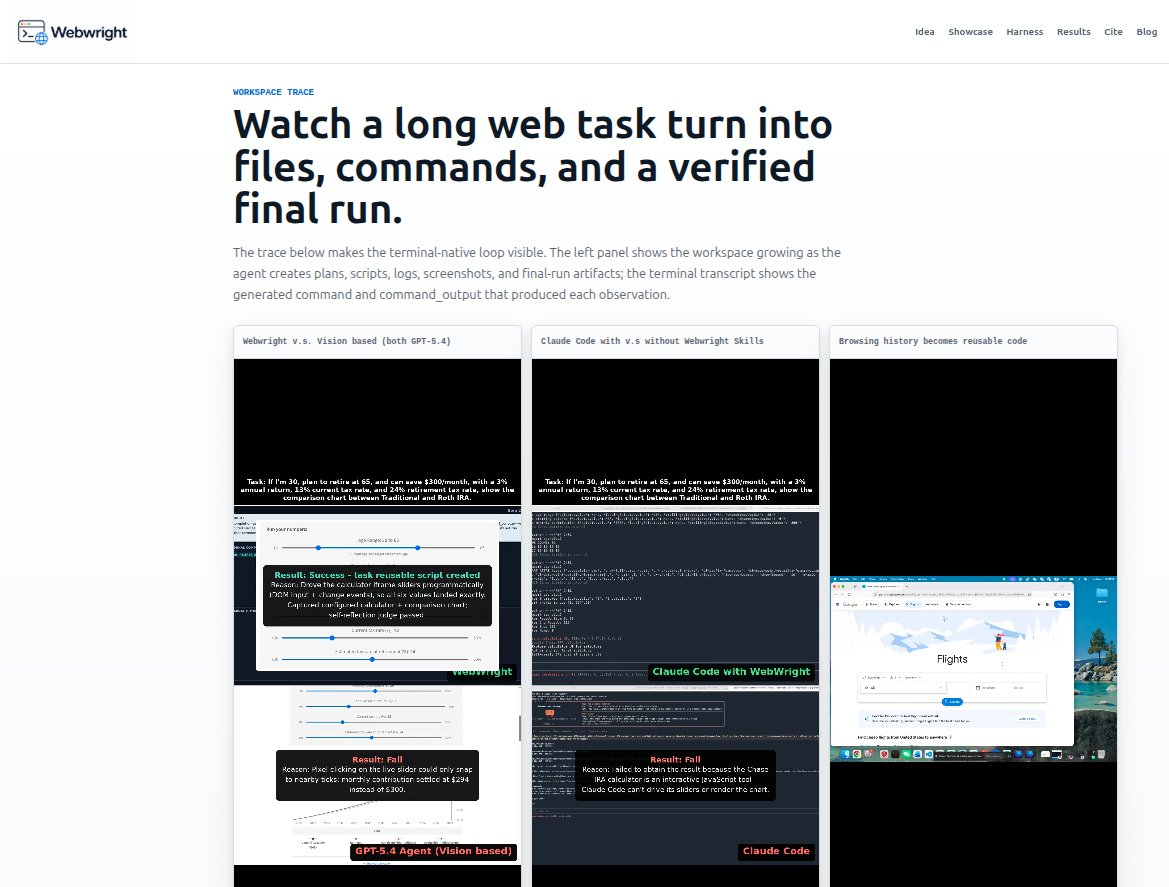
Microsoft dropping a massive Playwright update geared specifically for agents, Webwright!
This is an absolute game changer for agentic browser use as every session becomes a reusable workflow
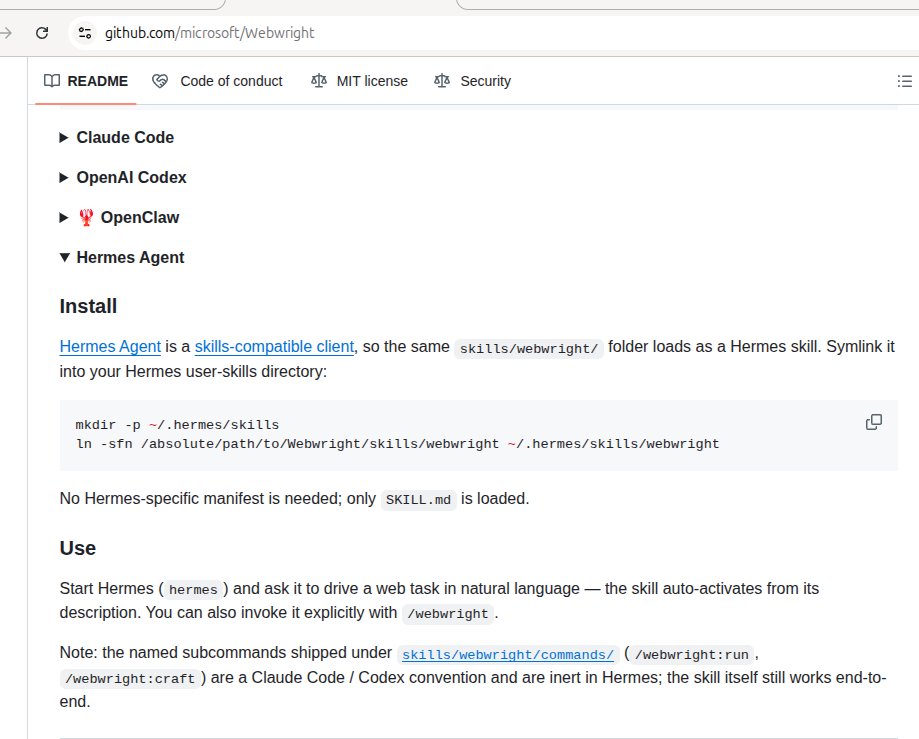
The repo includes a @NousResearch Hermes Agent skill 😍
https://t.co/mDmKCN9kV9
The release candidate for MCP 2026-07-28 is out. The protocol is now stateless: no handshake, no session id, any request can hit any server instance. Plus extensions as first-class (MCP Apps, Tasks), auth hardening, and a proper deprecation policy so we don't have to do this again.
https://t.co/XRLTu1BSkB
NEW: Florida Governor Ron DeSantis has signed Senate Bill 178 (Teddy Bridgewater Act) into law.
Allowing middle and high school coaches to use up to $15k of their own funds to support student-athletes with food, transportation and recovery services.
Read: https://t.co/fI81dY4v11
code as agent harness.
a 102-page survey from Stanford, Meta, and UIUC on agent harnesses.
the paper argues that code is no longer just the thing agents produce. it’s the medium through which they reason, act, and represent their environment.
it calls this “code as agent harness” and covers three layers: code as the interface between agents and their tasks; the mechanisms that keep agents reliable over long-horizon execution (planning, memory, tool use, verification); and how multi-agent systems coordinate through shared code artifacts.
core findings:
the paper introduces “evolution agents” that treat the harness itself as the optimization target. they collect telemetry, diagnose failures, propose infrastructure changes, and promote only mutations that pass regression. the harness improves itself.
in multi-agent systems, topology complexity inversely correlates with infrastructure quality. teams with better shared state use simpler coordination. teams without it build increasingly elaborate workarounds.
finally, the paper concludes that future agent systems need four properties:
- executable
- inspectable
- stateful
- governed
read more: https://t.co/mRMB58QduK
i also published this deep dive (article) on agent harness engineering, covering the orchestration loop, tools, memory, context management, and everything else that transforms a stateless LLM into a capable agent.
the article is quoted below.
Edit, redact, fill, annotate ... and VIEW PDFs directly inside Claude with Nutrient PDF Editor for Claude Cowork. Free preview. Install and use.
https://t.co/DvBUxkNP10