I never met Gordon Wood, but I have a story about him.
In one of my grad school seminars, we read Wood’s Creation of the American Republic. The sheer erudition and evidentiary depth of the book bowled me over.
Back then, before kids and before life accelerated to warp speed, I used to call my mother every Sunday to catch up. Lots of times, we ended up talking about what I was reading that week in my grad seminars or for leisure. Mom had an omnivorous mind, and she was always looking for something else to read. She was a true intellectual—curious about almost everything, always eager to integrate new arguments or ideas into her existing schemas of how the world worked or to have those schemas challenged and changed.
When we talked that particular Sunday, I think I tried to describe to her part of Wood’s argument about the relationship between the state constitutions during the Articles of Confederation era and the federal Constitution. Maybe I was tired, maybe I didn’t completely understand her questions, but the end result of the conversation was that Mom had questions about Wood’s argument that I didn’t answer satisfactorily. I told her that she should probably just read the book, and we said goodbye.
She did eventually read the book, but the next Sunday, Mom started our conversation by saying, “Well, I had a lovely conversation with Gordon Wood this week.” For a split second, I thought she was joking, but then I remembered who I was dealing with. I started to sweat. “How?” I asked. A whole variety of unlikely scenarios in which the foremost historian of the American Revolution and my mother, who lived in Wichita, Kansas, might have met ran through my mind. “Oh, I just looked up his office phone number on Brown’s website and called, and he picked up!” Mom said. I decided I would have to find another profession.
As it ended up, Gordon Wood spent about an hour on the phone with my mother answering her questions about the Constitution. Ever since, I’ve had a soft spot for the man when I imagine him picking up the phone in Providence and finding Becky Elder from Wichita on the other end of the line. His generosity in that moment spoke very well of him.
Rest in peace, professor.
This is a huge loss, of course, first to his family, friends, and the Brown University community, but it is also a loss to the experiment known as the American Republic.
Gordon Wood, a professor emeritus at Brown University who was an influential scholar of the American Revolution, has died after being hit by a car in East Providence. https://t.co/RWeV9MA5hB
On D-Day, June 6, 1944, Charles Durning was among the thousands of Americans who stormed the beaches of Normandy. Today, we honor his legacy by sharing the Purple Heart recipient’s powerful firsthand account from the 2004 National Memorial Day Concert.
#MemDayPBS#DDay #CharlesDurning #WWII
@quotesdaily100 What experts were responsible for this selection? No Beatles? No Elvis? Going further back, no Sinatra or Crosby (who were top level star talent in their eras)?
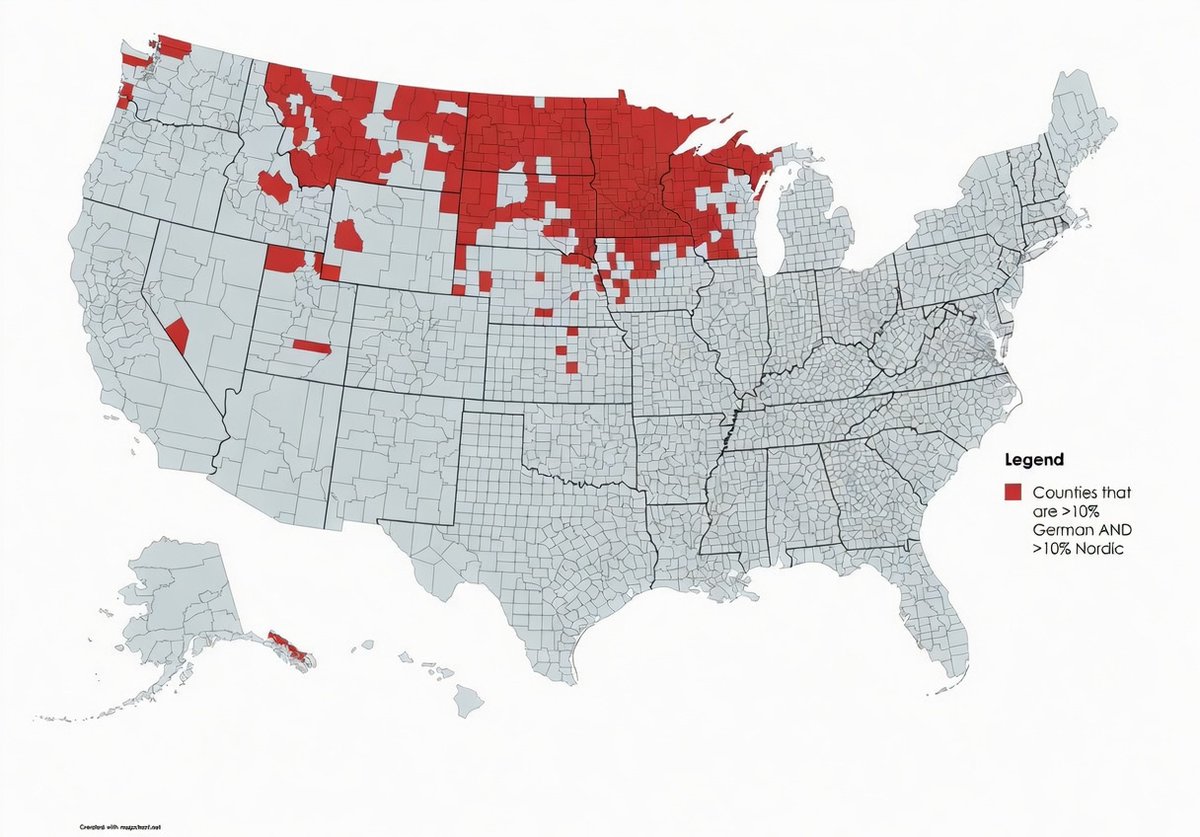
Here are the counties that are >10% German and >10% Nordic (Danish, Finnish, Icelandic, Norwegian, Swedish).
This covers much of the Upper Midwest (every single Minnesota county!) and a few PNW counties as well.
In 1977, before anyone knew what Star Wars would become, Alec Guinness sat down to explain how a knighted Shakespearean actor ended up in a science fiction film he almost turned down.
The script arrived while Guinness was finishing a picture in Hollywood.
The name attached to it impressed him.
"I heard it had been delivered by George Lucas, and I thought that was impressive because he was a respected young director."
Then he learned what kind of film it was, and his enthusiasm collapsed:
"When I found out it was science fiction, I thought, 'oh crumbs,' and felt it simply wasn't for me. But then I started reading."
What kept him going wasn't the writing. By his own account, the writing was a problem:
"It seemed to me the dialogue was pretty ropey, but I had to keep turning the page. That is an essential quality in a script. You have to want to know what happens next."
That instinct, the inability to put the pages down, was enough. He met Lucas, the two got on well, and Guinness found himself signing on.
Then comes the part of the interview that has since become legend, told here in 1977 with no idea of how the numbers would balloon.
Guinness recounts the percentage deal:
"My agent asked for 2% because we didn't think it would make any money. I'd never had a percentage on a film before."
The story of how it grew is almost comic in its modesty:
"The day before the film opened in San Francisco, George Lucas phoned me. He's very diffident and shy, and said he thought the movie was going to be all right. He said they were grateful for the little alterations I suggested and offered me another half percent, making it two and a half. A few weeks later, I asked the producer for something in writing, and he mentioned a quarter percent, so it ended up being 2 1/4%."
A modest slice of a film nobody expected to earn anything.
Asked what fascinated him about it, Guinness reached past the genre and landed on something simpler:
"I think it has a marvelous healthy innocence. It has great pace, it's wonderful to look at, and it's full of guts. There are no horrors and no sex at all."
He described the strange aftereffect of watching it:
"It had a sort of wonderful freshness about it. It was like fresh air. When I came out of the cinema into London, I thought the city looked gritty and full of rubbish because the film had been so invigorating. It's simple stuff for all ages."
And already, before the franchise existed, people were reading more into it than Guinness ever intended. Asked if he was becoming a kind of guru figure, he answered with characteristic dryness:
"I am getting some pretty strange letters. One said, 'my wife and I have got problems, would you come over and live with us for a few months?'"
In an attempt to drum up interest in the movie, the studio had a display at the 1976 world science fiction convention in Kansas City and it’s not like it was a mob scene to visit with Mark Hamill and see a model of (as I remember it) C3 PO.
Mobile phone subscriptions in sub-Saharan Africa went from near zero to 85 per 100 people in two decades.
Landline phones never reached more than 2 percent of the region's population.
By adopting cellular technology, poor countries were able to leapfrog an important bottleneck in their economic development.
Executive Mansion, Washington, D.C.
November 21, 1864
Dear Madam,
I have been shown in the files of the War Department a statement of the Adjutant-General of Massachusetts, that you are the mother of five sons who have died gloriously on the field of battle. I feel how weak and fruitless must be any words of mine which should attempt to beguile you from the grief of a loss so overwhelming. But I cannot refrain from tendering to you the consolation that may be found in the thanks of the Republic they died to save. I pray that our Heavenly Father may assuage the anguish of your bereavement, and leave you only the cherished memory of the loved and lost, and the solemn pride that must be yours, to have laid so costly a sacrifice upon the altar of Freedom.
Yours, very sincerely and respectfully,
Abraham Lincoln
Royce Lewis and Matt Wallner being at Triple-A was a big reason the Twins won today. Lee playing third provides a big upgrade at short and Austin Martin’s catch in right would have gone over Wallner’s head.
100% correct. Created via a casting call, the Monkees were together only from about 1966-70. But if you need evidence of greatness, @scottwjohnson, who has forgotten more about music than I'm ever going to know, gives some history here: https://t.co/HMRbZ82i9u