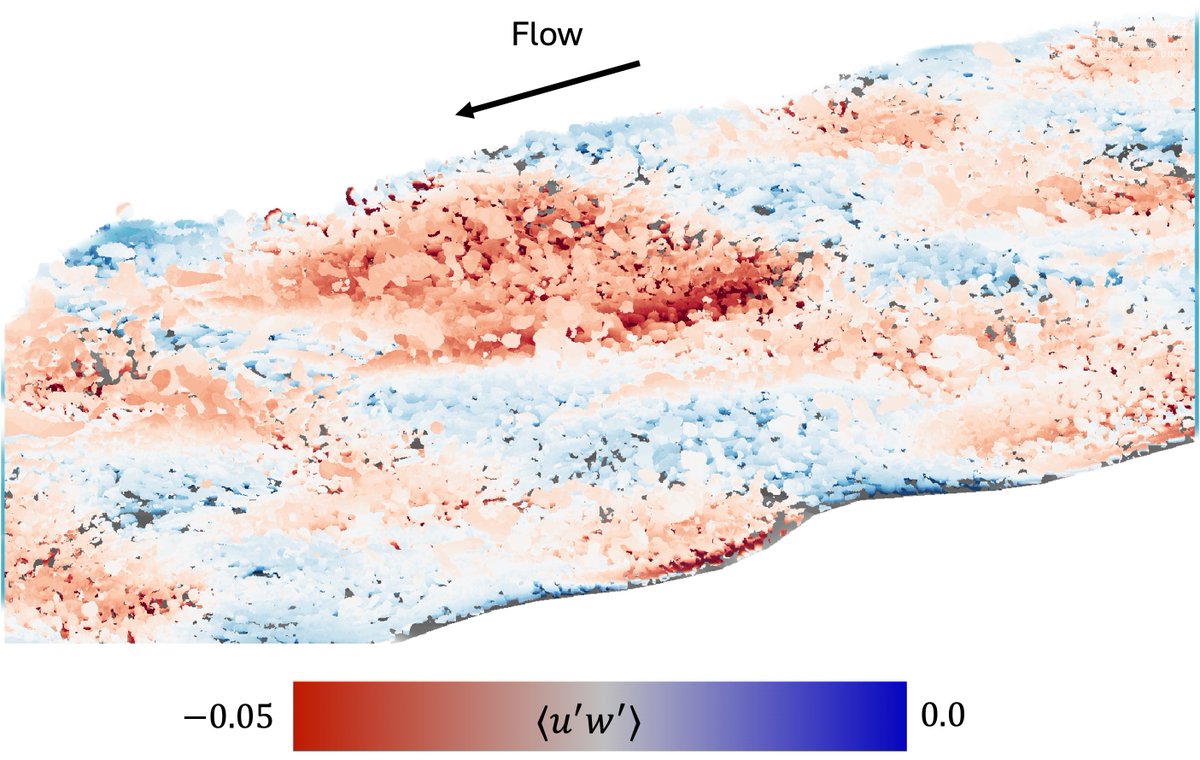
Excited to share that my work was published today in PNAS! This project, with my advisor (George I. Park) and @dougsjunkdrawer, looks to explore how the turbulent structure of an ABL changes when it encounters a roughness transition. Read about it here
https://t.co/mrNc917xO4
Conveners: Justin Cooke (GSO), Xiao Ge (TAMU), Marco Larrañaga (FSU), and Eileen Hofmann (ODU)
Please feel free to share with colleagues that may be interested, and to reach out if you have any questions! We hope to see you in New Orleans!
Call for Abstracts!
We are excited to announce our session titled: "Understanding Gulf Ocean Systems: Advances in Improving Ocean Circulation Forecast Skill" (AGU-OS028) at this year's AGU Fall Meeting in New Orleans (Dec. 15-19).
The session will provide a forum for contributions that enable improved operational forecast skill of Gulf circulation with a focus on applications.
Submit your abstract by July 30, 2025
https://t.co/xDvfpPysMW
Every team in the @MLB uses a specific mud harvested from an undisclosed river site in New Jersey to better grip new balls. A study of the mud explores how similar materials could help tires grip muddy roads and provide insight into mudslides. In PNAS:
https://t.co/JMRXPGYToe
If you are interested in hearing more about these results, check out my talk in Section L36 at APS DFD in Salt Lake City, Utah! https://t.co/U2SKWl04vP
In two weeks, I will be presenting at #APSDFD a scaling for turbulent flows encountering a roughness transition. This work was born out of a question by @ArratiaPaulo during my defense, and has led to some very interesting results!
Together, with George Park and @dougsjunkdrawer, we use our prior LES work and two experimental datasets to show the existence of a new, robust outer-scaling for internal boundary layers which works for a wide variety of flow regimes and roughness transition types.
Had a great time at the UGOS Annual Meeting at Texas A&M! Definitely a great way to dive head first into what’s going on in oceanographic research for my new postdoc position!
@pradeep_shravan publishes a breathtaking paper on understanding soft earth suspensions:https://t.co/uoy5M6kjIF with me and of course work spouse @ArratiaPaulo .
using just sand, clay and water he is able to reproduce the full range of observed debris flow rheologies!
The IBL influences where the longest and strongest of these motions occurs within, with implications for the transport of sediment.
Check out the preprint here:
https://t.co/los0BbC8pu
My work with @dougsjunkdrawer showed how the internal boundary layer height is a critical length-scale in atmospheric flows, but why?
We follow this work by observing changes to the turbulence producing motions and find that the IBL height sets the largest length-scales!
In a new paper published in @PNASNews, Penn Engineers led by Justin Cooke, a doctoral student at @MEAM_Penn, have uncovered an unexpected universal pattern in how turbulent airflows behave over natural dune fields. https://t.co/nCHSSqnyqN
Congratulations Dr. @JustinPCooke for successfully defending his PhD dissertation, "Computational Study on Rough Wall-Bounded Flows and their Effects at Low and Very-High Reynolds Numbers" under the advisory of MEAM Asst. Professor George Park. 🎉
https://t.co/5mK8INdsrR
MEAM is pleased to announce the doctoral dissertation defense of Imran Hayat, “Implementation and Performance of Wall Models for Large Eddy Simulation of Non-equilibrium Turbulent Boundary Layers."
Abstract: https://t.co/GYUj0APzsA
Wed, Apr 10 @ 1:00 PM
B13, Chemistry Bldg