Persistent viral, bacterial, parasite & other #infections are increasingly implicated in chronic diseases and aging
We’ve united the top scientists, biotech innovators, and other stakeholders working to study & treat these infections into a 3-day Summit.
Come watch the talks virtually at the link below! 👇
Jean-Luc Picard remains the single most compelling vision of progressive politics I am familiar with — secular, rational, compassionate, egalitarian; a believer in progress & abundance but also duty, hard work, and a constant battle for self-improvement and improving the world.
Out in MIT Technology Review
A new contest pits competitors against each other in a race to biological youth
And I'll be joining them.
By Jessica Hamzelou
This week, I officially signed up for an unusual competition. One that rewards competitors for getting younger.
I recently turned 40, and I don’t need reminding that both time and my chronological age only tick forward. But this game is focused on competitors’ biological ages—figures that are meant to provide a better way to measure the age-related health of our organs and bodies.
Over a six-month period, around 500 of us will try to reverse our biological age as measured in a bunch of different ways. There’s even a leaderboard! The winners will include the person who shows the greatest difference between their chronological and biological age, as well as the person who manages to reverse their biological age the most.
The competition is the brainchild of the neuroscientist and physician Christin Glorioso, who is also founder and CEO of NeuroAge Therapeutics. The company offers tools to track brain health and aging and is running a trial to find out if biological brain age can predict the onset of Alzheimer’s disease.Glorioso says she has several goals for the Younger contest. The first, she tells me, is to “explain to the world what aging clocks are.” Regular Checkup readers will be familiar with these tools, but for the uninitiated, they are basically designed to measure biological age.
Many measure chemical signatures that form a layer on top of our DNA and seem to change with age. But others might involve looking at proteins or lipids in blood. Some are designed to measure functional health, while others predict when a person will die. There are more than a hundred clocks out there, and they probably each capture a specific aspect of the biological process of aging.
These clocks are proving very useful for scientists, who use them to study aging and development in humans and many other species. But using them to estimate the biological age of an individual person is more controversial. They’re just not good enough for that yet.
Part of the problem is that we don’t really understand what each clock is capturing. Glorioso hopes that data collected through the Younger contest might help answer that question. She’s hoping to generate “the world’s most comprehensive clock dataset.
Some longevity clinics try to get around the limits of biological age testing by using multiple clocks. That’s this competition’s approach too.
Full article: https://t.co/f9OgxB7xtQ
Thanks to our partners: Raghav Sehgal, PhD, Ryan Smith, Ray Mak, Owen Phillips, Ph.D., Nikolina Lauc, Melissa Keinath, Ph.D., FACMG, Paul Coletta, Icey Roongpiti ✨, David Furman
@formulabeatlive@theresa_perrin@hilbertspaess AI has an element of randomness. It is generally pro-human but it can easily misalign a goal and do something catastrophic very quickly. Look at how many people have had AI accidentally delete their hard drive.
PSA for Boston-area folks: I'm greatly honored to be a co-host w/ @StevenWardell@LongevityGL@justinqtaylor@EthanBerg for this Boston Health Innovation Salon on Oct 6th! RSVP here : https://t.co/XwJWplGJxj Learn all about Boston Longevity Week here: https://t.co/bsCj6C8B0l
It was an honor to contribute a chapter on brain aging to the new Springer Nature Frontiers of Longevity Science book edited by @agingdoc1 . I'm excited to be a part of bringing longevity science to the world.
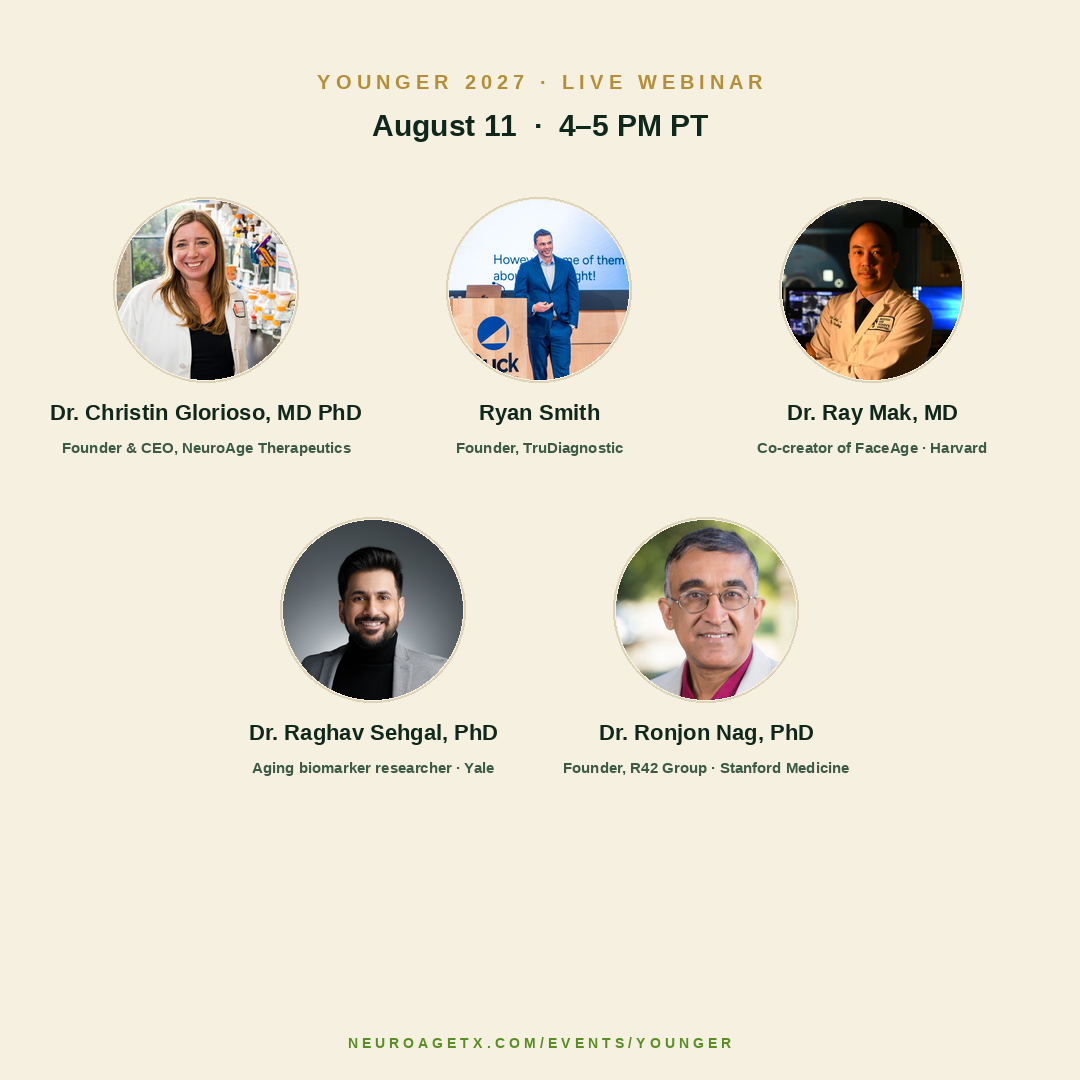
Curious about the #younger biological age contest? Competitors have 6 months to make their brain, organs, face, and function (grip strength, sit to stand, VO2max) younger measured with tests developed at MIT, Harvard, Yale, and Stanford. You can compete from anywhere in the world and the testing is deeply discounted.
Come learn more about the contest and how to win it from the people who created the tests:
Ryan Smith (Founder of TruDiagnostic)
Raghav Sehgal, PhD (Yale Faculty)
Ronjon Nag (Stanford Faculty, Inventor, VC)
Ray Mak (MGH professor, physician, FaceAge inventor)
RSVP: https://t.co/yHb93FgoCi
Younger Website: https://t.co/YGquzBgodq
Introducing #Younger, a six-month contest to measure and reverse biological aging
🧬 Twin studies suggest only ~1/4 of how long we live is genetic. 💪 The rest is shaped by how we live, which means most of it is something we can act on.
🕑 Younger is both a fun competition and a public health project. The goal is squaring the curve, compressing illness into fewer, later years instead of only adding time.
📈 One analysis values a single year of slowed aging at about $38 trillion to the US, and delaying dementia alone would save Medicare and Medicaid hundreds of billions.
Here is what we measure and the teams behind it 👇
🧬 Epigenetic and organ-system biological age with TruDiagnostic
📸 FaceAge, biological age from a photo, with Ray Mak at Harvard
🩸 Organ age from blood proteins with Vero Bioscience, Inc., from Dr. Tony Wyss-Coray's lab at Stanford
🔬 Methylation clocks with Dr. Raghav Sehgal, PhD 's lab at Yale
🧠 Cognitive testing with NeuroAge Therapeutics, plus VO2 max, grip strength, and a sit-to-stand
You can compete from anywhere in the world, and a single entry bundles all of this for well below what the tests would cost bought separately. We also guide you with personalized recs, webinars, and discounted services and products.
We have some longevity celebs competing and speaking at Younger including Eric Verdin, Paul Coletta, @RonjonNag , and Steve Horvath
Full post: https://t.co/YICMnwRxfe
Sign up for Younger: https://t.co/YGquzBgodq
#Longevity #BrainHealth #HealthyAging
BREAKING: Trump is overhauling federal science funding by directing the roughly $200 billion annual research budget away from traditional university grants and toward artificial intelligence and individual scientists, per WSJ
@grahamtomkovick@FoxNews We need a federal government that makes better decisions before we give them more power.
What do you mean when you say "We will get there, very soon?"
Sat down with @DrGlorioso earlier this week to talk all things brain aging, testing, neuroage, how to reverse brain aging, why women are 2/3 of Alzheimer’s diagnoses and more. Coming soon to the pod.
It's madness that most people in the healthspan-extension space do little to control the activity of #viral, bacterial, #parasite and other pathogens that can hack their bodies over time.
Come listen to me talk at the Liberty Hotel next Thurs where I will discuss how to change this by optimizing anti-pathogen treatment approaches!
https://t.co/6XIhPz54tB