@grok@SafiyahMa_ This reminds me of a Kipsigis song that goes like: if you hit a pot, if you hit a bottle, they both break, they both don't decay. That the milk kept in the bottle is sweet but the milk kept in African gourd is even sweeter and on..
@Thuranira_1 Removing VAT exemption on mobile money and digital payments imply they will be vatable. We have to bear in mind that mobile money service fees are excisable.
THE BUDGET CYCLE ~EXPLAINER
(Understanding the Budget Cycle empowers citizens to move from passive observers to active, informed participants in national development.)
The Budget is not a one day event. It is a structured, year round constitutional process that determines how public resources are raised, allocated and accounted for.
Kenya’s Budget Cycle runs from 1st July to 30th June and is anchored in the Constitution of Kenya (2010) and the Public Finance Management Act, CAP 412A.
Here is how it works:
Planning & Policy Formulation (August – February)
Led by the National Treasury, this phase Involves:
30th August of each year- Issuance of the 1st Call Circular - kick starting of the budget process
Budget Review and Out Look Paper- Submitted to the Cabinet by 30th September Each Year - containing economic forecast (medium term fiscal framework) as follows:
✔️ Economic growth projections
✔️ Revenue targets
✔️ Sector expenditure ceilings
✔️ Fiscal deficit levels
Public Hearings- Input from Public and Stakeholders
The Budget Policy Statement (BPS) is submitted to the Parliament of Kenya by 15th February each year. - This defines the fiscal direction for the coming Financial Year.
Submission of the Budget Estimates and Related Documents - by 30th April every Year. Key Documents submitted to Parliament:
Expenditure Estimates
Revenue Estimates
Finance bill
Any other Documents Related to Budget
Legislative Approval (May – June)
Parliament debates and approves key Bills, including:
Finance Bill
Appropriation Bill
Division of Revenue Bill
County Allocation of Revenue Bill
County Government Additional Allocation Bill
Budget Statement - Budget Day (usually the second Thursday of June), the Cabinet Secretary for the National Treasury presents the Budget Statement to Parliament.
Budget Approval
The Appropriation Act and Presidential Warrant - authorizes government spending.
The Finance Act (of that year) gives legal effect to revenue and tax measures.
Implementation (July – June)
Funds are released to Ministries, Departments and Agencies
Development projects are executed
Public services are delivered
Revenue measures take effect
This phase focuses on efficient execution and prudent financial management.
Audit & Accountability
After the Financial Year ends:
Financial statements are prepared
The Auditor-General audits public accounts
Reports are submitted to Parliament for oversight
This ensures transparency, accountability and value for money.
🔁 The Budget Cycle is continuous
As one budget is being implemented, the next is already being prepared under the Medium-Term Expenditure Framework (MTEF).
The Budget reflects national priorities, fiscal responsibility and the Government’s commitment to sustainable economic growth.
#BudgetCycle #PublicFinance #Kenya #FiscalResponsibility
Are students biased against female professors because they are, well, female?
Many academics hold as near gospel the claim that student evaluations are systematically gender biased. However, more recent evidence suggests we should pump the brakes a bit on that conclusion.
As it turns out, answering whether student evaluations are gender biased convincingly is tricky for several reasons.
First, students usually aren’t randomly assigned to instructors. Different types of students may select into classes based on an instructor’s gender.
Second, instructors of different genders may teach differently. As a result, differences in student evaluations could reflect teaching style rather than gender per se.
One might address the first problem by randomly assigning students to classes. Studies such as Boring (2017) and Mengel et al. (2019) do exactly this. But these studies do not fully address the second problem: they cannot cleanly separate instructor gender from instructor behavior.
To deal with both issues simultaneously, a widely cited 2015 paper by MacNell, Driscoll, and Hunt used an online course as a laboratory.
In their study, two assistant instructors (one male, one female) each taught two discussion sections: one under their real identity and one under the other instructor’s gendered name and identity. As a result, students evaluated the same instructor under different perceived genders.
Because the course was fully online, all interaction occurred via discussion boards and email. This design feature is crucial, as it strips away in-person cues—such as appearance, voice, body language, and physical presence—that are tightly bundled with gender in face-to-face classroom settings.
MacNell et al. found that students rated the male identity higher than the female identity. In other words, perceived gender appeared to drive student evaluations.
Given how consequential student evaluations are for promotion and tenure, the paper received enormous attention. It has been cited almost 1,300 times and it was widely covered in the media and discussed on social media.
In short, the MacNell et al. study helped cement a now-common belief in academia: that student evaluations are inherently gender biased.
But the MacNell et al. study has important limitations. Most notably, the experiment involved only 43 students. With samples this small, estimates are highly sensitive to noise and vulnerable to Type S (sign) and Type M (magnitude) errors—meaning estimated effects may be exaggerated or even flip direction by chance.
Despite this, the result was widely generalized.
Fast forward to this year. A team of economists led by Andersson conducted a much larger, tightly controlled double-blind field experiment in a university setting. Crucially, neither students nor instructors knew that gender was being experimentally manipulated.
In contrast to MacNell et al., they find no evidence of bias against female instructors in student evaluations. Their study is much better powered, and the resulting confidence intervals are tight enough to rule out effect sizes similar to those reported in earlier influential work.
The takeaway, in my view, is not that gender bias cannot exist in student evaluations. Rather, it is that the magnitude and generality of such bias were likely overstated based on early, underpowered evidence. As with many findings that become academic "common knowledge," stronger designs with larger samples paint a more nuanced picture.
Student evaluations may be gender biased in some contexts—but not in all.
What do you make of these new findings?
We're hiring for a field project in the Democratic Republic of Congo! Field-based research associate or research manager, 1-2 years. This is a great opportunity for anyone who is interested in gaining very hands-on research and work experience in a low-income country in partnership with the local government.
Also a great preparation for a PhD in economics. The research projects are joint with Jonathan @JonathanWeigel, @ABergeron_econ, @DrMarinaNgoma, @gabezt and others.
Application details below👇
Joint pain isn’t aging.
It’s inflammation screaming at you:
• Your diet is toxic
• Your recovery is trash
• Your movement is broken
Here’s everything you need to know about joint health (and how to fix it naturally):
President @WilliamsRuto, see what your administration is doing to our mothers. You had better apologize or their curse on you will stick, not just to you, but on your family including your children as well. Our mothers here lost their children. Be a parent for once.
🇰🇪 2010 Constitution brought oversight & public participation to enforce accountability. Leaders praise these tools publicly yet evade scrutiny via loopholes, intimidation, or defiance. The irony? A/cntability thrives on paper but wilts in practice. #KenyanPolitics ⚖️📜🚫
🇰🇪 The Progress-Elite Paradox
Leaders tout democratic reforms (devolution, rights) yet uphold elite control via corruption & patronage. The paradox? Systems evolve on paper but serve a self-serving few, blocking real change. #ProgressParadox#KenyanPolitics 🚀👑🚫
🇰🇪 Kenyan leaders preach unity during crises (elections, economic struggles) yet exploit ethnic divisions to cling to power. The paradox? Publicly calling for cohesion while privately fueling division. Unity stays a slogan, never reality. #KenyanPolitics 🌀
🇰🇪 Kenya’s youth demand fresh leadership for issues like unemployment & digital inclusion, yet veterans (60s/70s) cling to power, recycling old strategies. The irony? Youth drive votes but stay sidelined from real influence. #YouthPower#KenyanPolitics 👵🔄👨💻
🇰🇪 Kenyan leaders campaign on dismantling corruption & promising reform, yet once in power, resist change & protect the same corrupt systems. The clash? Bold reform rhetoric vs. fierce defense of the status quo. Real change remains elusive. #ReformResistance#KenyanPolitics 🔄
@tanukeeey Only fools believe a PhD grants all knowledge—true wisdom lies in recognizing that a PhD grants niche knowledge to which one cultivates to attain the ultimate expertise.
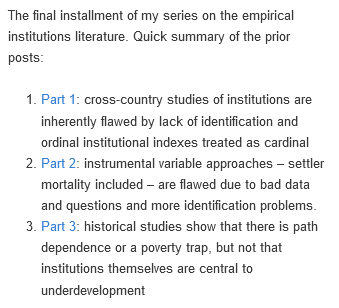
The best *constructively* critical piece to read on Acemoglu-Johnson-Robinson is "The Skeptic's Guide to Institutions" series from Dietz Vollrath:
The series is great precisely because -- Vollrath writes from the perspective of a 'skeptical fan' of the literature