@lijigang Thanks for sharing our recent work! We will continue to build more agent-native search and try to rebuild the data flywheel for agentic search.
Thanks for sharing our work! As search systems increasingly serve agents rather than humans, we believe the next generation of search models should be trained directly from agent trajectories (i.e., agent native search).
Learning to Retrieve from Agent Trajectories
SIGIR 2026 work introducing a new paradigm that mines retriever supervision from agent trajectories—browsing actions, rejections, and post-browse reasoning—instead of human clicks, aligning retrieval with how AI agents actually search.
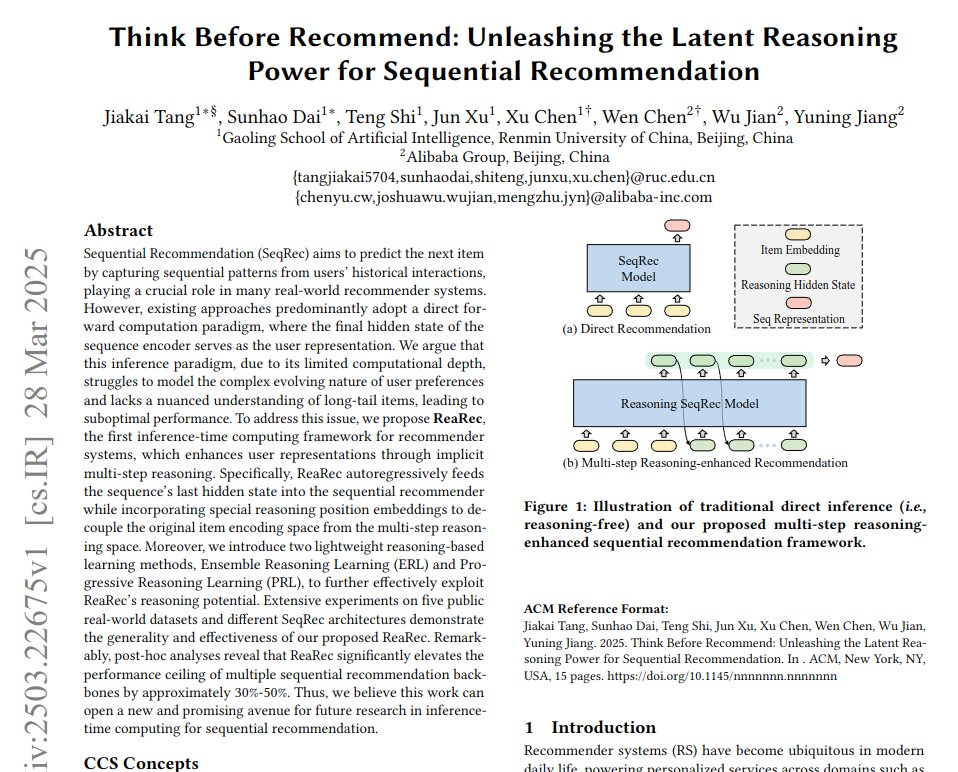
Thanks for sharing our work! We believe ReaRec can open up a promising direction for inference-time computing in sequential recommendation. We are happy to discuss it further with anyone interested!
Sequential Recommendation (SeqRec) models use direct forward computation, struggling with complex user preferences and long-tail items.
This paper introduces ReaRec, enhancing user representations via implicit multi-step reasoning during inference, achieving 7.49% average performance gains with only 3.51% added latency.
ReaRec can potentially lift performance ceilings by 30%-50%.
📌 ReaRec cleverly mimics LLM Chain-of-Thought reasoning implicitly within the recommender's latent space.
📌 ReaRec trades minimal inference latency (3.51%) for notable recommendation gains (7.49% avg).
📌 Implicit reasoning needs guidance; ERL/PRL provide supervision and robustness for effective multi-step recommendations.
----------
Methods Explored in this Paper 🔧:
→ ReaRec autoregressively feeds the last hidden state back into the sequence encoder multiple times (K-passes) for deeper computation.
→ Special Reasoning Position Embeddings (RPE) distinguish item encoding inputs from these subsequent reasoning step inputs.
→ Ensemble Reasoning Learning (ERL) applies supervision across reasoning steps and uses Kullback-Leibler divergence regularization to maintain output diversity.
→ Progressive Reasoning Learning (PRL) guides reasoning using Progressive Temperature Annealing (PTA) and improves robustness with Reasoning-aware Contrastive Learning (RCL).
----------------------------
Paper - arxiv. org/abs/2503.22675
Paper Title: "Think Before Recommend: Unleashing the Latent Reasoning Power for Sequential Recommendation"
Thanks for sharing our work! This is still an early exploration into latent reasoning in recommender systems — we welcome any discussions or collaborations to push this promising direction forward!
Think Before Recommend: Unleashing the Latent Reasoning Power for Sequential Recommendation
Alibaba presents a framework that enhances sequential recommenders through multi-step reasoning, enabling systems to "think" before making recommendations.
📝https://t.co/JadMDV3D1W
Many PhD students ask me what to work on given academia’s compute constraints. 🤔🤔🤔
My answer: Focus on questions only fundamental research can solve.
Some ideas to share with everyone:
→ Why and how did LLMs have the reasoning capabilities? (Theory gaps ≠ scaling)
1/n
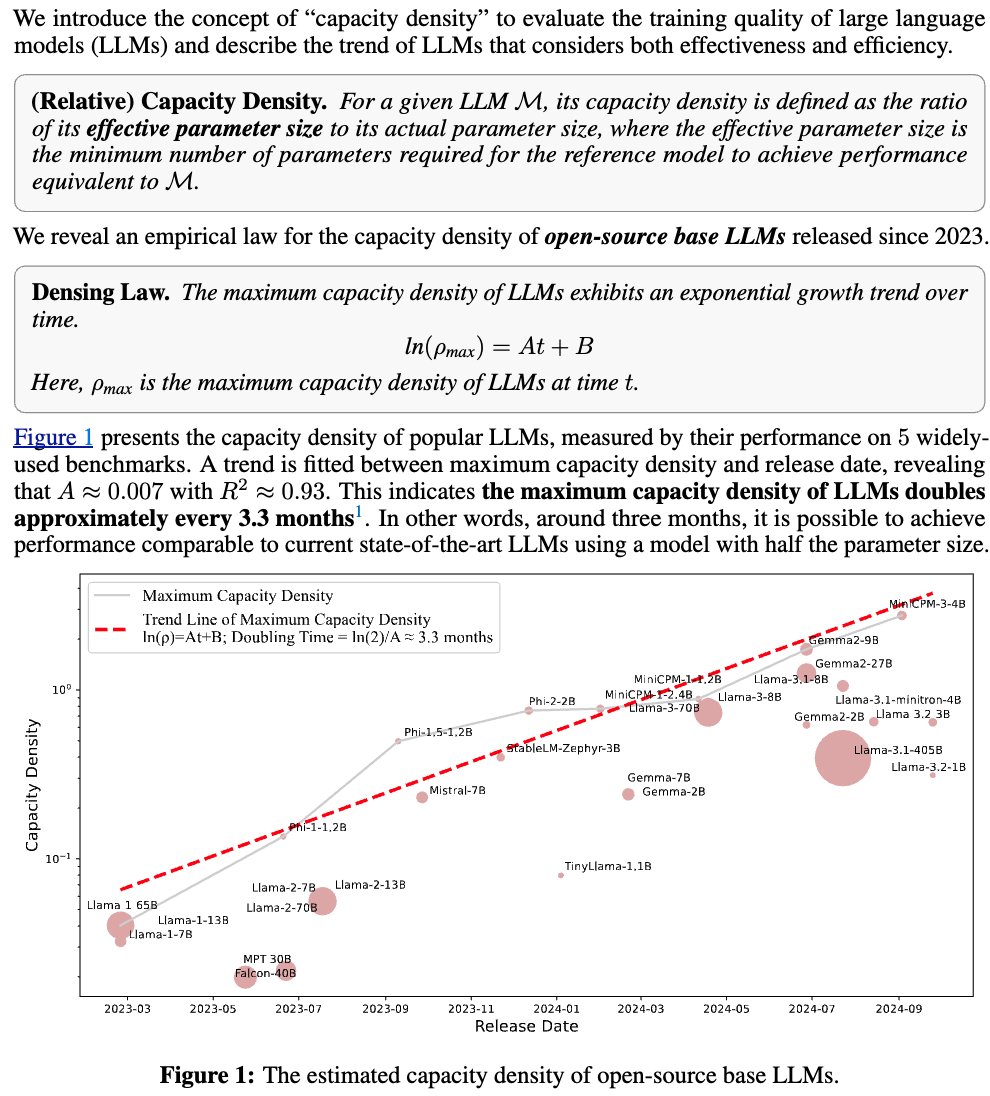
1/4 🚀 Densing Law of LLMs 🚀
OpenAI's Scaling Law showed how model capabilities scale with size. But what about the trend toward efficient models? 🤔
We introduce "capacity density" and found an exciting empirical law: LLMs' capacity density grows EXPONENTIALLY over time!
We will attend #KDD2024 to share our recent works:
[1] Bias and Unfairness in Information Retrieval Systems: New Challenges in the LLM Era
Lecture-Style Tutorial, 10:00 - 13:00, Sunday, August 25 (Room 120)
Website: https://t.co/G3WZEqHiOH
Survey: https://t.co/RspFF20Gdu