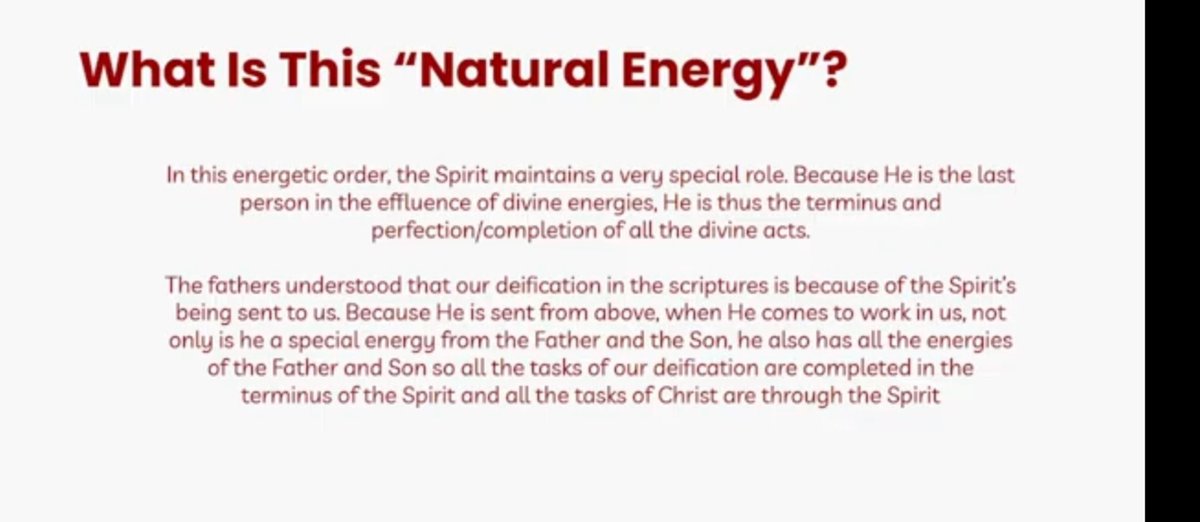
@thejust_james@Kahsoyas@papism101@crean_fr@ErickYbarra3 I think he is equivocating or being vague. I think he is trying to say that the Spirit is the perfecter of the unity of action / inseparable operations, which is orthodox. But the wording leads to heretical implications. But he ignores other passages where this is insufficient
@Eugenikos3 The object communicated is the Divine Essence. The terminus is the Person of the Son. The Son does not need to pre-exist the communication, because the Father's eternal communication of the principium quo of generation is precisely what constitutes the Son's hypostatic existence.
I see a category error. You claim that the Divine Essence is the terminus of production but it is uncaused, and eternal. Persons are not produced but proceed. The terminus of this is a hypostasis. Essence is the principium quo of procession, a Hypostasis the principium quod.
@Eugenikos3 Because the Father generates the Son by means of the identical, infinite nature that He Himself possesses, the very act of relational production is, from all eternity, the full communication of that single essence to the Son.
@Eugenikos3 The eternal communication of the essence is the production of the Person. The recipient does not need to precede the communication because the communication is precisely what constitutes the recipient's existence as the eternally begotten Son
@Eugenikos3 Are you confusing a formal distinction with a temporal sequence? Production and communication are not two successive actions; they are the exact same eternal reality viewed under different aspects.
The Father does not produce a Person and then communicate the essence to Him.
@thejust_james@Kahsoyas@papism101@crean_fr@ErickYbarra3 It's not a very good video. He basically observes that the Spirit is sent by the Son and assumes that this means temporal procession only. He also says some problematic things like this where "the Spirit is the terminus of all divine acts"
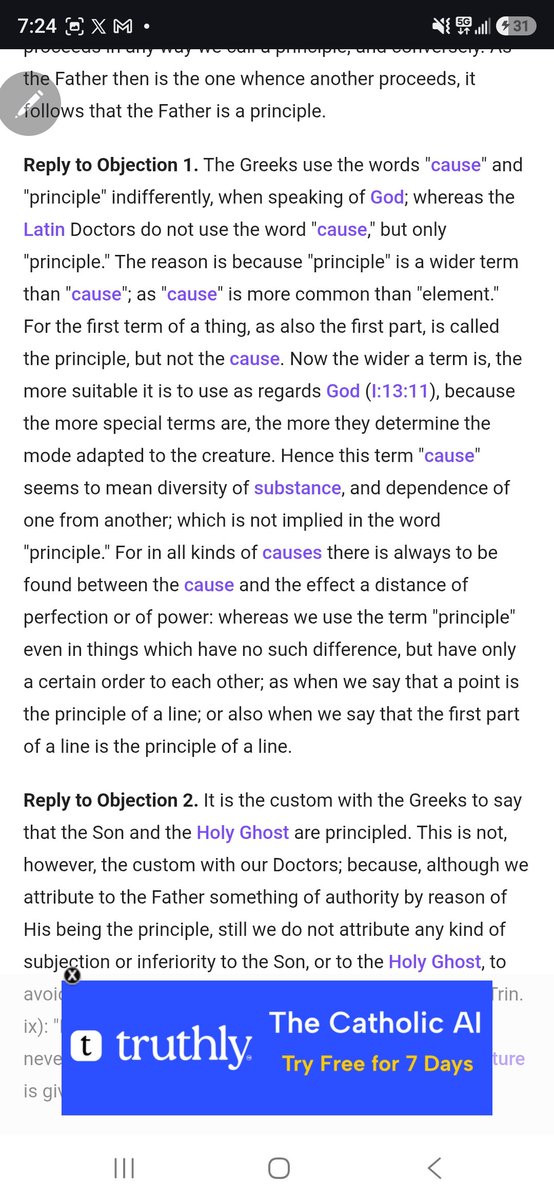
@SilentMindView@papism101 You failed to understand that the sense in which a word is used is context dependent and not univocal across centuries. By the time of Florence, Greeks used 'aitia' and 'arche' indifferently, as Aquinas observes. Florence used 'aitia' as principle, not principium principaliter.
@yahunna9@a_terechenko True but if this statement is taken as univocally dispositive (or no further clarifications are necessary) it is strange that three (or four) subsequent ecumenical councils made clarifications and exposition of the deposit of faith.