Again $CRWV bankrupt. $NVDA and NeoCloud circular financing deals now a direct and major concern of the Federal Reserve.
Barr
“Chipmakers and hyperscalers have invested more than $100 billion in AI laboratories and cloud startups, which subsequently purchase computing services or GPUs from their investors. I’m concerned that these smaller companies must eventually generate sufficient revenue from independent customers to support their commitments.”
Holy smokes. Uber AI bull and cheerleader just laid out my AI bear case flawlessly. If he sees it, and can change his mind and portfolio, most others certainly will too. The AI Data Center boom is over. $NVDA $ANT $GOOG $AMZN $ORCL $CRWV
🦔Three CoreWeave founders cashed out $3.3 billion of stock, and now one of them wants a pat on the back for buying $30 million of bonds. If Venturo believed in the stock, he’d buy the stock. Bonds get paid first if things go bad, and these ones paid around 16% in October, which is what lenders charge when they’re nervous. Nvidia backs CoreWeave so it can buy more Nvidia chips, and the founders already took their money off the table.
Hedgie🤗
For the 12th time (yes getting old). No company in history has achieved a 12 month liability that’s 2x ARR. they have no choice to invest in compute, unless they magically print $15-$20 billion in the next 12 months, they’re bankrupt. There’s no cash to buy bonds. They owe $24.4 billion by next year on $14 billion ARR. they owe tens of billions to $NVDA who invented this fraud.
$CRWV bankruptcy imminent in’t it?
$24.6 billion due in 12 months on $3.7 billion quarterly revenue. Desperation hitting.
Guesses on who buys in bankruptcy? Or is company dissolved because pre-payments wiped out all future collections on the chip ABS?
AI Isn't The Bubble — The CAPEX Boom Is & The Bond Market Will Kill It
Please ❤️like, bookmark🔖, and 🔁share with fellow investors
In this Short video, Porter Stansberry @porterstansb and @AdamTaggart discuss why the AI trade may be entering its final inning, with a major bust potentially unfolding before the end of 2027.
But the central argument isn't that artificial intelligence is a failed technology. It's that the massive capital expenditure boom supporting it has become financially unsustainable, and the bond market may ultimately bring it to an end.
*
Porter draws a striking parallel to the late-1990s internet bubble, when telecommunications companies spent billions building fiber-optic networks.
The technology was revolutionary, but excessive investment created enormous overcapacity.
Bandwidth prices collapsed toward zero, leaving behind vast amounts of unused "dark fiber" and destroying the economics of businesses that depended on selling network capacity.
He believes the same cycle is repeating in AI.
*
Today, technology companies are pouring unprecedented amounts of capital into data centers, GPUs, computing infrastructure, and cloud capacity, betting that future AI demand will justify the spending.
But history suggests that even transformative technologies can produce devastating investment losses when infrastructure expansion gets ahead of sustainable economics.
The biggest warning sign? The financing structure is changing.
*
The AI boom has shifted from equity funding toward debt financing, with borrowing requirements potentially approaching $500 billion in 2027.
He doubts the bond market will provide that capital.
His thesis is straightforward: massive CapEx cycles don't necessarily end when the technology stops working. They end when creditors refuse to finance further expansion.
Once the bond market says "no more," the circular financing arrangements supporting AI investment could unravel, triggering a sharp contraction in infrastructure spending and cascading losses across the technology sector.
*
Porter's company-specific forecasts are especially aggressive.
He believes CoreWeave $CRWV could become worthless, Oracle $ORCL could crash, and Nvidia $NVDA could see revenues decline by 50%.
None of those outcomes, he argues, are adequately reflected in current valuations.
*
The consequences could extend well beyond technology stocks.
Porter expects the collapse in AI investment to remove more than half of current economic growth, weaken commodity demand, reduce spending on technology services, and trigger a significant Nasdaq $QQQ drawdown.
*
He also points to Federal Reserve tightening as a potential catalyst.
The dot-com bubble burst after the Fed began raising rates in 1999, and he believes today's tightening cycle could similarly accelerate the end of the AI boom.
*
But there's an important distinction: this isn't a prediction that AI disappears or fails to transform the economy.
The internet survived the dot-com crash and went on to reshape the world. Yet many companies financing its original infrastructure boom suffered catastrophic losses.
Porter expects AI to follow a similar path.
*
The technology may be revolutionary.
The investment cycle is still vulnerable.
And if the bond market pulls the plug, the AI CapEx bubble could burst long before the technology reaches its full potential.
*
💡 Get access to notes with the key takeaways from this interview by visiting Thoughtful Money Substack (link in the @AdamTaggart 's bio OR in the tweet below)
The WSJ just reported that Nvidia is now under SEC investigation - of course it did that only after market close
Colette Kress, who signed those cooked financial, is about to present Nvidia earnings and at this point I wonder how can anyone trust whatever number she will put out
Steve Eisman says Jensen Huang built a virtual vertical holding company around Nvidia, and the neoclouds inside it are about to get ejected
"I think the other major issue is that Jensen Huang created what I call a virtual vertical holding company. And it's unwinding."
"I think the neo clouds are all in big trouble, though, because they're part of that vertical holding company. And I think they're about to get ejected."
[ The latest Commerce Department stuff, that would affect the neo clouds, you might think, right? ]
"It affects everything."
"But like I said, this whole structure that Jensen Huang created is going to unwind. It's going to be painful."
$CRWV bankrupt. Already owes $NVDA $7.5 Billion in OEM financing it used to secretly hide massive losses.
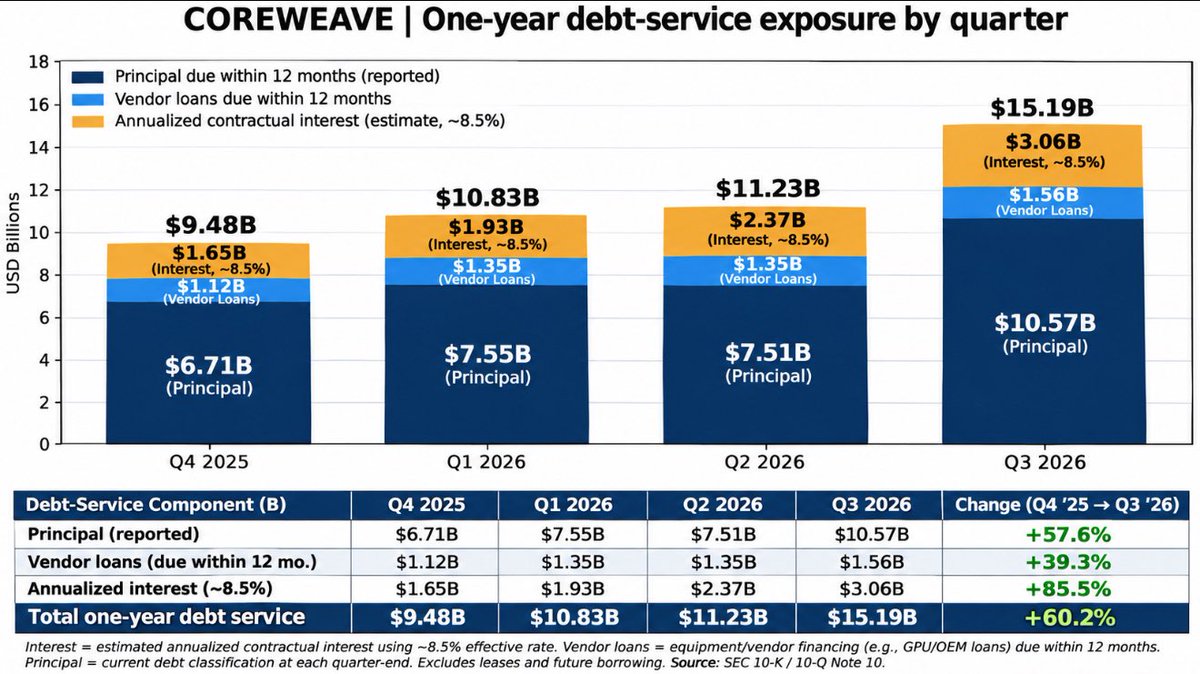
CoreWeave owes $19.05 billon in principal and interest by end of 2027. $15.2 billion by Q3 next year.
EISMAN:
“.. Since going public, the three founders have sold combined over 3 billion in stock. Let me say that again."
"How much stock have the three founders bought back? Zero."
$CRWV
"Since going public, the three $CRWV founders have sold, combined, over 3 billion in stock. Let me say that again."
"How much stock have the three founders bought back? Zero." -Steve Eisman
After running every scenario imaginable, I have yet to find one where $CRWV survives 2027.
They are entering the first quarter where now convertibles likely aren’t an option even, leaving all DTLL which has a one year repayment term. The graph shows how principal and interest due on that has already ballooned on that over a one year period, but amount owed through the end of 2027 (not one year) has already ballooned to $19 billion when including Q4 for DTLL and vendor financing due at the time.
The company only projects $27 billion in revenue in 2027 while suffering expanding losses. It’s over without at least a $15 billion 5 year bond to rescue them. Every dollar they borrow from DTLL is due back with principal and interest within a year. It simply doesn’t work, especially when accounting for slower additions with pre-payments they 100% rely on for revenue and organic revenue they won’t be collecting from contracts expiring 1.5-2 years out because they’re already covered from old pre-payments made.
$CRWV management said during the call it had plenty of cash and didn’t need to raise more debt - that triggered a short squeeze sending the stock 20% higher the next day
After the close, $CRWV announced they will raise $4b more in debt issuing a bond
This is securities fraud
👀Look closely👀
One of these is a debt-fueled arbitrage between the long term cost of ownership vs short term rentals that's run by crooks and never had any chance of turning a profit.
The other is WeWork.