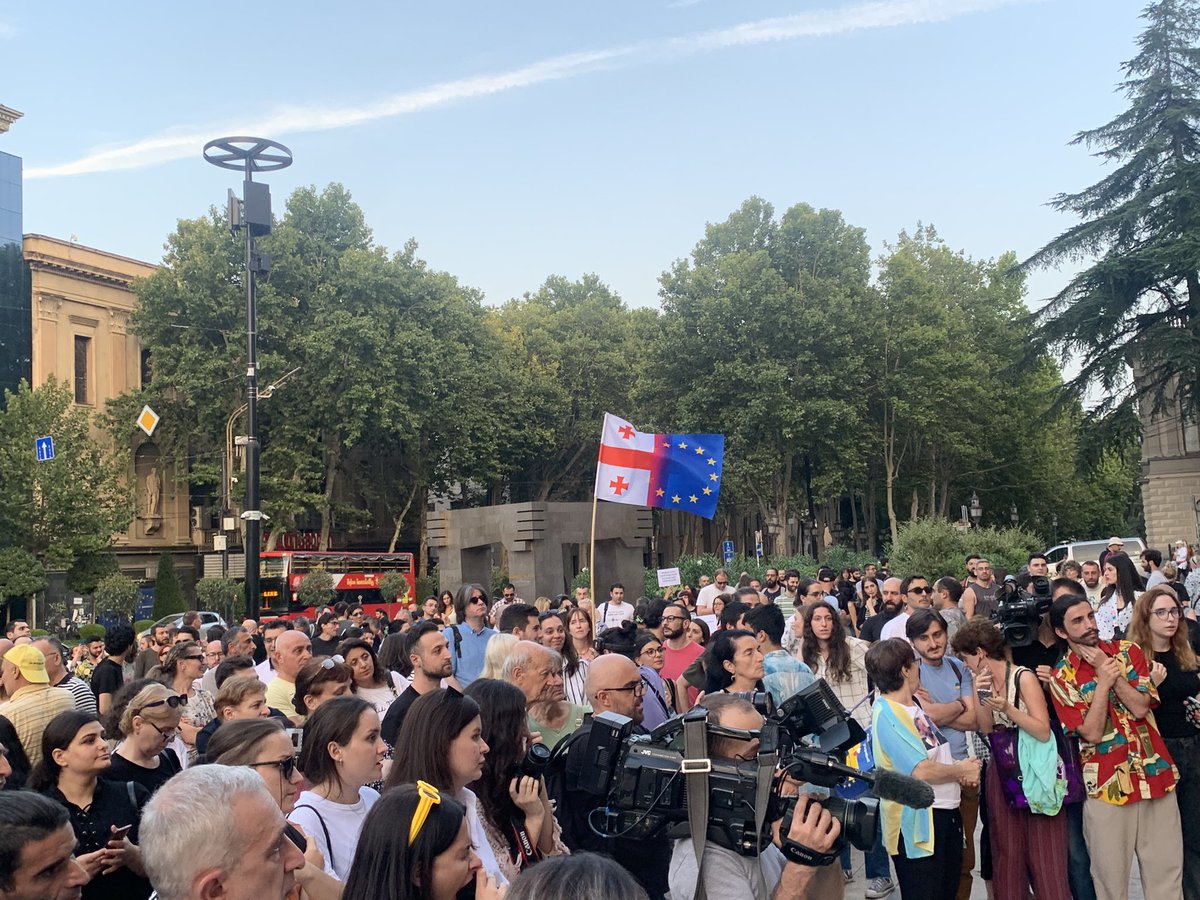
February 25th is a tragic day in Georgia’s history, as it was on this day in 1921 that Russia’s invasion of Tbilisi ended Georgia’s democratic and European development.
In November 1921, the Georgian people went on strike, showing their resistance to Russian occupation. Clearly, this was not enough to restore independence, and the repressions of 1924 and 1937 buried the idea of independence for decades.
February 25th is a day that reminds us of what can happen if history repeats itself. Today, Georgians face the same existential threat—either we will win or lose the most valuable thing we have: our national independence and freedom.
For the third month in a row, Georgians are standing firm in the streets, defending their future. Unlike the past, we are much stronger in this fight.
Therefore, on February 25th, at 16:00, Georgia will go on strike.
#GeorgiaProtests #Georgiastrikes
#RussiaIsATerroristState
I invite all my friends and Georgia Watchers to follow @protest_24. One of the best resources to stay updated about #GeorgiaProtests -- they do daily schedules and more.
How do #Georgians#protest?
For over a month, Georgians have taken to the streets, standing against an illegitimate government and its decision to suspend 🇬🇪’s 🇪🇺 integration. Swipe through to explore creative and diverse forms of protest Georgians have adopted.
Very Georgian news: somebody decided to make Mtsvadi (traditional Georgian grilled meat) on the 8th floor of the building. Neighbours thought the flat was burning and called for the firefighters
I went to the national library today to see what Georgian press has written about the Parliament building over the years.
For once I am thankful for all the crazy stuff soviet or later propagandistic press came up with :)))
Photo from the cover of journal Drosha, 1952
Not sure how twitter algorithm works but if this tweet reaches any social scientists :
I am looking for good articles on Russian Imperialism/colonialism, any suggestions?
"As for August 7 and 8, I believe it is more beneficial for the state to celebrate this date on August 8, considering the resolution of the European Council, which the National Movement signed. The resolution states that Saakashvili started a war on August 7, and Russia's reaction followed on August 8. Therefore, celebrating this date on August 8 aligns with the established tradition continued by the previous government."- said the chairman of the party Georgian Dream, Irakli Kobakhidze.
When russia invaded🇬🇪I was 11.
I couldn't understand what's happening.
The only thing I remember-while we were ignored,the Presidents of Ukraine,Poland,Estonia and Latvia arrived in my home city.
Since then I'm biased toward Ukrainians,Pols, Estonian, Latvians(+Lithuanians)❤️
Today marks 15 years since #Russia’s invasion of #Georgia.
In 2008, I was 8, looking at the bombed Gori from the car.
Now I am 23 and I still have to watch 🇷🇺 using same methods in 🇺🇦 .
Hoping that in 15 years (if not sooner) Putin’s imperialist aspirations will be destroyed.
Ann Svanidze: „For the people affected by Shovi disaster, if anyone needs a place to stay/overnight, we can shelter 4-5 people in Ambrolauri for the next few days. 1/2
‼️ Most streets leading to #Batumi Seaport were blocked by the police in preparation for the arrival of the cruise ship #AstoriaGrande, which started its tour from #Russia.
‼️ Students and activists are planning a protest.
‼️ The citizens have begun gathering near the port.
Versions of the #Georgian Parliament Building presented in 1930s. Before final project was approved.
Quite different from what we have now👀
Source: Janelidze N. 1957
3/3 Book prompts the reader to wonder how bivocal narratives express themselves in contemporary political narratives and how we continue to use memory as cultural practice to navigate through our sense of belonging towards the #western world.
1/3 #Book number 2 from my summer reading list: The Bivocal Nation, by my professor Nutsa Batiashvili.
Again highly recommended!
Not only for people who are interested in #anthropology but also for ones who wonder how “Georgianness” is constructed through memory narratives.
2/3 This book shows how #Georgia as a nation is imagined not through univocality, but through self-idealizing and self-condemning narratives (thus bivocal)
Additionally book describes how Georgians make sense of Russo-Georgian relationship and employ past to reassart their views