🚨🎙️ Pep Guardiola was asked:
“Who is the GOAT between Lionel Messi and Cristiano Ronaldo?”
🗣️ Pep Guardiola smiled:
“Honestly, I don't like this debate anymore because people always want a five-second answer for a question that deserves five hours.”
🗣️ “The moment you say Messi, Ronaldo fans get angry. The moment you say Ronaldo, Messi fans get angry.”
🗣️ “Football is not social media. Football is not about choosing a side in ten seconds.”
🗣️ “To understand greatness, you have to understand football first.”
🗣️ “Cristiano Ronaldo is one of the greatest competitors I have ever seen in any sport.”
🗣️ “His mentality is unbelievable. His discipline is unbelievable. The way he transformed himself from a winger into the greatest goalscorer football has ever seen is something that should be studied.”
🗣️ “You don't score that many goals by accident.”
🗣️ “You don't dominate England, Spain, Italy and international football by accident.”
🗣️ “Cristiano earned every single achievement he has.”
🗣️ “But then there is Messi.”
🗣️ “And this is where the conversation changes.”
🗣️ “When I coached Messi, I realized very quickly that I wasn't looking at a normal football player.”
🗣️ “I was looking at football itself.”
🗣️ “There are players who score goals.”
🗣️ “There are players who create goals.”
🗣️ “There are players who control matches.”
🗣️ “Messi does all three at the same time.”
🗣️ “People see the goals.”
🗣️ “I see the passes nobody else sees.”
🗣️ “I see the spaces nobody else understands.”
🗣️ “I see the decisions that change games before anyone realizes what happened.”
🗣️ “That's why I always laugh when people compare football only through statistics.”
🗣️ “Football is much deeper than statistics.”
🗣️ “If football was only about goals, then maybe the debate would be different.”
🗣️ “But football is also creativity.”
🗣️ “Football is intelligence.”
🗣️ “Football is influence.”
🗣️ “Football is making everyone around you better.”
🗣️ “And for me, nobody has ever done that better than Messi.”
🗣️ “Can Ronaldo be called one of the greatest ever?”
🗣️ “Of course.”
🗣️ “Without any doubt.”
🗣️ “But if you ask me personally, if you ask me honestly, if you ask me as somebody who watched Messi every day…”
🗣️ “Then my answer is Lionel Messi.”
🗣️ “Not because Ronaldo isn't incredible.”
🗣️ “He is.”
🗣️ “Not because Ronaldo didn't change football.”
🗣️ “He did.”
🗣️ “But because Messi changed the way football is understood.”
🗣️ “That is a different level.”
🗣️ “And maybe some Ronaldo fans will criticize me for saying this.”
🗣️ “That's okay.”
🗣️ “I respect Cristiano enormously.”
🗣️ “But I cannot ignore what my eyes have seen.”
🗣️ “For many years I watched Messi do things that should not be possible on a football pitch.”
🗣️ “Things that coaches cannot teach.”
🗣️ “Things that defenders cannot stop.”
🗣️ “Things that only belong to geniuses.”
🗣️ “Cristiano Ronaldo is one of the greatest players in football history.”
🗣️ “Lionel Messi is the greatest footballer I have ever seen.”
🐐🇦🇷✨
🗣️ “Sometimes the hardest answer to give is also the simplest one.”
Made in India : A Titan Story is a story about Xerxes Desai.
But if you're an investor, the character you should actually be watching is Gurav Dhar.
Because Gurav Dhar is based on Bhaskar Bhat. And Bhaskar Bhat is responsible for what Titan became.
Rather long but I hope you enjoy reading it as much as I did:
I am an Indian,
and everyone says I lack civic sense.
They can burn streets,
and vandalize a city after a championship game.
I dance at an airport excited about my first foreign trip, and suddenly I am the face of poor civic sense.
I am an Indian,
and everyone says I steal jobs.
They move factories across oceans,
shift profits through tax havens.
I study, compete, earn a visa, work 18 hours a day, sometimes multiple jobs and somehow I am the one stealing jobs and scamming the system.
I am an Indian,
and everyone says I am everywhere.
I build your software,
treat your illness,
teach your children,
drive your taxis,
and open your stores.
The world became a village,
yet my presence remains a problem.
I am an Indian,
and everyone says I am too loud.
The evening news screams outrage.
The internet echoes with anger day and night.
I celebrate a wedding, a festival, a victory,
and I am told my joy is too loud.
I am an Indian,
and everyone says I smell of curry.
The world smells of gunpowder,
of hatred,
of division,
of endless arguments about race and religion.
I carry the fragrance of spices from my grandmother's kitchen,
and somehow that is what offends.
I am an Indian,
and everyone says I have no culture.
I come from a civilization that counted the stars
when much of the world was still learning maps.
I speak languages older than nations.
I celebrate hundreds of traditions,
yet I am told I have no culture.
I am an Indian,
and everyone says I am backward.
I send missions to the Moon.
I build vaccines for millions.
I run companies across continents.
Yet a viral video of one fool becomes evidence against a billion people.
I am an Indian.
I celebrate my favorite actor's success
with flowers, music, and a few glasses of milk.
Others worship influencers who sell outrage, turn every disagreement into a battlefield, and every opinion into a war.
Yet my celebration is the one that makes headlines.
I am an Indian,
and everyone says I gather in crowds.
We walk together in processions,
celebrating our faith, our culture, our traditions.
Everyone is welcome.
No shops are looted.
No neighborhoods are burned.
No one is threatened for thinking differently.
We sing.
We dance.
We pray.
And somehow our gathering becomes the problem.
I am an Indian,
and everyone says I bring my culture everywhere.
I light a lamp in a foreign land.
I wear a saree in the snow.
I teach my children the language of their grandparents.
Others build walls between neighbors,
argue endlessly over identity,
and forget where they came from.
Yet I am told I should leave my culture behind.
I am an Indian,
and everyone says I live in the past.
But my past gave me yoga,
mathematics, philosophy, meditation,
and the idea that the world is one family.
The future keeps borrowing from my past,
while telling me to be embarrassed by it.
I am an Indian,
and everyone says I should be ashamed.
Ashamed of my accent.
Ashamed of my food.
Ashamed of my festivals.
Ashamed of my traditions.
Ashamed of existing.
But I am not ashamed.
I am the child of farmers and philosophers,
scientists and saints, workers and dreamers.
*I come from a land that taught the world
that truth can be many-sided,
that all paths deserve respect,
and that the entire world is one family.*
*Yes, we have flaws. Every nation does.*
*But judge me by my actions, not by your stereotypes.*
For I am an Indian.
*And before you tell me what is wrong with me, look honestly at what you have normalized in yourself.*
For I am an Indian.
The world may mock my accent,
question my customs,
laugh at my celebrations,
and judge me through a thousand stereotypes.
*Yet I stand tall. For I belong to a civilization older than empires, a culture richer than prejudice, and a people whose spirit refuses to bend.*
For I am an Indian.
More than half the S&P 500's total value is now in stocks priced above 10x sales. This was once considered an outlandish valuation, as it leaves little room for error. The list includes Nvidia, Apple, GOOG, MSFT, Broadcom, Tesla, Micron, Eli Lilly, AMD, Oracle, and 57 more.
"Markets have a way of finding your weakest personal trait and exploit it against you."
Borrowing from history, I am reminded of Scott McNealy, CEO of Sun Microsystems (Bloomberg Interview in 2002), and I quote:
"Two years ago, we were selling at 10 times revenues when we were at $64....At 10 times revenues, to give you a 10-year payback, I have to pay you 100% of revenues for 10 straight years in dividends ...That assumes I have zero cost of goods sold, which is very hard ... That assumes zero expenses...pay no taxes... Now, having done that, would any of you like to buy my stock at $64?
Do you realize how ridiculous those basic assumptions are? You don't need any transparency. You don't need any footnotes. What were you thinking? "
AI is humanity's Promethean moment- fire, stolen at last from the gods. Burning through jobs, this fire will cause a financial conflagration. We collectively possess the water and sand to tame this fire, but we must act swiftly to begin an urgent society-wide policy dialogue.
Excited to partner with @Citrini7 to release the first part of our series, The Global Intelligence Crisis- The Rise of Agentic AI
After years of exponential growth, the recent capability jump to agentic AI is set to upend the world as we know it beginning in 2026. Here is the uncomfortable truth: AI is no longer just a tool for economic growth; it is a near-direct substitute for human cognitive labor. In the near term, it will displace white-collar workers far faster than new markets can absorb them. In this three-part series, I draw on 20 years of experience investing in public markets and 15 years building AI companies to outline my perspective on the coming economic storm.
Our entire economic system is built on a single premise: human intelligence is a scarce, expensive resource. It is the key input required to turn raw materials into goods and services that dictate our living standards. In 2026, as agentic AI comes of age, that foundational assumption is collapsing. AI is no longer a mere tool or complement; it is rapidly becoming a direct substitute for human cognitive labor. This shift fundamentally devalues white-collar work. Fueled by surging AI progress and capital, this displacement will inexorably accelerate, creating an economic shock that could eclipse the Industrial Revolution, the Global Financial Crisis and the pandemic. Without urgent policy action, this has the potential to cause a significant financial crisis in the next two years.
My warning should not have you mistake me for an AI doomer. AI is humanity's Promethean moment- fire, stolen at last from the gods. Its capabilities put us less than a generation away from abundant living standards for all, limitless clean energy and the eradication of most diseases. Our challenge is not the technology itself but rather surviving the severe economic shock of its arrival and required rewiring of our financial system.
The era of AI as a simple conversational chatbot is over. Over the past six months, we have crossed a critical threshold into the era of agentic AI- systems that operate autonomously to execute complex, multi-step workflows. The pace of this evolution is staggering. According to METR, a third-party that evaluates autonomous AI capabilities, the duration of tasks models can complete unaided is doubling every six to seven months, with the most recent examples suggesting a further acceleration in trend. Today, the leading models can execute 14.5 hours of continuous, autonomous work. The trendline points to a full month of unaided work by mid-2028.
My Vantage Point
I began my finance career as a consumer analyst at two large hedge funds, Viking Global and Citadel, where I invested through the global financial crisis and its aftermath. In 2011 I left to run my own fund called LOTUS. There, it became clear that the limiting factor on my performance was my ability to process the growing torrent of information that drives markets. My workflows were split across Bloomberg, S&P Capital IQ, Excel, Outlook, OneNote and various financial apps and websites. To centralize these disparate workflows, my brother Naman and I built Sentieo, an AI financial search engine. The results were striking–I could see the world more clearly, operate faster with a smaller team and generate better investment performance. We eventually grew Sentieo to over 1,000 investment management, banking and corporate clients before selling the business to a competitor for over $200 million in 2022.
Since selling Sentieo, I have been running @lotusaifund, @LittlebirdAI - a personal AI company, and Studio Management- a startup incubator. Building Sentieo fundamentally shifted my worldview. I realized AI is the ultimate force multiplier, and I began seeking ways to use it in every facet of my companies and life.
Our Use of Agentic AI
At my companies, we aren’t just observing the agentic AI trendline; we have aggressively rewired our organizations to run on it.
Nowhere is this shift more dramatic than in software engineering. Prototyping a new feature used to require a week of designing specifications with a product manager and designer, followed by a week of engineering iteration with a small team of engineers. Now, agentic coding interfaces allow me to write a detailed prompt and generate a functional prototype in minutes. While it isn’t usually production-ready on the first pass, it largely cuts other humans out of the initial build process and significantly increases our velocity of shipping finished product.
We are seeing a similar trajectory at LOTUS. A year ago, AI models could do a decent job of answering basic financial structure and valuation questions. Today’s agentic AI is fully connected to Factset and S&P Capital IQ financial and document databases. In the old model, if I wanted to research a new idea, I would assign it to an analyst. It would take a few days for the analyst to read the relevant documents, research the key debates and data and then prepare a financial model and email with their key findings. We would then iterate on this over another few days. Today, an agentic AI can synthesize the filings and key debates, construct the financial model and generate a comprehensive memo of near comparable quality in a few minutes. This quick turnaround means I can rapidly drill down into the key issues and reach an investment decision days faster than before.
The token cost for delivering this agentic work is less than 1% of the cost of a human performing the same work. Agents don’t need to sleep, don’t take vacation and can be spun up (and down) into swarms of agents as needed. Perhaps the most profound change, however, is the way we coordinate in an agent-driven organization.
Human coordination is the largest, most exponential cost in any business. Economist Ronald Coase’s seminal 1937 Theory of the Firm can be paraphrased as- Firms exist because internal coordination costs are lower than market transaction costs, but only up to a point. The firm stops growing when the marginal cost of organizing one more internal transaction equals the cost of doing it via the market. Passing instructions from a founder to a product manager to an engineer is a lossy game of telephone, requiring endless messages, meetings and presentations just to keep everyone aligned. Indeed, we can think of the entire Microsoft Suite of Outlook, Word, PowerPoint and Excel as human coordination technologies. AI agents, however, share nearly perfect, continuous context. Where feasible, swapping humans for agents eliminates this massive coordination tax, collapsing friction and ramping output.
We are not actively shrinking our teams today, as we run high growth early-stage businesses that are gaining market share. However, we have significantly slowed the pace of our hiring and need fewer humans than in the past. Each human can do more and is expected to adopt AI aggressively to multiply their output and impact. There are certain roles that we have concluded are better performed wholesale by agents instead of humans. These include data analytics, data migration, certain design roles, certain devops roles and certain customer service roles. This list is growing monthly as AI capabilities improve.
Jobs Commentary from AI CEOs
The AI threat to jobs is certainly not a new or original idea. There has been a growing chorus of warnings of white-collar job replacement emanating from the AI labs over the past year. Unsurprisingly, CEOs have been reticent to put the pieces together to go from layoff risks to downstream economic consequences.
In an interview with Axios last May, Dario Amodei, CEO of Anthropic, warned that "AI could wipe out half of all entry-level white-collar jobs – and spike unemployment to 10-20% in the next one to five years." While Amodei has an incentive to talk up Anthropic’s potential, his capability improvement predictions look prophetic today.
Nine months later, Mustafa Suleyman, CEO of Microsoft AI, seemed to say the quiet part not so quietly in an interview with the Financial Times last week. "White-collar work, where you’re sitting down at a computer, either being a lawyer or an accountant or a project manager or a marketing person – most of those tasks will be fully automated by an AI within the next 12 to 18 months."
State of the Labor Market
Agentic AI is clearly ramping up its ability to perform white-collar work and AI CEOs seem very worried about layoffs. It’s worth examining the state of the white-collar job market coming into the rise of agentic AI.
In the chart that accompanies this piece, the dashed white line represents core white-collar employment, excluding employment in sectors driven by government spending, specifically Government, Health Care (government spending is half of spending) and Private Education (government loans and loan guarantees drive a significant portion of the market).
We can clearly see a stagnant and declining trend in core ex-government white-collar employment since 2023. While there was certainly a 12-18 month hangover from the torrid post-pandemic hiring boom, the last 18-24 months betray a fragile balance. These core white-collar jobs are up only 4% from pre-pandemic levels over six years, compared to population growth of 5% and real GDP growth of 11% over the same period. The Information sector, which should be ground zero for AI job losses, already shows an 8% drop from its peak, with current levels below even 2020 pre-pandemic levels. Corporations are clearly doing more with fewer humans even before agentic AI enters the scene.
Labor Market Supply-Demand Balance
A previous section laid out agentic AI adoption in a typical startup that stands to benefit more from rapid revenue growth than from labor cost savings. This approach represents a roadmap for how larger companies will adopt agentic AI over the next year. However, larger companies have much higher coordination costs, more automatable legacy processes and most importantly, larger steadier businesses with less revenue upside and more cost savings opportunities. Ultimately this means much higher potential for corporate layoffs that have been a consistent feature of the white-collar labor market since 2023. The nexus of a weak white-collar labor market and agentic AI adoption suggests a growing risk of a white-collar jobs crisis.
Agentic AI will accelerate these trends and market forces will multiply them. Critics’ objections that large enterprises will move slowly are fair, but most companies operate in competitive markets. Any company that is slow to adopt agentic AI will see a cost disadvantage and an impaired competitive position versus peers. CEOs understand this dynamic and are almost universally making AI adoption their top priority for 2026, with spending budgets to back it up.
It won’t take many layoffs to upset the already fragile supply-demand balance for white-collar labor. Imagine we get 5% white-collar job losses in 12-24 months, which seems to be significantly less than what Dario or Mustafa are suggesting. These jobs are unlikely to come back as AI progress continues to accelerate. These displaced workers will be forced to seek blue-collar and gig economy jobs, putting downward pressure on wages for all workers in the economy. Employees who keep their jobs will be keenly aware of the growing risk leading to plummeting consumer confidence and spending.
Contagion Risk
Together with Citrini, we have written a detailed prospective timeline of how a crisis might unfold in Part Two–THE 2028 GLOBAL INTELLIGENCE CRISIS, A Thought Exercise in Financial History, from the Future. Rather than repeat all the details here, this is the high-level view of how we think it goes down.
The 5% job loss estimate above assumes the economy is a closed system near equilibrium. It is not. The economy is highly reflexive, and the engine driving job losses, AI intelligence itself, continues to accelerate every quarter.
First, there is no natural brake. AI capabilities improve, companies need fewer workers, displaced workers spend less, weakened companies invest more in AI to protect margins, and AI capabilities improve further. Each company’s individual response is rational. The collective result is a negative feedback loop that feeds on itself.
Second, the spending damage is wildly disproportionate to the job losses. The top 20% of earners drive roughly 65% of all US consumer spending. These are the white-collar workers most exposed to AI displacement. A modest percentage decline in white-collar employment translates into a much larger hit to discretionary consumer spending, devastating the businesses that depend on it and triggering further layoffs.
Third, AI agents will dismantle the vast intermediation layer of the US economy. Over fifty years, we have built trillions of dollars of enterprise value on top of human limitations: things take time, patience runs out, and most people accept a bad price to avoid more clicks. Agentic AI eliminates this friction. Software, consulting, financial services, insurance, travel, real estate and payments are all built on monetizing complexity that agents find trivial. As these sectors suffer steep revenue losses, they will shed jobs aggressively and compound the bleeding.
Fourth, the financial system is one long daisy chain of correlated bets on white-collar productivity growth. Over $2.5 trillion of private credit has been deployed into leveraged buyouts underwritten against revenue assumptions that no longer hold. The $13 trillion mortgage market is built on the assumption that borrowers will remain employed at roughly their current income for thirty years. These aren’t subprime borrowers–they’re 780 FICO scores who put 20% down. The loans were good on day one. The world just changed after they were written.
Fifth, the government’s fiscal position inverts at the worst possible time. Federal revenue is essentially a tax on human work. As white-collar incomes decline and payrolls shrink, tax receipts dry up just as the need for transfer payments surges. The government will need to send more money to households at precisely the moment it is collecting less from them.
Where I Could Be Wrong
There are a few important ways that this forecast could be wrong. The most likely way is that job losses are very gradual, allowing AI driven productivity to accelerate and boost GDP growth. A roaring economy with near stable jobs would allow for a gradual transition to an AI world. This is the market’s current base case. While certainly possible, the information sector payroll trend since 2023 looks particularly damning for this theory. Moreover, it would likely require AI progress to slow significantly which seems like a losing bet based on current trends.
The second way involves comparing AI to past technological revolutions. The thinking goes that in every previous cycle when technology and automation replaced jobs it created more new jobs in new sectors. While true, every previous technology was a complement to human labor, not a near-direct and near-complete substitute. Every previous technology revolution also coincided with periods of robust job growth; US core white-collar jobs have been shrinking for over 3 years and are hopelessly off the pre-covid trend line.
The third way is that decisive policy action acts to prevent a crisis. I’m not here to handicap those odds today, but I do believe that there is a credible path to align most of the electorate with many corporate, AI and political stakeholders towards this future and I’m hoping to start that dialogue in earnest soon in the forthcoming Part Three: The Path Forward.
Disclosures
As a fund manager and startup builder, my job is to forecast the future and allocate capital and resources accordingly. Because I see this AI-driven displacement as a likely path, my portfolios and companies are positioned for it. If my thesis plays out, my firms will benefit financially.
I am stating this plainly for full transparency, but my intent in writing this is not to “talk my book” or cause panic. The societal risks of this transition are simply too massive to ignore. Even if there is a 10% chance of this specific crisis materializing, the downside is severe enough that we must start a society-wide dialogue today.
Acknowledgments
Thanks to my littlebird co-founders Alex Green and Naman Shah, as well as David Shor, Citrini and Josh Constine for feedback on ideas and proofing.
Claude, ChatGPT, Gemini and littlebird were also each important in gathering the data, researching concepts, checking numbers, creating graphics, rewriting and finally proofing this essay. Each shined in different areas reflecting the spiky and rapidly evolving nature of the intelligence frontier. In comparison, the multiple word processors I used, and their spelling and grammar check functions felt terribly dated.
@DuaneStiller@vtchakarova India has already picked a side. The West. It will NEVER be in China’s camp. With Russia it has a long friendship based on arms supplies. India will not abandon its friends
Just to get people off the debate on QC, I propose the following topic:
Do we really need to have stock trading for 6 hrs a day?
Why not just keep the market open for (say) 3 hrs a day. Will give employees more time to do their thing, people to do more research and traders can do another job or read more/think more. Whatever trades are happening in 6 hrs can happen in 3 hrs also with a little effort.
Minds are closed to markets making a new high. How tide turns? 9 months back sentiment was market won't correct, now it is 180 degree turn.
And the best part is participants have a good reason which they can take comfort in why the market won't rally much.
In markets what is comfortable, is rarely profitable.
#behavioralbiases #Markets
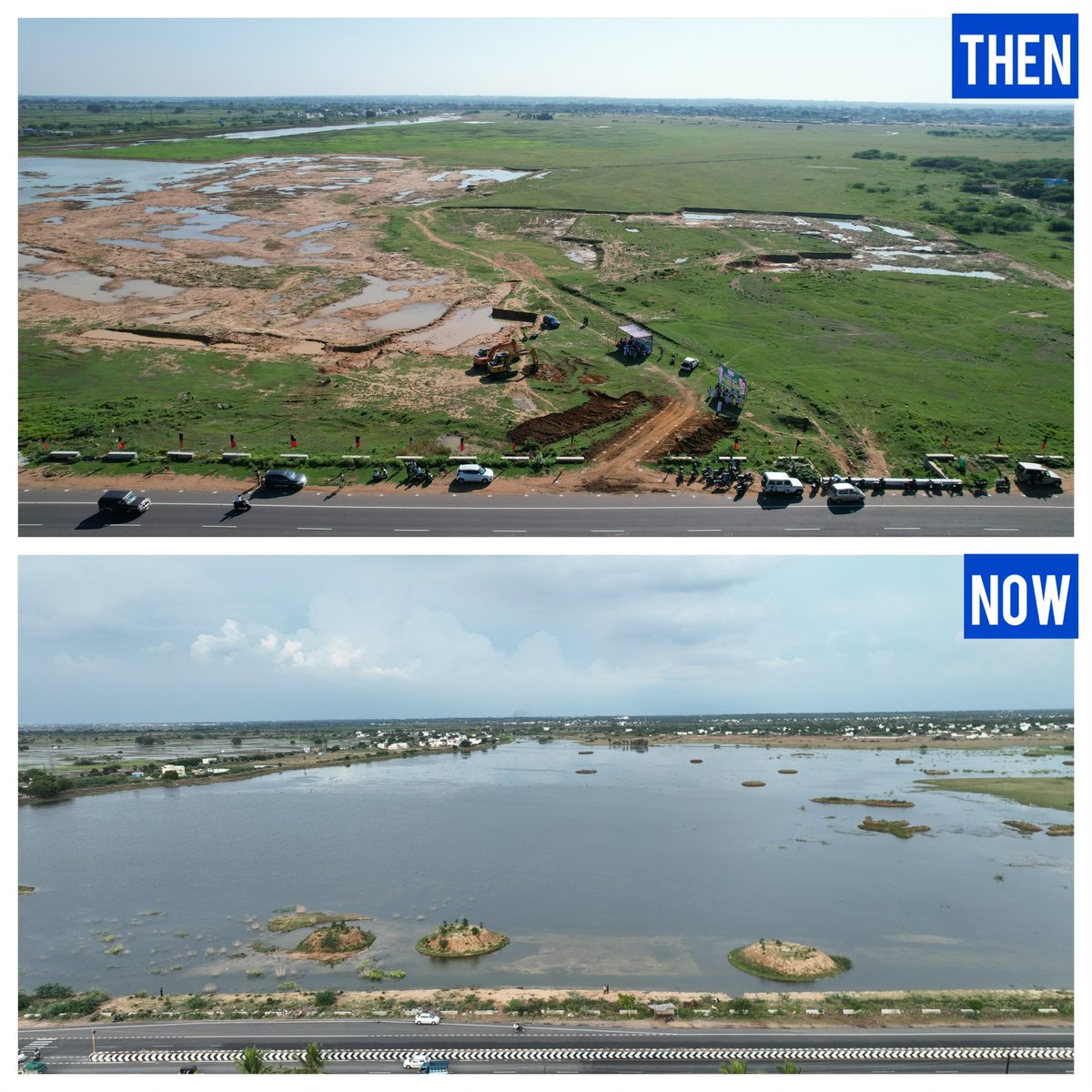
#BounceBackRamnad#SaveWater
This is one of the 253 waterbodies we rejuvenated.
Before and After rejuvenation pictures of Thiruppalakkudi lake, RS Mangalam Taluk, Ramanathapuram district.
Area of the lake: 13 acres.
Water storage capacity: 25 crore litres.
Together Lets Make Our Mother Earth Green Again💚
#MegaFoundations #WaterCrisis #SDG
“Restored a 377 acres lake, 5 km from Trichy airport”
“This is our 177th Waterbody restoration project out of the 250 projects that we have done so far”
Guntur lake in Guntur, Trichy - Pudukkottai NH (5kms from Trichy airport) was not maintained for years. After our restoration work the lake is now filled with water.
The transformation picture shows the condition before and after our restoration work.
Location: Guntur Panchayat, Trichy District.
Gps co ordinates: (10.7245103, 78.7281189)
Area of the lake: 377 acres
Water storage capacity: 5000000000 litres
We would like to thank our sponsor
@Herbalife international pvt limited" and Trichy administration for all the love and support.
Together Lets Make Our Mother Earth Green Again💚
Best Regards,
Nimal Raghavan.
#BounceBackDelta #BounceBackRamnad #SaveWater #Cauvery #MegaFoundations #WaterCrisis #SDG
Nifty has given 6.5% returns from the bottom and Defty has given 8.5% returns from the bottom. FIIs have been net buyers of more than $2bn since this tweet.
What a move in USDINR (88 to 85.4), it’s become almost a consensus that $ has to strengthen and INR has to weaken. I believe minds are not prepared for INR strengthening.
Also the overtly negative minds who could see doom everywhere won’t know what hit them when market makes a new high (don’t know when but can say for sure it’s not a base case scenario even for the most ardent bull). Inherent expectations is valuation pendulum HAS to swing to extreme lows.
Being bullish seems like being foolish.
#markets #staybullish #stayfoolish
Human interaction with tech went from "writing code" to "touchscreen inputs." The next revolution in human-machine interaction: SOUND! - Mr. Kumar Abhishek, Founder & CEO @tonetag
Panel III: Tech-Driven Businesses
@ravidharamshi77@sameervq#Tech#PEInvestorDay2025#VQ
The Energy Transition Pie is growing, & medium-sized players also have significant room for growth in this expansion. -Mr. Alok Garodia, Managing Director, Jupiter International Ltd.
@ravidharamshi77@sameervq
ValueQuest Private Equity Investor Day, Panel I: Energy Transition
#EnergyTransition #PEInvestorDay2025 #VQ