We’re now Kapwa Business.
Kapwa is a Filipino word that doesn’t translate cleanly. The closest is “shared self.” Not “the other person,” but the recognition that the other person is part of you.
What we build: B2B payment infrastructure for the Philippine corridor. Settlement runs on a PHP-pegged stablecoin underneath, and the client never touches it.
Why this name: the corridor we’re building is the same one millions of Filipinos abroad use to send money home. Serving them is where this is headed. We’re starting with businesses because that’s where infrastructure gets proven first.
Same build. Same account. Clearer name.
MoneyGram: 60 million customers, 200+ countries, roughly 500,000 retail locations.
In June they launched their own stablecoin on Stellar, then joined Solana as a validator the same month.
That's not a remittance company experimenting at the edges. That's one rebuilding its core.
Appreciate that, and yeah, that was the reasoning. Trust over flexibility for something people are meant to rely on.
Been discussing whether to revisit it before mainnet, audit scope and cost are the holdup more than the decision itself. Still non-upgradeable as of today.
And thanks for the kind words on the grant too.
Stablecoins are now 65% of transaction volume on Fireblocks. Two years ago it was 40%.
Institutional volume didn't gradually shift toward stablecoins. It mostly already has.
@DouglasGan Not licensed. The Philippines has a moratorium on new VASP licences, so the route is through a licensed issuing partner rather than around it.
How a yen payment becomes Philippine pesos through our PHP Settlement Layer:
1. Client sends yen
2. FX rate locks
3. Client accepts the rate
4. Token minted at the Philippine peso value
5. Payment sent
6. Token burned on completion
The client sees steps 1, 2, 3 and the money landing.
Steps 4 and 6 never appear anywhere in their experience.
That's deliberate.
The chain is plumbing, not a product.
@DouglasGan To be precise: the design is fully reserved 1:1, but the token isn’t issued yet. No circulating supply. That’s deliberate.
The contract is deployed and audited, and issuance waits until there’s a licensed issuing structure and third-party reserve attestation behind it.
It's just a token.
The token is maybe a fifth of the work.
The rest is custody, role permissions, freeze and pause controls, reserve accounting, the banking relationship on each end, and the compliance process that sits over all of it.
The token is the easy part.
It's also the only part anyone talks about.
"Stablecoins settle instantly."
The on-chain leg does. Seconds, sometimes less.
Then it has to become money someone can actually spend, through a bank that has cutoff times and a weekend.
Fast in the middle. Not fast at the ends.
Anyone promising instant end to end is describing one leg of three.
What actually happens to a cross-border business payment today:
It leaves your bank. Hops through one to four correspondent banks that have relationships with each other. Each hop adds a fee, a cutoff time, and a chance to sit overnight.
Then it arrives, and the recipient's bank converts it at a rate nobody showed you in advance.
The transfer was never the slow part.
Transfers are fast and cheap, on basically any chain.
Getting the money back out is not.
Converting a token into spendable local currency means a bank in that country, a licence, a compliance process, and enough liquidity that the rate doesn’t move against you.
Everyone demos the transfer. The off-ramp is where it actually gets hard.
RPC infrastructure is the thing you don’t think about until you’re staring at rate limits at 2am.
A year of Helius free for Superteam Japan members. If you’re building on Solana and haven’t claimed this, go do it.
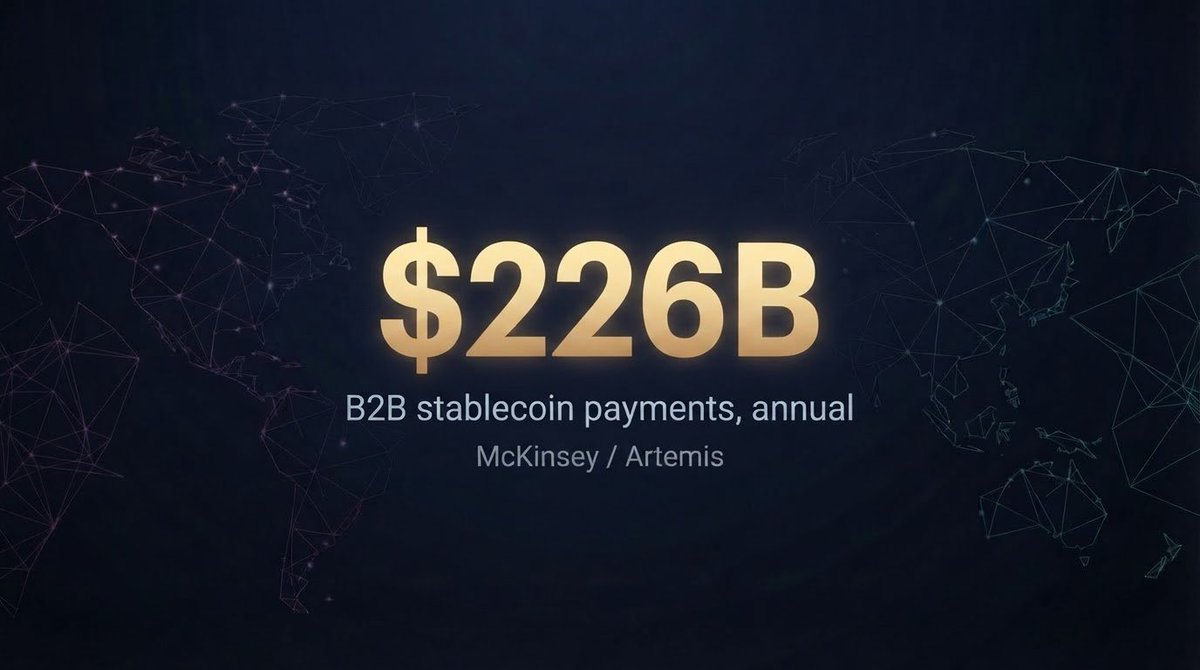
B2B stablecoin payments: around $226 billion annually, up 733% year over year.
That's the macro trend. Japan to the Philippines is one corridor inside it, and the settlement layer underneath is still mostly manual.
Japan’s three largest banks just completed a joint yen stablecoin pilot for cross-border corporate payments, under FSA supervision.
Worth reading the detail. The token is yen-denominated, and the pilot moved money between one company’s Japan office and its overseas offices.
That solves the issuance leg. The recipient still needs local currency at the other end.
That last leg is the one we’re building.
LATEST: 🇯🇵 Japanese megabanks SMBC, Mizuho, and MUFG completed a proof-of-concept for jointly issuing a yen stablecoin and using it for cross-border payments.