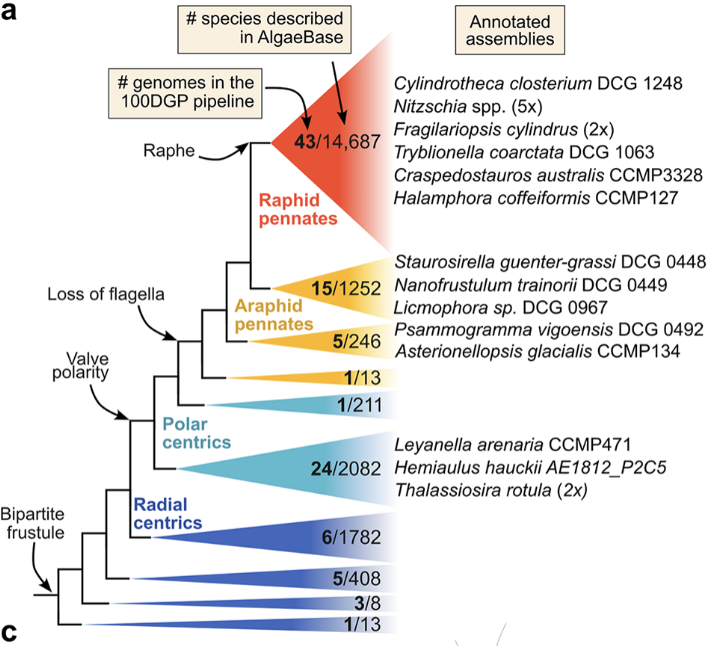
On behalf of 108 colleagues and friends from 11 countries, thrilled to share the first paper from our 100 #Diatom Genomes Project (100DGP). Just out @PLOSBiology | @micronorwich | @uniofeastanglia |@jgi
https://t.co/9Q9bY5BiIt
The mesopelagic as a niche for diatoms adapted to low blue light and high pressure? Check out our new preprint led by Zenghu Zhang, @yongyu_zhang and others at #CAS QIBEBT in Qingdao. #diatoms#Chaetoceros
https://t.co/tYxDfsPeL1
Today in @Nature we report how AI-guided redesign enhances protein evolution. Integrating ProteinMPNN sequence design with autonomous laboratory evolution, we establish a workflow to engineer enzymes with improved properties over those evolved from natural proteins. Redesigned starting points consistently evolve an expanded fitness landscape, reaching new function with higher activity, specificity, and stability than their natural counterparts.
https://t.co/pNlw6z1zvU
1/14
Do eukaryotes need introns? Seems like they don’t. Very nice use of synthetic genome engineering in yeast to remove all introns and lose the splicosome. https://t.co/w3p8B04wPR
Excited to share our new preprint co-led with Hwan Su Yoon and Hocheol Kim.
The genomic basis of evolutionary stasis in the 500-million-year-old red #seaweed genus Ahnfeltia. A living fossil in coastal oceans. It also appears to be an ocean cactus...
https://t.co/6ZbHJu94yT
The @SchulichMedDent at @WesternU invites applications for a Tier 1 Canada Research Chair (CRC) in Mass Spectrometry ‘Omics for Novel Therapeutics.
https://t.co/Iu92bX6zt8
Huge day in K-lab! @Daniel_Nucifora successfully defended his PhD thesis titled “Acholeplasma laidlawii as a New Platform for Creating Synthetic Cells.” Congratulations, Dr. Nucifora!
This work builds on our earlier efforts on Acholeplasma and synthetic genomes. Both published in @ACSSynBio First one was published in the very first issue: https://t.co/VTVJMDS6em and one more recently: https://t.co/Y2SdHbRLmY
Newest paper from our lab lead by @Daniel_Nucifora. We show that the entire genome of A. laidlawii can be transferred directly into yeast by cell fusion. Cloning whole genomes in yeast is a key step toward building and engineering synthetic cells.
https://t.co/P1f4EtYYOg
Awesome new synthetic biology paper in Nature today led by Bolin An (SIAT) and Zijay Tang (Harvard/MIT) on cell fate gene circuits that specialise cell progeny to different tasks and control their population ratios.
This is the most #synbio paper ever!
https://t.co/Az4B2PavhG
Excited that our latest diatom engineering research @SchulichMedDent was highlighted by CTV News London! Congrats @ejlwalker and all authors.
https://t.co/Bp5WfRTKux