✨ What if Ramayana stopped feeling like a story… and started feeling real?
I welcome you to join my unique heritage trip on Kishkinda Kanda focused on Hampi
🏛️ Track Ram's path in search of Sita 📖 Explore Vijaynagara architecture
🌄 Make history feel alive again
DM to join
@Sriram1172@13tuckerr@adithya Dumbo, first of all, no two person can have same horoscope as lagna changes evry 120sec. This is universal fact!
But the post claims that Periyava told "all of them had same horoscope" - which is wrong & cant be mentioned by a soul like Him
Pls understand my point
@Sriram1172@13tuckerr@adithya I surrender myself to Periyava, not to the fake stories built around him. I belive in His miracle, not in these baseless stories.
@redBus_in Message says there'll be a pick up arranged. Bus driver is rejecting such claims and has no clue what's he blabbering. A simple location share is not being done. Is this jow @redBus_in treats customers? Clueless?
@redBus_in the bus I booked is rejected to pick me up at the designated pick up point. They are asking me to travel 8km from the point where my actual pick up is. Tf is this? No response from the driver or operator on how to even reach that point
@redBus_in The operator is drunk and he's not even mentioning the proper pick up point. He's randomly asking me to come to shanti nagar. I've no idea where's it. He's not even sending a simple location of poic up point. Pathetic fraud
Pawaya, Madhya Pradesh, seems to be one of those forgotten archaeological sites that deserves far more attention.
Identified with ancient Padmavati, it has yielded remarkable sculptures, terracottas, inscriptions, coins and architectural fragments.
Many of these treasures can now be seen at Gujari Mahal Archaeological Museum, Gwalior, including important Hindu, Jain and Buddhist antiquities.
Walking through Gujari Mahal, I kept coming across sculptures from Pawaya - and it made me want to see the ancient city itself, not just the treasures that survived from it.
I drew this Nataraja Swami: Nataraja Swami, expressed through mathematics.
Circles form the halo, trigonometric equations shape the flames, and Bézier curves trace the dance-a tribute to the beauty of art, mathematics, and devotion.
@Lovepettyquotes@traversingkrith Few mid weekdays are usually less crowded. We just shot it deliberately with a thought not to capture anyone. Nothing special 😊
@traversingkrith No ma'am. Just a casual one. More of an heritage experience organizer across south India. The video you see was shot during our Chola trip.
Dm'd you ma'am 🙏
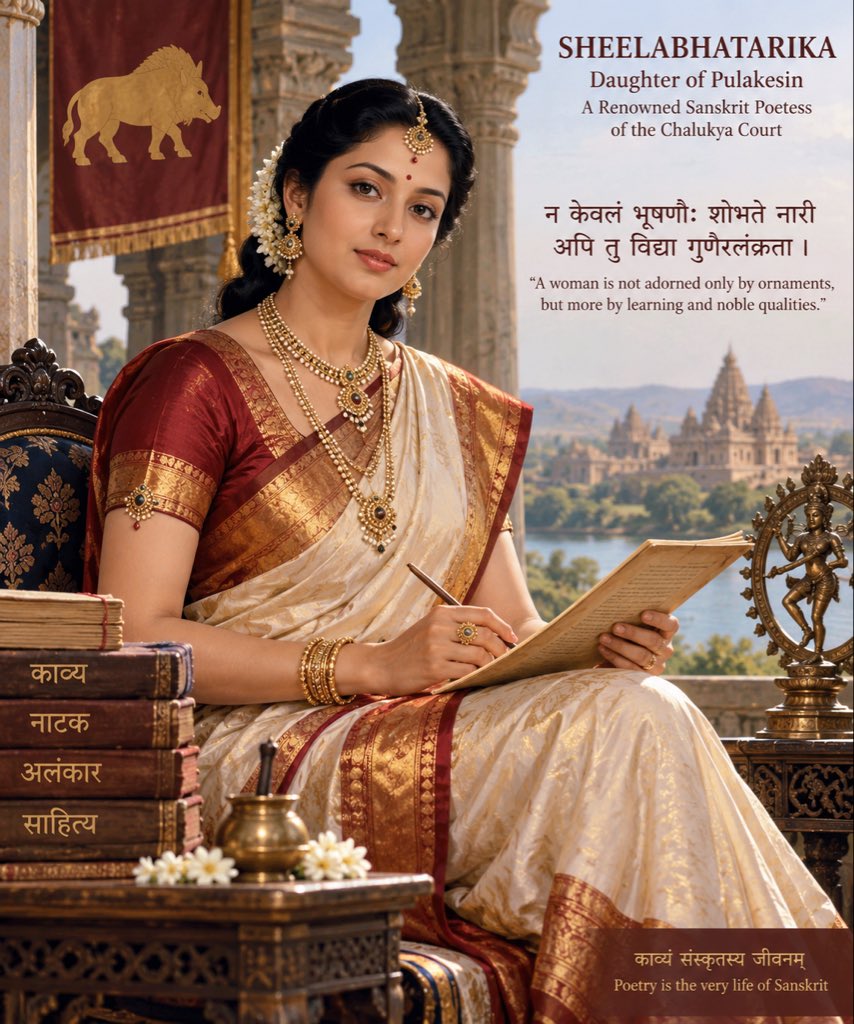
SHEELABHATTARIKA, a famous Sanskrit poetess and the daughter of Pulakeshin II is mentioned in the Pune Copper plate of Bādāmi Chālukya King Vijayaditya
This set of copper plates(contains 5 leaves) with Varaha, preserved in Bhandarkar Oriental Research Institute,Pune,Maharashtra.
It is written in Sanskrit language and Kannada characters,issued in *his 21st regnal year,śaka 638,Māgha,uttarāyaṇa.
Gives the genealogy of the Bādāmi Chālukya kings from Pulakeśin I to Vijayaditya.
It records the gift of a village Sikkaṭṭeṛu along with Arakabāl̥(hamlet of the gifted village) situated in Kogal̥i-vishaya to a brahmin named Vishnusharma,son of Revasharma of Vatsa-gōtra,who was a great scholar of Vedas and Vedāṅgas,by the king Vijayaditya,at the request of Mahendravarman,son of *Sīlabhaṭṭārika* and Dadiga (Ganga King Srivallabha?) The above gift was made when king was camping at Mūgundugrāma.
It is very interesting to note that Sīlabhaṭṭārika,daughter of Pulakeśin II appears to be the famed poetess mentioned by Sanskrit critics Rājashekhara(Author of Kāvyamīmāṁsā)
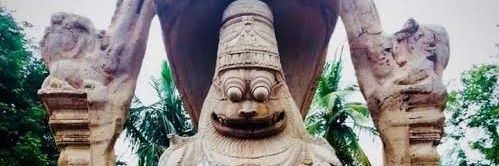
This is a very important inscription recording a grant made to the Narasinga Perumal Temple at Yanaimalai, near Madurai, by Parakrama Pandya, who ruled during one of the most turbulent periods in Pandya history.
The significance of the record lies in its historical setting. In the early 14th century, the Pandya kingdom had been severely destabilised by invasions from the north, particularly the campaign of Malik Kafur. Madurai and the surrounding regions had suffered enormously, and Parakrama Pandya was compelled to rule under extremely difficult circumstances, apparently from a makeshift centre near Madurai.
Yet, even amid this political and military turmoil, the traditional functions of kingship did not cease. Parakrama Pandya continued to support temples and religious institutions, and this inscription records one such grant to the Narasinga Perumal Temple at Yanaimalai.
It is equally significant that Parakrama Pandya is credited with the construction of the imposing western gopura of the Madurai Meenakshi Temple during this troubled period. Even while the kingdom was struggling for survival, resources and royal patronage continued to be directed towards temples.
Seen in this context, the Yanaimalai inscription provides a remarkable glimpse into the resilience of the Pandya state. Political authority might have been weakened and Madurai itself subjected to repeated upheavals, but the responsibility of the ruler to protect, patronise and rebuild the sacred institutions of the kingdom continued.