How do galaxies keep forming stars without running out of gas? To figure out how, I study the gas clouds that are flowing into, out of, and within galaxies.
My graduate student April Horton is about to defined her PhD thesis!!! She has made some incredible contributions to our understanding of the Large Magellanic Cloud galaxy’s gas flows using @HubbleTelescope ULLYSES and GASKAP observations.
My postdoc Suraj Poudel explored the galactic wind emanating from the 30 Doradus starburst region in the nearby Large Magellanic Cloud galaxy. He found that some of the gas is moving pretty fast away from that galaxy toward ours @stsci@NASAHubble#ULLYSES https://t.co/m3WzUmtIKk
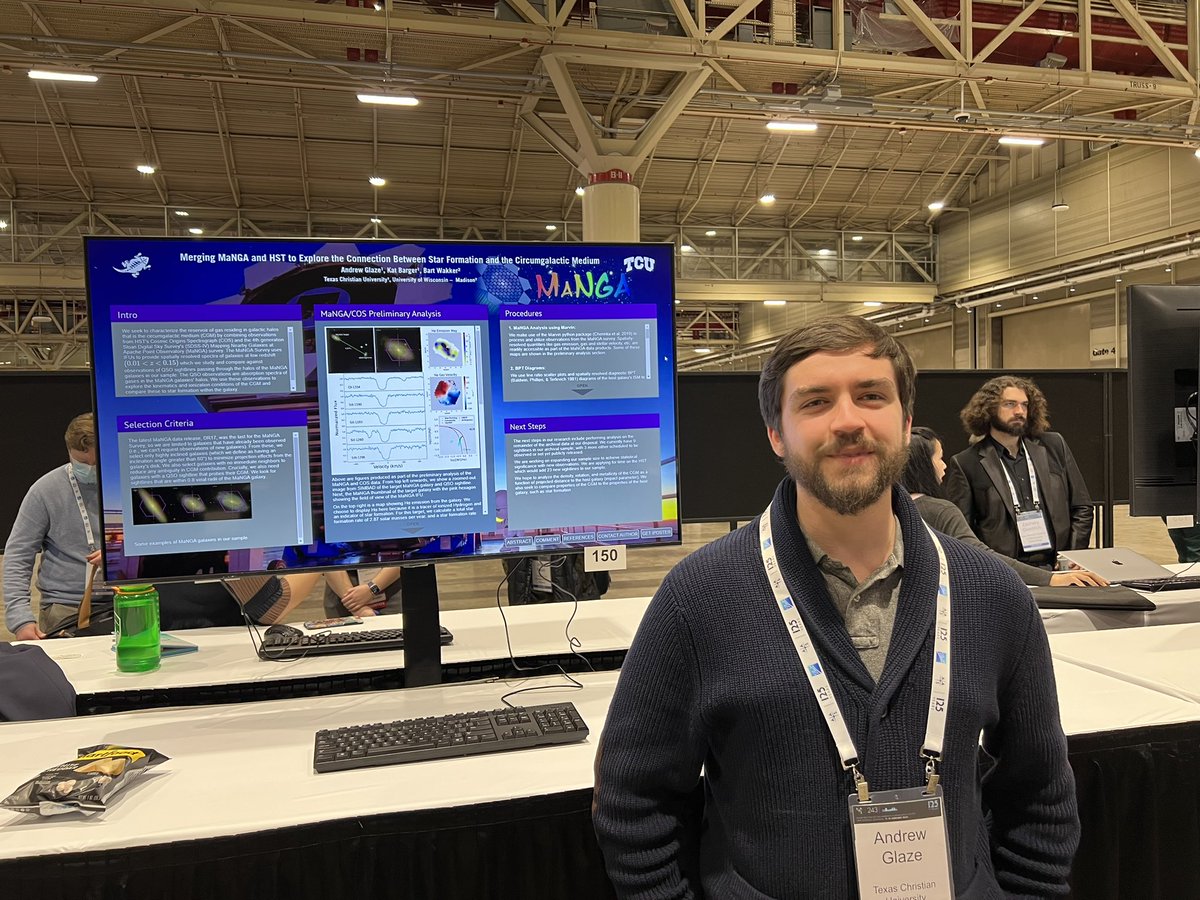
Great job Andrew Glaze on your first AAS poster presentation! He is working on connecting what is happening within galaxies with the gas that surrounds them. #AAS243@TCUPhysAstro
Come check out my graduate student Andrew Glaze’s research in the iPoster session NOW at monitor 150. He is connecting galaxies to their environments using @sdssurveys/@MaNGASurvey and @HubbleTelescope
Feel free to message me if you want to meet and chat about this position. It is an open call for astronomers of any subfield. @TCU is an R2 university and @TCUPhysAstro has an active PhD program. Both @pmfastro and I are part of @sdssurveys IV and V.
Astronomers, there is still time to apply for the tenure track faculty position @tcu. Deadline is January 19th. Both @KatBarger and @pmfastro will be at the #AAS243 meeting this week and are happy to answer your questions.
On my way home from @GreenBankObserv. Had a blast! Amazing views from the top! This telescope has a 100 meter diameter and I was 165 meters above the ground in this picture. Excellent views!!
Last week, @KatBarger’s research team observed with the @GreenBankObserv. Her grad students Jo & April were pointing the telescope at gas clouds surround our galaxy. These neutral hydrogen observations will be combined with @HubbleTelescope to assess their chemical composition.
We have tenure track opening for an astronomer at @TCUPhysAstro for someone to start Fall 2024. This is an open call for all areas of the field. https://t.co/TljQq2HBQX
Here is one of my undergrads presenting their research at a @TCU symposium. Great job Stone Gebhart! He's helping us with our @HubbleTelescope Legacy Archive project on the galactic winds of the Large Magellanic Cloud galaxy.
Stone Gebhart presented is research on gas kicked out of the nearby Large Magellanic Cloud galaxies from exploding stars! Here he is at @tcu's Research & Creative Activities symposium. #UndergradResearch@KatBarger
It's my pleasure to announce that @TCUPhysAstro is hiring a tenure track astronomy faculty for Fall 2024. This is an open call & sub fields and types of astronomy will be considered. We especially encourage those from underrepresented groups to apply. https://t.co/TljQq2I9Gv
@quantumbonde No idea. The reviews indicate that its upper undergrad level, though one says "advanced undergraduates or beginning graduate students". The reviews say that it goes deeper into concepts, which I like and appreciate. Did you use this book? I assume you liked it? I'll check it out!
Congrats grad student April Horton on her funded NSF GRFP program to explore how the Large Magellanic Cloud galaxy is generating a galactic wind from exploding stars in its disk using @WHAM_CTIO and @HubbleTelescope observations. @NSF@KatBarger
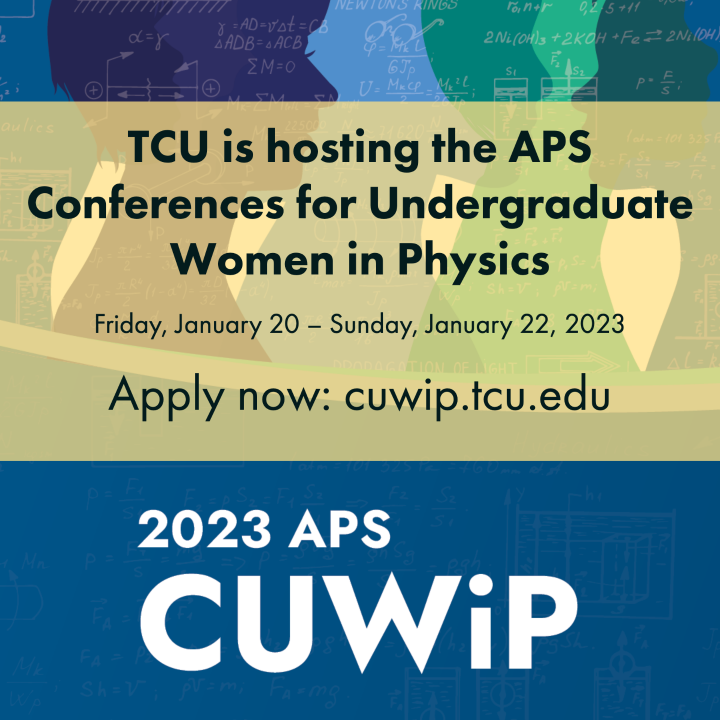
Are you an undergrad in Physics that is interested learning about graduate school
and professions in physics? Join us at the #TCU_CUWiP meeting! Applications are due Oct 10. https://t.co/pjTwXfVJfS
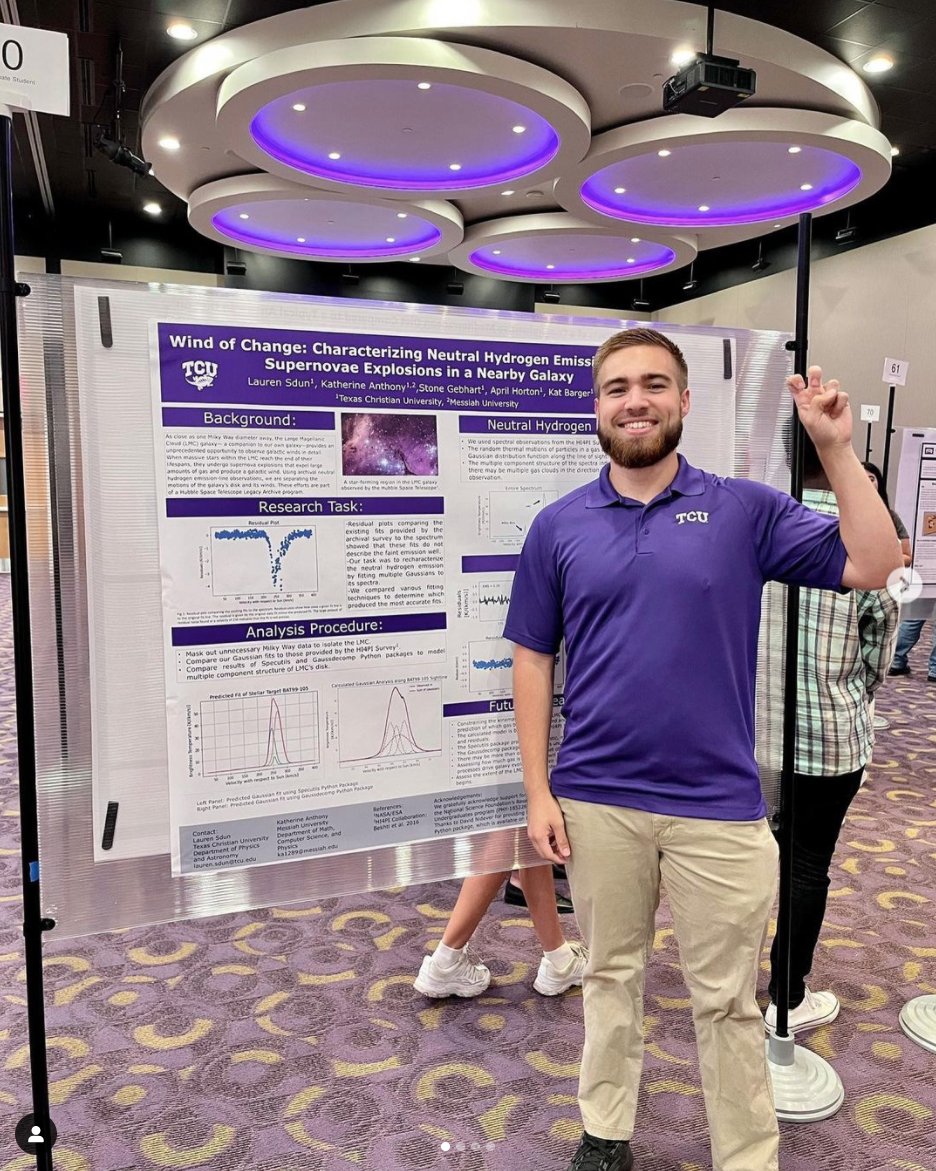
My summer REU student Katie Anthony giving her end of project talk on how she characterized the neutral hydrogen in a supernovae explosion wind in a nearby galaxy! Great job Katie!
Katherine Anthony is presenting her work on “Wind of Change: Characterizing Neutral Hydrogen Emission from Supernovae Explosions in a Nearby Galaxy” right now in TUC 145. She did this work as a summer intern though our Research Experience for Undergrad program #REU@NSF