One of the greatest tragedies of Nigerian society is how we have managed to turn honest labour into a source of shame.
In London, Germany, the Netherlands, Canada and other developed societies I have visited recently, a cleaner is not automatically considered inferior. A carpenter is a professional. A plumber is a skilled worker. A construction labourer is a productive member of society.
People earning minimum wage are not automatically stripped of their dignity.
You can meet a cleaner driving a beautiful car, living in a decent home and raising children with confidence. Not because every cleaner abroad is wealthy, but because society has built systems that give ordinary workers a better chance at a decent life.
Now come to Nigeria.
A cleaner is often treated as someone who has failed in life. A security guard can be insulted by someone whose only achievement is having more money. A carpenter is looked down upon until his services are urgently needed. Domestic workers are sometimes treated as though poverty has cancelled their humanity.
We have created a society where the dignity of a human being is increasingly measured by the size of their bank account, the car they drive, their job title and the people they know.
And this is destroying us.
The same Nigerian who respectfully greets a cleaner in London may return to Lagos or Abuja and humiliate someone doing exactly the same job.
What changed? The occupation or our mentality?
There is something fundamentally troubling about a society where the people who clean our hospitals, construct our homes, maintain our roads, protect our buildings and repair our infrastructure can work tirelessly and still struggle to afford the most basic necessities of life.
Meanwhile, we celebrate unexplained wealth and sometimes give more social recognition to people who produce absolutely nothing of value.
This is one of the contradictions we must confront if we genuinely want to build a civilized nation.
Civilization is not measured by the number of billionaires a country produces. It is also measured by how ordinary people are treated, how fairly productive work is rewarded and whether someone can earn an honest living without surrendering their dignity.
A country cannot develop sustainably when young people would rather appear wealthy than become productive because society respects the appearance of success more than the value of work.
The cleaner is not inferior to the banker. The carpenter is not inferior to the engineer. The labourer is not less human than the politician.
Their responsibilities, skills and earnings may differ, but their human dignity must never differ.
Nigeria must become a country where honest work pays enough to sustain a decent life, where vocational skills command respect and where no child grows up believing that becoming a cleaner, mechanic, farmer or artisan makes them a lesser human being.
The real disgrace is not earning a living by cleaning toilets. The real disgrace is building a society where someone who cleans toilets honestly cannot live with dignity, while someone who steals public money is celebrated.
Until we correct this mentality, we will continue producing a generation that worships wealth instead of productivity.
Is our biggest problem poverty, or have we also developed a culture that disrespects the very people whose labour keeps society functioning?
Hello everyone, I am not sure how to do this as this is my first time. It's about @WURAFADAKAGC, the popular clothing line. Mid June last year, 2025, I invested in their business (all receipts are here), thinking they were credible. Not knowing their intention was to defraud me.
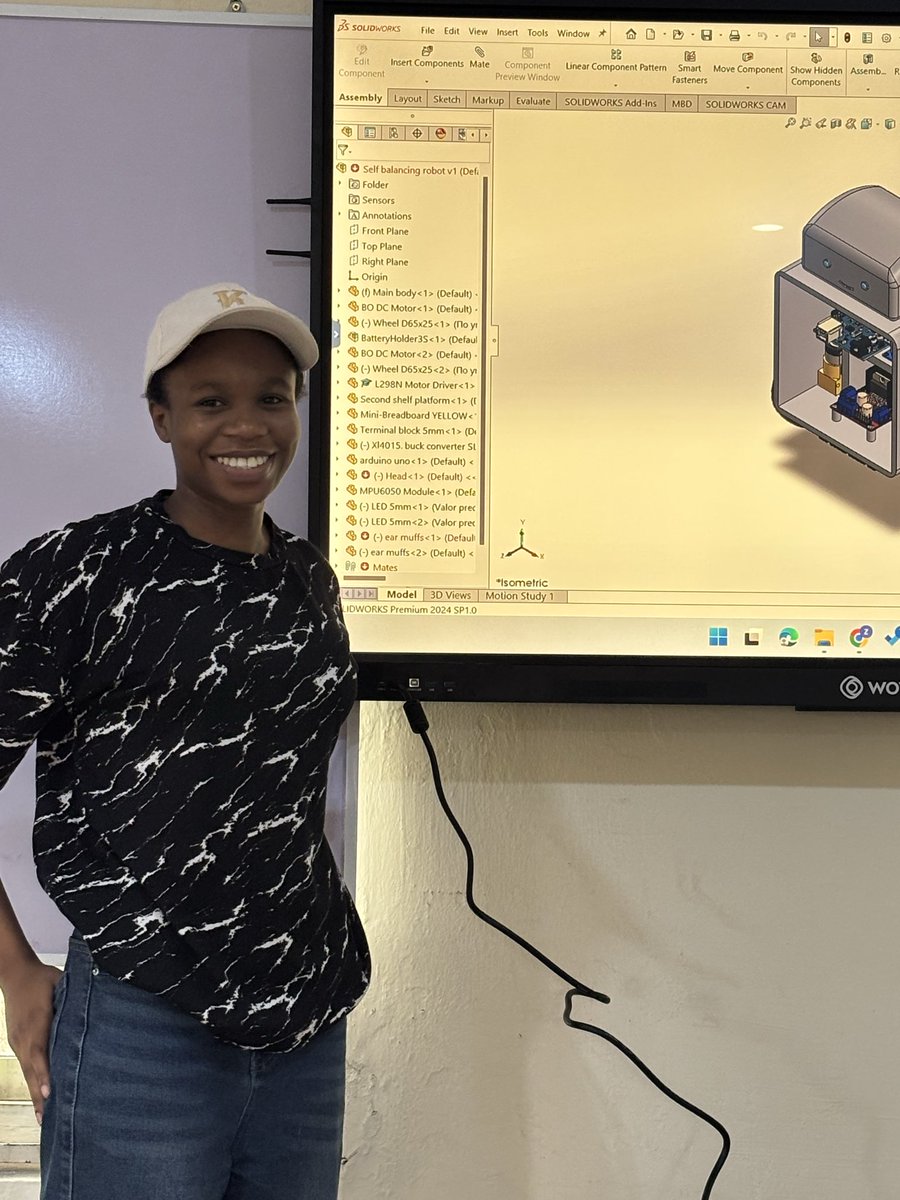
This girl, Chizoba, just graduated from Mechatronics at Nile University with a CGPA of 4.96.
She will be with us for the next 4 weeks teaching our children hardcore Robotics and AI. All practicals.
Her final-year project was constructing and programming a 3D printer from scratch. She also built unique technology that converts waste water bottles into 3D printing filaments.
These next 4 weeks are going to be on fire. Our children will also build drones from the ground up.
We selected the top 40 South East Maths Olympiad Winners from Enugu to participate in this program.
You can do 2+2 easily in your head, but you would struggle do 7863 x 1278 in your head, and would need to put it down on paper to solve it right.
...the brain of average people is not designed to handle complex problems in the air, you have to write it down.
This is why whenever you are getting overwhelmed with a life problem it gets less heavier when you journal and write about it. Put all the pros and cons on paper, then make a plan in step by step bullet points
Try it next time
I've been thinking about this almost every day.
What would it actually take to ensure every single child in the South East is in school?
I don't mean reducing the number of out-of-school children.
I mean ZERO.
I'm setting myself a target:
Zero out-of-school children in the South East within the next 24 months.
And within 4 years, I want us to drive illiteracy as close to zero as possible.
I know it sounds ambitious.
There are children out of school because of poverty. Some because of culture. Some because of religion. Some because they have to work. Others because there are barriers we've not even identified yet.
But I genuinely believe this is a problem we can solve if we stop treating it as someone else's responsibility.
So I'm asking for your help.
If you had to achieve this, what would you do?
I want practical ideas. Bold ideas. Crazy ideas. Lessons from other countries. Community-based solutions. Technology. Policy. Anything.
I'll read every suggestion.
If we can solve this in the South East, we'll create a blueprint that the rest of Nigeria and maybe even Africa can learn from.
At Sam Mbakwe airport Owerri, a billboard has been put up for our star boy, Egejurum Onyedikachi, to celebrate him as he arrived in Owerri today.
He is 11 years old and the world’s best in the Primary category for Mathematics.
He is so good that he finished the exam and fell asleep.
What a star!
We captured this beautiful moment of Chimdiebube Onwubiko arriving in Enugu yesterday to a hero's welcome.
He won a gold medal at the International STEM Olympiad Grand Finale in Rome.
I love seeing education reclaim its rightful place in our society.
This is just the beginning of something great.
@the_beardedsina I was surprised when I learnt they built the world's tallest building (Burj Khalifa) and the tallest twin skyscrapers (Petronas Towers). You'd be surprised to know they also build military artillery systems including tanks and drones. They're also into finance and many others.
@Dr_Gbe1000@the_beardedsina I was surprised when I learnt they built the world's tallest building (Burj Khalifa) and the tallest twin skyscrapers (Petronas Towers). You'd be surprised to know they also build military artillery systems including tanks and drones. They're also into finance and many others
Baptist pastor Matthew Olson of FBC Sharon just preached through the entire bible for 96 hours straight, setting an unofficial world record for longest marathon speech.
Watch till the end to see his final words.
Today, we concluded another partnership with Sterling Bank to launch the Sterling Bank National Mathematics Quiz. A nationwide competition designed to discover, reward, and celebrate Nigeria’s brightest young minds.
Starting Saturday, June 20, 2026, students from Primary 1 to SS3 across Nigeria will compete online every two weeks for the prizes.
1st Prize – ₦500,000
2nd Prize – ₦300,000
3rd Prize – ₦200,000
That’s ₦1,000,000 every two weeks and ₦24,000,000 every year dedicated solely to rewarding academic excellence among Nigerian children.
But this is not just about winning money.
It is about building a culture where intelligence is celebrated.
It is about giving every child, whether in Lagos, Enugu, Kano, Bayelsa, Maiduguri, Aba, or a remote village, an opportunity to compete on a national stage.
Competition Schedule
• Every two weeks
• Saturdays
• 6:00 PM – 6:20 PM
• Online nationwide
The top performers will then advance to a live championship session streamed online next day same time, where Nigerians can watch some of the country’s brightest students solve challenging mathematical problems in real time.
To ensure fairness and give more students the opportunity to benefit, every student can only win once.
And here’s what makes it even better:
Every participant will be able to review their questions after the competition, identify their weaknesses, learn from their mistakes, and prepare for the next challenge.
This means that even students who don’t win become better mathematicians.
Parents, teachers, school owners, and students should begin preparing immediately.
The questions will be tough and the competition will be fierce.
Registration is now open:
https://t.co/5dGxuzgLU1
Please share this with every child, parent, teacher, school owner, principal, and education stakeholder you know.
Let’s make academic excellence prestigious again.
TO WHOM IT MAY CONCERN,
𝐒𝐊𝐈𝐋𝐋𝐒 𝐍𝐈𝐆𝐄𝐑𝐈𝐀𝐍𝐒 𝐒𝐇𝐎𝐔𝐋𝐃 𝐋𝐄𝐀𝐑𝐍 𝐈𝐍 𝐍𝐈𝐆𝐄𝐑𝐈𝐀 𝐁𝐄𝐅𝐎𝐑𝐄 𝐓𝐑𝐀𝐕𝐄𝐋𝐈𝐍𝐆 𝐀𝐁𝐑𝐎𝐀𝐃, 𝐬𝐨 𝐲𝐨𝐮 𝐝𝐨𝐧’𝐭 𝐬𝐮𝐟𝐟𝐞𝐫, 𝐛𝐞𝐠, 𝐨𝐫 𝐝𝐞𝐩𝐞𝐧𝐝 𝐨𝐧 𝐩𝐞𝐨𝐩𝐥𝐞.
This is the part nobody likes to talk about. All you want is japka as if money is growing on trees abroad.
Before visa.
Before IELTS.
Before embassy prayers.
There are BASIC, LOW-LEVEL, HIGH-DEMAND skills Nigerians should already know before leaving Nigeria.
Real-life survival and money skills.
𝟏. 𝐃𝐑𝐈𝐕𝐈𝐍𝐆 𝐈𝐒 𝐍𝐎𝐓 𝐎𝐏𝐓𝐈𝐎𝐍𝐀𝐋 𝐀𝐁𝐑𝐎𝐀𝐃
If you cannot drive, you will suffer.
Full stop.
Driving gives you:
• Freedom
• Multiple income options
• Time control
• Independence
People abroad make money from:
• Uber / Bolt
• Amazon Flex
• DoorDash / Instacart
• Medical transport
• Private deliveries
• Chauffeur work
Learning to drive abroad costs:
• Thousands
• Months of delay
• Failed tests
Learn it in Nigeria cheaply.
Master it.
Arrive ready.
2. HAIR BRAIDING & BEAUTY SKILLS PRINT MONEY
People joke about “braiding hair.”
Let me tell you something.
Hair pays rent abroad.
Skills that make cash fast:
• Hair braiding
• Wig making
• Loc installation
• Barbering
• Lash extensions
• Nails
These skills:
• Need little English
• Have African clients everywhere
• Pay cash
• Travel with you
Many salons abroad are owned by Nigerians.
Clients are booked months ahead.
3. COOKING IS A BUSINESS, NOT JUST A TALENT
If you can cook well, you are sitting on money.
Abroad, people pay heavily for:
• Nigerian food
• Party trays
• Meal prep
• Catering
• Frozen meals
Learn:
• Portion control
• Food hygiene
• Packaging
• Pricing
People abroad are tired.
They buy convenience.
4. SEWING & ALTERATIONS
Fashion doesn’t disappear abroad.
People need:
• Clothes shortened
• Zips changed
• Dresses adjusted
• Wedding outfits fixed
Learn sewing properly.
Not Instagram tailoring.
Real measurements.
One sewing machine abroad can feed a family.
5. CLEANING IS A BUSINESS IF DONE RIGHT
Not house-help mentality.
Commercial cleaning pays:
• Offices
• Schools
• Airbnb
• Construction sites
Learn:
• Deep cleaning
• Equipment use
• Chemicals
• Speed & quality
Many Nigerians abroad clean quietly and own houses later.
6. HANDYMAN & REPAIR SKILLS ARE GOLD
People abroad don’t fix things themselves.
Learn:
• Painting
• Basic plumbing
• Light electrical work
• Furniture assembly
• TV mounting
Clients pay for 30 minutes what some earn in a full day.
7. LAUNDRY & IRONING IS UNDERVALUED MONEY
People hate washing and ironing.
Abroad:
• Time is money
• Convenience is king
Learn professional laundry:
• Stain removal
• Folding
• Packaging
Simple skill. Constant demand.
8. CHILDCARE & ELDER CARE SKILLS
Not just “watching children.”
Learn:
• Basic childcare
• First aid
• Safety routines
• Elder support
Care jobs are always available.
Certification helps.
Experience matters.
9. BASIC COMPUTER SKILLS SEPARATE YOU FROM SUFFERING
You don’t need to be a tech genius.
But you must know:
• Email
• Online forms
• Scheduling
• Scanning documents
• Printing
Many Nigerians abroad lose jobs because they can’t fill simple forms.
If you are still in Nigeria:
Learn something with your hands.
Learn something practical.
Learn something people pay for.
Visa expires.
Skills don’t.
Best wishes
As someone who partially grew up among European elite kids like him, this reminds me just how incredibly hollow some of them are.
For a quick background, I went to one of the poshest high schools in France (Janson de Sailly, for those who know) and, afterwards, to what was at the time - and probably still is - the most expensive undergraduate school in Europe (EHL in Lausanne, Switzerland).
Needless to say, many of my classmates were from unbelievably privileged backgrounds. Just in my classroom in Lausanne I had the son of a (very famous) Russian oligarch, the son of Italy's largest real estate developer and the son of Spain's largest real estate developer (funnily, the latter two were flat mates).
Another classmate of mine came from the richest family in Naples, Italy and - while we were at school - his father (known in Naples under the nickname "Il Sultano") got arrested for having bribed half of Naples's city council - which, if you know Naples, ought to tell you something.
These were the kids I was doing group projects on business ethics with (literally) 😅
Anyhow, my story, and probably my luck, was that - before going to high school in Paris - I was raised in very normal public schools in the South of France where my friends were anything but wealthy. Their parents were farmers and everyday workers.
Which means - and I'd come to realize this was very important in life - that it was easy for me to understand how big a mistake it is to see money as identity and meaning - and to confuse someone's net worth with their actual worth.
What really struck me at the time was the contrast with my "poor" classmates of earlier in my life. They couldn't define themselves by what they had - by definition - and this forced them to reach deeper for their identity: their skills, knowledge, humor, etc.
Rich kids can skip that entire process, and the tragedy is that most of them do: they reach for the readymade identity that money provides. I remember being incredibly frustrated by many of my classmates, like "ok, I get it, your dad is rich and you own a lot of nice things but who are YOU, what else is there?" The answer, more often than not, was nothing.
To be fair, there were exceptions. One of my classmates I was most impressed by came from one of Zurich's wealthiest families (which, if you know Zurich, means insanely wealthy) yet he was almost OCD in not showing he had money: driving the shittiest car imaginable, living in a small studio, etc. He was very intellectual, very contrarian, and clearly at war with the idea that his family's wealth ought to define who he was.
I only discovered who he actually was when I started my first company and he approached me to invest: to discuss the investment I went to one of his family homes, which it turned out was a literal palatial castle on the shores of Geneva lake. The guy had decided to live in a small rundown studio when he literally had a castle sitting empty a 5-min drive away.
THAT I was impressed by: it's easy to see that money isn't meaning when you don't have any. To see it when you have more than almost anyone - when everyone around you is organized around the opposite assumption - is much harder. But to actually live it, to choose the studio when you have the castle keys in your pockets - with no audience to applaud you for that - that shows real depth.
At the end of the day, I think, the real distinction isn't between rich and poor but between people who exist from the inside out and people who exist from the outside in.
Wealth just happens to make it incredibly easy to be the latter, to skip the work of becoming someone and settle for a borrowed identity that glitters from the outside but is hollow all the way through. A Potemkin village identity.
This is actually a real societal issue, and magnified by social media (with idiotic posts like this one 👇): the more "outside in" folks out there, the less people with genuine internal anchors, the more fragile everything becomes.
When you think about it, everything that genuinely matters in a society is built by people who think for themselves: they take the world in, pass it through something genuinely their own, and give back something that didn't exist before: an idea, a conviction, a stand.
Every reform, every invention, every act of moral courage in history came from someone with an internal anchor strong enough to resist the current. Remove those people and all you have left is the current.
This isn't new, by the way. Most ancient traditions warn against exactly this, from the Bible (the golden calf story) to Confucius, who built his entire ethics around the distinction between the exemplary person (the Junzi, 君子) - oriented around internal cultivation and righteousness - and the petty person (Xiaoren, 小人), oriented around profit and gain. The junzi builds himself from the inside, the xiaoren chases what's outside.
So please, do not make the mistake of being impressed by wealthy people flaunting their wealth. Don't focus on the glitter, focus on the hollowness it's trying to hide.