A support-ticket router and a chess move picker have the same interface:
state + allowed options in
one probability per option out
The difference: the router's answer ends the task. The chess move changes the board, and the next decision depends on it.
1. Whats an decision Model?
An LLM writes its answer one token at a time. A decision model is handed the allowed answers up front and returns a probability for each one.
Same question, two contracts.
Generative model: "I think this ticket is about billing, because..." (free text, parse it, hope it's on your list)
Decision model: billing 0.81, support 0.15, sales 0.04
The second one can only answer from the options you gave it.
Omarchy is taking off like a rocket, so the next release will feature a Tokyo Night version of that iconic Starship launch as its default background to celebrate 🚀
Made my customizations finally!!! Started with a few minor ones @dhh
A treat to someone who developed an OCD to arrange and track things haha...
Lot more to come
Omarchy 4.0.5 has been released. Another big batch of fixes, tweaks, and dependency updates. We're still hard at work on the next major update with new features, apps, and aesthetics! https://t.co/M2az8B0Rx2
But isn't it not possible to one shot an approach that might reduce compute for better evals. Trial and error must happen but I agree that lot of paper comes with these things are experiments on checkpoints and won't see the light of the day in massive model training or it hasn't happened yet given the amnt of new things coming out
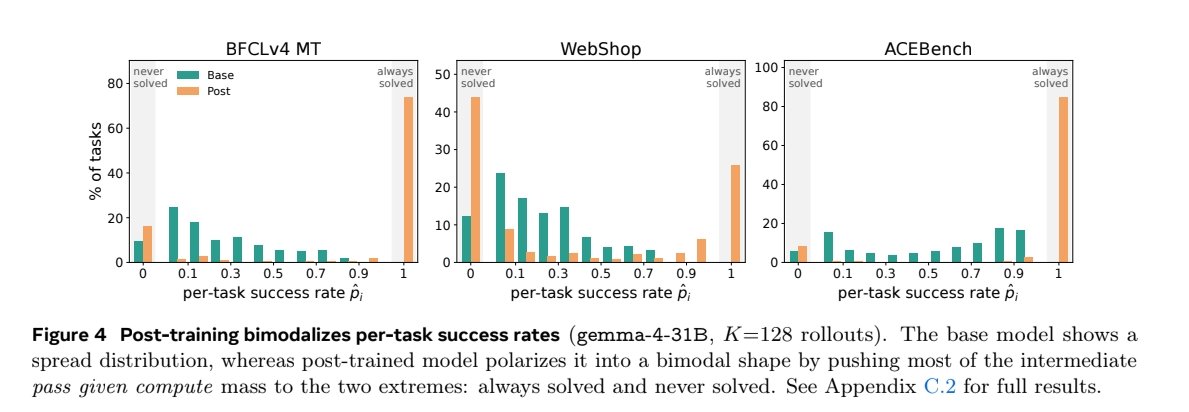
RL post-training may be making LLM agents better at solving a task once, while worse at solving it when given more attempts.
A new paper introduces the “Sharpening Tax”:
Across 14 base/post-trained model pairs and 3 agentic benchmarks, post-training improves pass@1 but often reduces solution coverage under larger test-time budgets.
The striking part: base models with a lightweight harness can catch up to or surpass their post-trained versions as the number of rollouts increases.
Why?
Post-training pushes tasks toward two extremes: “almost always solved” or “almost never solved”, removing the middle where additional sampling can recover failures.
They find a positive Sharpening Tax in 36/42 model-benchmark cases.
They also propose PTGS, which adaptively increases temperature on hard prompts and decreases it on easy ones during RL training.
On Qwen2.5-7B, PTGS improves both single-shot accuracy and pass@128 while reducing the Sharpening Tax for PPO and GRPO.
Really interesting result for anyone working on RL, test-time compute, or agentic reasoning.
Paper: https://t.co/JXxjKxUENR
@arxiv Yet a paper from my team got held for 2.5 months without any reasons, they gotta have a better policy on informing publishers of the status of the papers instead
@askalphaxiv Generalization of LLMs should be explored more numerically across training. Even tho it might end up in a state to generate text in a certain way, the black box is to analyse all phases and explore how to make use of it and which phase is good to train for which agents etc..
Went thru the paper and the math part alone took me 2 hrs. Looking forward to experimenting it soon (Preparing checkpoints with my own data to compare against olmo's).
Would upload the math notes and problems in the next few posts. Haven't been excited about RL than this...
RELEX has been accepted to #NeurIPS2026! 🥳 Enjoy ~100% performance with just 20% of the RLVR training cost!! 🚀🚀🚀
📚 Paper: https://t.co/rGtOpQr8Sw
📝 Blog: https://t.co/UWUJ1CBGjp
💻 Code: https://t.co/gkr4FuaLKX
🤗 Checkpoints: https://t.co/vPAV0j8LvO