🇰🇷 | High tensions in South Korea as protests erupt against Iran war deployment plans.
South Korea is actively preparing to become the first country to join the US militarily in the Strait of Hormuz — and Seoul has seen daily protests ever since officials confirmed it.
Police tried to contain demonstrators as they took to the streets. With slogans such as "Everyone opposed to the Hormuz deployment, unite!" and "Refuse US military pressure!", activists are protesting near the US embassy in the capital.
The demonstrations are organised by Seoul Peace Solidarity and National People's Action, which have urged the government not to bow to US pressure or capitulate to Washington, and vowed to continue the mobilisations. Further protests are planned.
Washington has pressured Seoul for months to deploy forces to West Asia. It has never looked closer to reality.
Seoul has notified Washington it is willing to dispatch naval ships and maritime patrol aircraft, and local media report parliamentary approval is already being prepared.
It would be South Korea's first deployment at US request in 22 years.
The deployment still requires that approval to proceed, but officials confirmed preparations are already under way regardless.
While South Korea frames the package as "defensive," it would actively supply and enable US military operations against Iran, providing logistics, intelligence and direct cooperation with US forces.
South Korea imports essentially all of its crude oil, 70% of it from the Gulf, leaving it heavily dependent on traffic through the Strait.
Iran's foreign ministry spokesman Esmail Baghaei warned Seoul on Monday, in Korean, that any country operating in the Strait would be regarded as directly supporting the aggressor, and that a sovereign state must not yield to US pressure.
Just last month, Washington downgraded its most important annual drills with Seoul, saying South Korea had refused to back its war on Iran.
South Korea is arguably the most subordinated country in the world to the US military. Under OPCON, it is the only country on earth whose military would pass to American command in wartime.
It hosts one of the largest US contingents anywhere, and Washington is its most important diplomatic and military partner.
THE GLOBAL FOOD CRISIS IS STARTING TO GET WORSE.
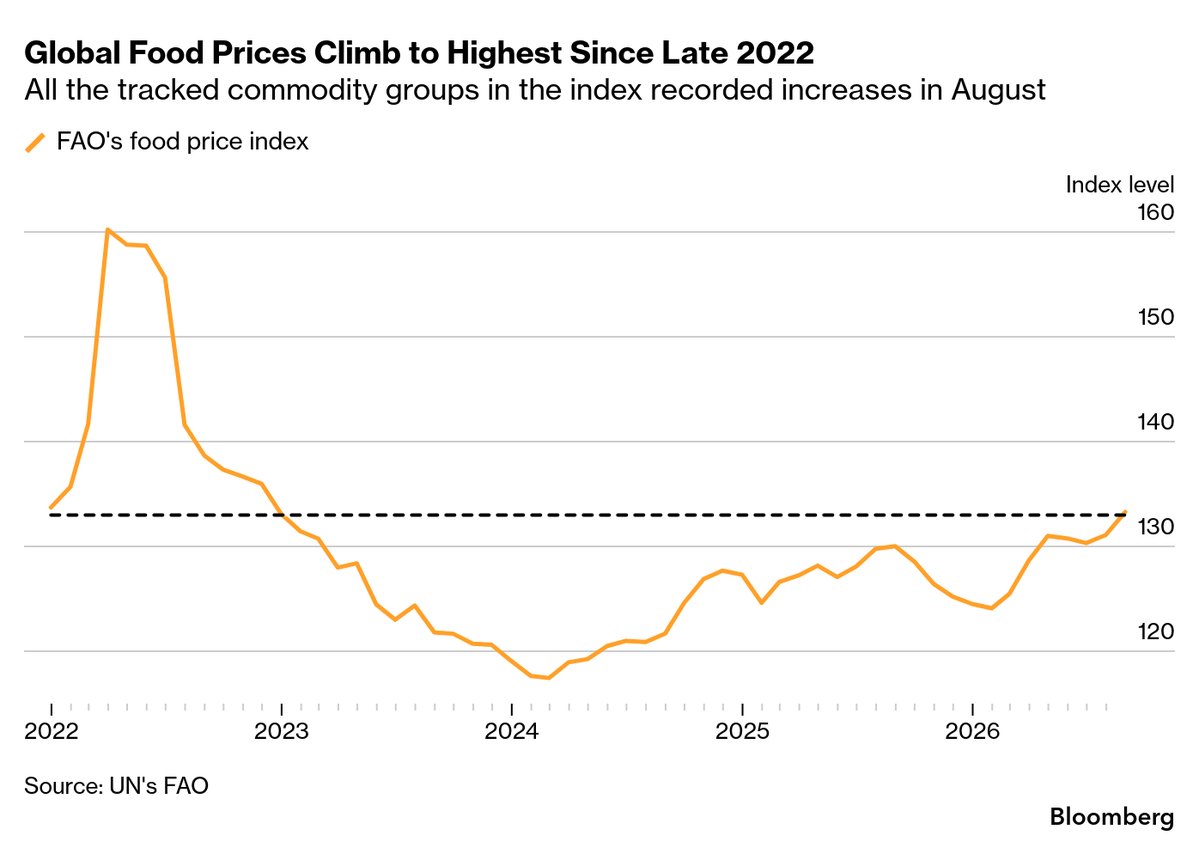
World food prices just hit their highest level since 2022, and several major risks are hitting at the same time.
Extreme heat and drought are hurting crops in Europe.
A severe El Niño is threatening production across Asia.
The Black Sea war is disrupting grain shipments, while the U.S.-Iran conflict is putting pressure on fertilizer supplies.
Sugar prices jumped 11.9% in August alone, while grain prices reached a three-year high.
The FAO has now also cut its 2026 global cereal production forecast and lowered its estimate for global stocks.
Food is already getting more expensive. If supply keeps getting tighter, 2027 could become a much bigger problem.
China’s warning to the United States can be translated as:
You can overthrow Maduro.
You can kidnap him.
You can rewrite Venezuela’s politics.
You cannot rewrite China’s contracts.
China–Venezuela commercial agreements are protected by international law and by the laws of both countries.
Washington is not a party to those contracts.
Regime change does not magically erase Chinese assets, debts, concessions or commercial rights.
And Beijing’s last sentence is the actual warning:
China’s lawful rights and interests in Venezuela must be protected.
In plain English:
Whatever you do to Caracas, keep your fucking hands off China’s property.
🚨 WARNING: SOMETHING EXTREMELY BAD JUST HAPPENED
Japan has dumped $71 BILLION in U.S. Treasuries - its biggest sell-off in decades.
But that's not even the scary part.
Japan is still sitting on a massive ¥15.3 TRILLION in bond losses.
And now, they've hit the panic button.
Here's what's really happening right now:
Japan is constantly selling U.S. Treasuries to support the yen and prevent a much larger market crash.
And at the exact same time, Japan's gold holdings have hit an ALL-TIME HIGH.
That is not a coincidence.
Japan is selling dollar-denominated assets while keeping all their gold.
The reason is simple.
Japan needs to defend the yen.
So they're using their massive foreign reserves to intervene.
And U.S. Treasuries are one of the biggest assets they can sell.
But here's where things get MUCH bigger.
China is doing the same thing.
China has been dumping U.S. Treasuries while its gold reserves continue reaching new ALL-TIME HIGHS.
Now we're watching two of the world's largest economies move in the same direction.
→ Japan is selling U.S. Treasuries
→ Japan is increasing its gold holdings
→ China is selling U.S. Treasuries
→ China is increasing its gold holdings
Both countries are reducing their dependence on dollar assets.
This is no longer an isolated Treasury sale.
It is a much bigger shift in how major economies manage their reserves.
Japan is trying to support the yen.
China is building greater independence from the U.S. dollar.
And GOLD is becoming increasingly important to both strategies.
And this is where things get dangerous.
If Japan has to keep selling Treasuries to defend the yen, the selling pressure will continue.
And China is doing the same thing.
The implications are enormous.
→ More Treasury selling
→ More pressure on bond markets
→ More currency intervention
→ More gold accumulation
→ Less dollar dependence
Japan isn't trying to crash the market.
They're trying to support the yen and prevent a much larger financial crisis.
But the actions they're taking will have consequences across global markets.
And if other countries follow, the pressure on the U.S. dollar and Treasury market will accelerate.
This is exactly how global financial systems begin to change.
Not overnight.
But gradually.
Then suddenly.
And the global reserve system is changing right in front of us.
I've studied markets for over 12 years and called nearly every major top and bottom.
And I'm warning you now.
If you want to survive the 2026-2027 cycle, follow and turn on notifications.
A lot of people will wish they had started paying attention earlier.
THE BIGGEST COUNTRIES in the world yesterday stood up for Iran and for the people of Palestine.
The attack on Iran is illegal, they declared. And Palestinians need justice.
But western mainstream media outlets ran an astonishing news blackout on the meeting of the Shanghai Cooperation Organization, with most outlets giving it zero coverage.
.
ATTACK VIOLATES INTERNATIONAL LAW
Leaders of China, India, Indonesia, Russia, Iran and other countries declared that the US attacks on Iran “violate the UN Charter and the principles and norms of international law, posing a serious risk to world peace, security, and stability”.
The lack of coverage from most western mainstream media outlets is bizarre.
The SCO is more than three times the size of NATO.
The pro-peace Eastern organization covers 42.5 per cent of humanity, compared to NATO’s 13 per cent.
.
MODI SIGNED
While China is seen as the de facto leader of the organization, much of the attention was on India’s Narendra Modi, who has been cozying up to Israel’s Benjamin Netanyahu
And Turkey’s leader Recep Tayyip Erdoğan, who has also been trying to play both sides.
But both turned up and signed the declaration.
.
MOURNING THE DEAD
Leaders at the huge gathering of nations also used the opportunity to condemn the murder of Iranian leader Ali Khamenei and his family by the United States and Israel.
In an unprovoked attack on 28 February this year, they killed 40 people, including the leader’s granddaughter Zahra, aged 14 months. Other victims, the same day, included 120 children at a primary school.
.
NO MILITARY ANGLE
Participants also reminded the world of the difference in character between itself and NATO.
NATO focuses on diverting public cash to weapons and the military.
SCO is non-military, and promotes friendly relations between countries through mutually beneficial trade and shared pro-peace policies.
.
.
Ten countries, including China, Russia, and India just condemned as “illegal” the US-Israeli war on Iran — and affirmed Palestinian sovereignty and Tehran’s right to a nuclear program while they were at it.
Sri Lankan journalist @shiranperuma breaks down the Bishkek Declaration, signed by every country at this week's Shanghai Cooperation Organization (SCO) summit in Kyrgyzstan.
Japan's four largest life insurers were sitting on about 15.13 trillion yen of unrealised losses on domestic bonds at the end of June. Roughly 96 billion dollars, and up 7 percent in three months.
This morning the 30-year yield printed 4.19 percent and the 10-year touched 3 percent for the first time since September 1996.
The level the market is watching is 4.5 percent. That is where strategists expect impairment rules to start forcing insurers to sell their own government's long bonds. Ryutaro Kimura at BNP Paribas named it in June. The 30-year is 31 basis points below it.
That level is not a law of markets. It is an accounting rule.
And in February the Japanese Institute of Certified Public Accountants proposed easing it, so that bonds held for asset liability matching are treated differently. If that goes through, the tripwire moves or disappears, and it will have been moved by accountants rather than by the bond market.
The sector is not behaving like a single seller either. Nippon Life sold around 4 trillion yen of bonds last financial year and took roughly a trillion in losses doing it. Meiji Yasuda called 4 percent a perfect buying opportunity and doubled its planned purchases to more than 2 trillion yen. Insurers net sold super long bonds in May after net buying them in April.
Underneath all of it, the driver is fiscal. Prime Minister Takaichi has a 370 trillion yen public and private investment plan running to 2040, with a semiconductor and AI sleeve of about 101.6 trillion. The yen is near 160. Oil is around 91 after another exchange with Iran. The Bank of Japan sits at 1 percent, a 31 year high, and most economists polled expect a hike on 18 September.
The part that is unambiguous is the regime. For three decades Japan lent the world duration almost free. Domestic yields were zero, so Japanese institutions bought American, French and German long bonds and became the marginal buyer at the long end of every major market. At 4.19 percent that logic breaks at home.
It has not fully reversed. Japanese investors still bought 13.59 trillion yen of foreign bonds during 2025. This is a turn, not a completed flow.
But the long end is repricing everywhere at once. The American 30-year auction cleared at 5.216 percent last month, the highest since 2001. France's 30-year is near 4.98, the highest since September 2008. Germany's is 3.83.
Which is the awkward backdrop for what both Tokyo and Washington are trying to fund. Takaichi is terming out semiconductors and AI at the highest long rates in Japanese history. In America, a consortium is arranging to mobilise more than 500 billion dollars against AI compute, and Morgan Stanley expects roughly 570 billion of AI related debt issuance this year.
Two industrial states are reaching for long money in the month long money became the most expensive it has been in a generation.
Next 30-year auction is Thursday. The Bank of Japan meets on the 17th and 18th.
Watch 4.5 percent. Watch the accountants more!!
#URGENT The protests in the United States have intensified. Today, hundreds of thousands of Americans took to the streets to demand an end to funding for Israel, a development that has clearly left Trump sleepless, as evidenced in this recording. Help us spread it, so they don't remove it from X.
#TrumpsteinPedoCoverUp
Great news! This 🇨🇳Chinese movie, Once Upon a Time in the Middle East, a movie about the U.S and UK invasion of Iraq in 2003, will be shown in many places!
It's among my Top 2 favorite movies this year! 😭 And I like how it's challenging Hollywood's narrative of wars in West Asia.
Sept. 11, 🇭🇰Hong Kong SAR, 🇲🇴Macau SAR.
Sept. 11, 🇦🇺Australia, 🇳🇿New Zealand and 🇲🇾Malaysia.
Sept. 17, 🇸🇬Singapore
Sept. 18, 🇯🇵Japan.
October, 🇰🇭Cambodia, 🇮🇩Indonesia, 🇹🇭Thailand, 🇱🇦Laos and 🇵🇭the Philippines
🚨The BoJ banker who apologized for the measures prepared and got the US Treasuries to directly intervene… just watched the biggest banks in the country confirm his call in real time
BoJ’s Yuto apologized for the measures being prepared. The BoJ and finance minister threatened of bold actions to save the yen.
Then Boom, the US Treasury intervened and effectively took control of BoJ operations to stop Japan dumping its $1.4T in Treasuries, which would collapse the entire US debt market and trigger a global liquidity crisis.
Months ago, @yutokanzakireal dropped “Japan is about to put its government bonds ON-CHAIN.” This came at a time when Japan still seemed not so crypto-friendly and their version of Clarity Act had not even been introduced.
Now, Japan’s FSA, Ministry of Finance and three mega banks just officially confirmed it.
Japan set to launch its tokenized bond and stock market on-chain. Japan is literally putting the JGB’s on-chain‼️
Now the real play is clear: Japan is using crypto, yen stablecoins, and on-chain rails as its EXIT RAMP from the dollar chamber.
They’re using digital assets to prevent a catastrophic carry trade unwind.
While the West clings to the old system, Tokyo is building the new financial order right under our noses.
The same banker admitted that the coming shift will hit billions and there’s no going back.
Most people still have no idea.
JAPAN COULD SOON SPEND ALMOST ¥1 OUT OF EVERY ¥3 JUST ON ITS DEBT.
Japan’s total budget requests are expected to cross ¥130 trillion for the first time.
But around ¥36.6 trillion of that could go toward debt servicing alone.
That’s a 17% jump in one year, the biggest increase in two decades.
And with the 10-year JGB yield recently touching a 30-year high of 2.945%, keeping that debt funded is getting much more expensive.
Think about what that means.
The government may spend nearly 28% of its budget on debt before anything else.
Japan’s debt isn’t just getting bigger anymore. It’s starting to eat the government budget.
JAPAN IS NOW ASKING ITS OWN PEOPLE TO HELP BUY ITS MASSIVE DEBT.
The BOJ is cutting back its massive government bond purchases, leaving Japan with a simple problem.
Someone else has to buy that debt.
Now the government is considering tax benefits to convince Japanese households to buy more JGBs, including possible inheritance tax relief and access through tax-free NISA accounts.
This comes as Japanese yields continue to rise, with 10-year retail JGBs now offering around 1.87%, compared with roughly 1.25% on major bank deposits.
Japan needs bond buyers so badly that it’s now considering tax breaks to convince ordinary people to put their savings into government debt, which is showing every sign of a crisis.
🚨 THE U.S. TREASURY HAS ANNOUNCED TO START AN EMERGENCY $1 TRILLION BOND BUYBACK OPERATION
The U.S. Treasury Is Quietly Admitting The Bond Market Is Breaking. The Government’s $950 Billion Treasury General Account Emergency Fund Is About to Be Used as a Bond Market Bailout.
The U.S. government borrows money by selling bonds. When people get nervous about all the debt, they demand higher interest rates (called “yields”) to keep lending.
Right now the 30-year yield (the interest rate on the longest bonds) has shot up to levels we haven’t seen in almost 20 years. That means borrowing is getting extremely expensive for the government, businesses, and even your mortgage and credit cards.
This is the ongoing bond market crisis.
Last week the Treasury got so worried that they suddenly announced they would DOUBLE the amount of old long-term bonds they buy back every time (from $2 billion to at least $4 billion).
Buying their own bonds is a way to try to push those high yields back down and calm the market. They even called it a “Treasury Twist.”
NOW they’re going even further: reports say they might use almost $1 TRILLION sitting in the government’s cash account (the Treasury General Account) to fund EVEN BIGGER buybacks.
That’s like emptying the emergency savings account just to keep the bond market from blowing up.
When the government has to raid its own cash pile and frantically buy its own debt just to stop yields from exploding… that’s not normal.
If this doesn’t work and yields keep rising, the cost of America’s massive debt could spiral out of control. Higher rates everywhere. Bigger deficits. More panic.
This is how bond markets start sending warning signals that something is seriously wrong.
Yuto also revealed that Bank Of Japan discussed a worst-case scenario where dollar loses its reserve status due to loss of creditor’s trust.
Japan dumping their U.S. Treasuries holdings would trigger that catastrophe.