Early infection of 🍓strawberry anthracnose fruit rot #AFR (Colletotrichum acutatum) on highly resistant #Florida127 and moderately susceptible #FloridaBeauty cultivars, a combination of initial inoculum and favorable weather conditions! #perfectstorm
Thanks to @daanmoca for some #nematode insight! Follow this guy if you haven’t already. His work is focused on #fumigation practices and potential effects on beneficial nematodes like bacterial and fungal feeders that play an important role is #nutrientcycling and #soilhealth.
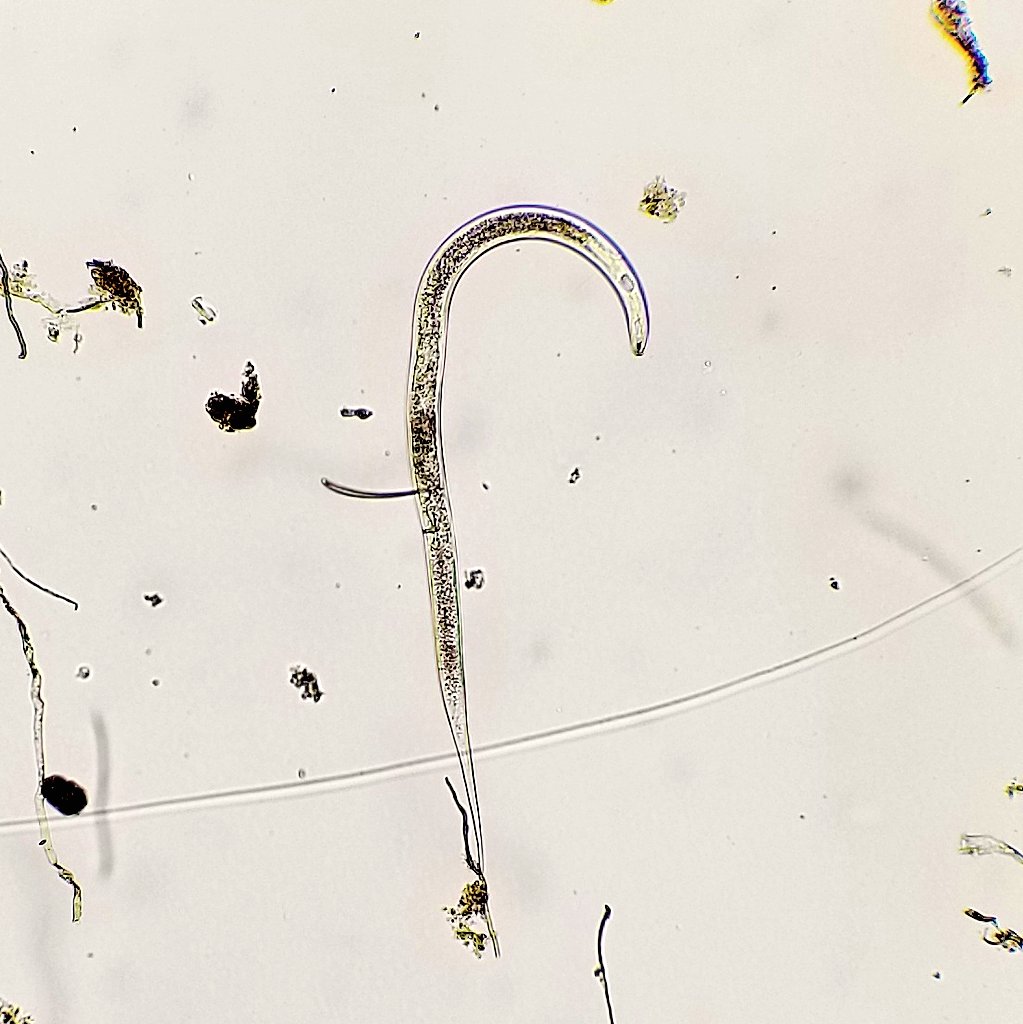
"All plant-parasitic nematodes posses a stylet but not all nematodes that have a stylet are plant parasites."
*non-parasitic fungal feeding Tylenchus sp. nematode (left) and a plant-parasitic Root-knot nematode (right).
#UFBugs#UFNematodes
@AliceLfc4@UFPlants@UFGulfCoastREC @UFPPGSO @plantdisease Could have been a possibility, but from what I found there were Alternaria conidia with some nice beaks on the left, and conidia of Corynespora covering the fruit on the right.
So happy to see this #robot up and running at @UFGulfCoastREC. No pesticides, no labor, clean #strawberries. Congrats to @rodrigobonofre and his collaborators for thinking outside of the box in #science to create a technology just as useful as it is epic!
@periquita009@UFGulfCoastREC @UFPPGSO @plantdisease If you look closely, both have concentric rings, however early blight is notorious for getting in at the calyx and having black lesions. Target spot is usually lighter in color and lesions crack in an X or star pattern. Thanks for answering!
@daanmoca@UFGulfCoastREC @UFPPGSO @plantdisease Early blight lesions are usually black and get in at the calyx (sometimes rings are a present) vs target spot which directly penetrates, it’s typically lighter in color, and causes a characteristic “X” or star shaped cracking pattern (concentric rings present, but not always)
@PathologyPlant@UFGulfCoastREC @UFPPGSO @plantdisease Very true. Also, in this case, early blight (left) typically infects at the calyx, vs target spot (right) which directly infects the fruit cuticle and also causes a characteristic “X” or star shaped cracking pattern, which you can see here.
@PathologyPlant Because cultures were grown in the dark, it leads me to believe that time is the culprit. Take a look at what happened when I took multiple subcultures of the mutated phenotype. Some sustained the mutation, while others reverted:
Some #Corynespora#cassiicola plates that were all plated at the same time from the same stock... Any ideas what could cause a #mutation that confers a morphological change?... Age of isolation? Media type? Scalpel still too hot? #plantpathology#mycology#fungus
My heart goes out to #Romaine farmers. Consumers don't realize that behind each bag of lettuce is a family farm having to dump their crop and therefore their income. #FoodSafety#RomaineLettuceOutbreak
Took a stroll through the #2blades fields today. While #tomatoes have had #bs2 for nearly a decade (on the left), consumers continue to live in fear of #GMOs, which gives us no choice but to spray copper and other heavy metals to mitigate damage by #bacterialspot (on the right).
@PathologyPlant I plan to analyze differences in sporulation and pathogenicity, however, this genetic change may be unrelated... we will see! Thanks for your comments!
@PathologyPlant We thought this may be the issue, but plates were fresh upon transfer and grown in the dark at room temperature. However, we are also unsure of the optimal temperature for these specific strains...
@PathologyPlant Original cultures were taken from -20C storage on filter paper, grown for 2 weeks, and transferred to the plates you see here. These culture plates are 1 week old.