I've been a backend Engineer for 12+ years. Today, I'm a Principal Engineer at Atlassian.
I've designed systems that handle millions of requests. Sat on both sides of system design interviews.
Reviewed more architecture docs than I can count.
Starting today, I'm breaking down the fundamentals of scaling for the next 25 days.
If you're learning system design bookmark this thread, you're going to get a lot of learning from this.
If you're serious about becoming a Senior Backend Engineer in 2026, master this progression:
Level 1: Postman / Bruno
Test APIs properly before your users become your QA team. Contracts matter from day one.
Level 2: Redis
Speed is easy. Cache invalidation is the real challenge. Learn to weigh trade-offs over cleverness.
Level 3: PostgreSQL
Data modeling, indexing, transactions the foundation of real backend thinking. Schema design is system design.
Level 4: Kafka
Async systems are powerful, but retries, ordering, and idempotency separate juniors from seniors. Failure is a feature you design for.
Level 5: Docker
"Works on my machine" should have ended in your junior years. Consistency beats convenience every time.
Level 6: OpenTelemetry
Trace requests across services and distributed systems finally make sense end-to-end. Observability isn't optional it's essential.
Level 7: Grafana
Dashboards that show latency, errors, and throughput not just pretty graphs. If you can't measure it, you can't improve it.
Level 8: Prometheus
Metrics that force you to think in SLOs and system health, not just features. Reliability outpaces feature velocity in the long run.
Level 9: k6
Load test your "scalable" backend. Watch it break. Then fix it. Scale is a verb, not an adjective.
Level 10: Terraform
Senior engineers don't just write code. They own the infrastructure it runs on. Infrastructure is code. Ownership is culture.
The pattern:
• Foundation: Postman/Bruno, PostgreSQL, Redis
• Resilience: Kafka, Docker, k6
• Observability: OpenTelemetry, Grafana, Prometheus
• Ownership: Terraform
Master one layer before rushing the next.
(save it)
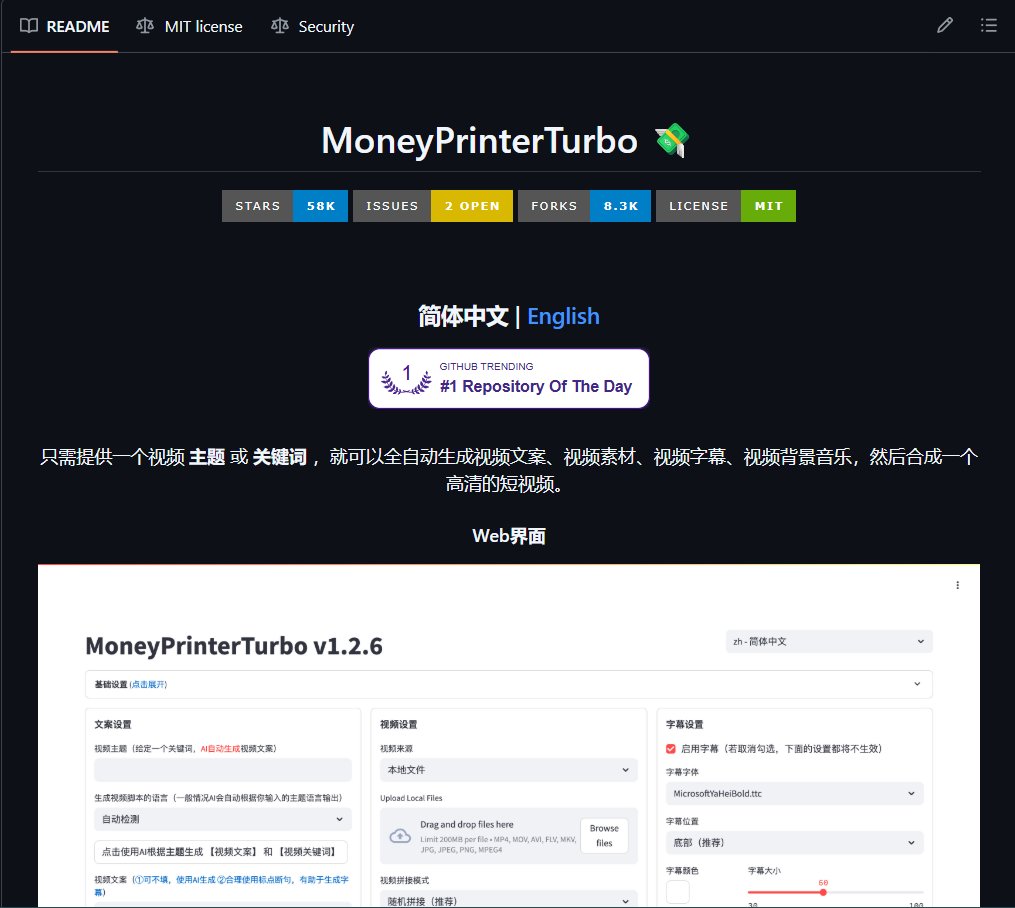
A Chinese developer built a free money printer. Literally named it MoneyPrinterTurbo. 13,000+ stars on GitHub.
You type a topic or keyword. It generates the script, finds HD copyright-free footage, adds subtitles, background music, and voiceover - then outputs a finished short video.
This is the exact pipeline TikTok Shop and YouTube faceless channel creators use to scale to $6,000-10,000/month. The difference: they paid for tools. This is free.
> What's inside:
Script generation via Claude, DeepSeek, Gemini, GPT, or any LLM you already have access to.
Batch video generation - create multiple versions at once, pick the best one. 9:16 vertical for TikTok and Reels, 16:9 horizontal for YouTube.
Voice synthesis with real-time preview.
Custom subtitles - font, size, color, position, outline. Background music from built-in library or your own files.
> Runs locally on your machine. Web UI and API both included. Docker supported. Google Colab supported if you don't want to install anything.
No subscriptions. No watermarks. No usage limits.
The repo is actively maintained - last commit was 44 minutes ago.
https://t.co/W4mlxu2jml
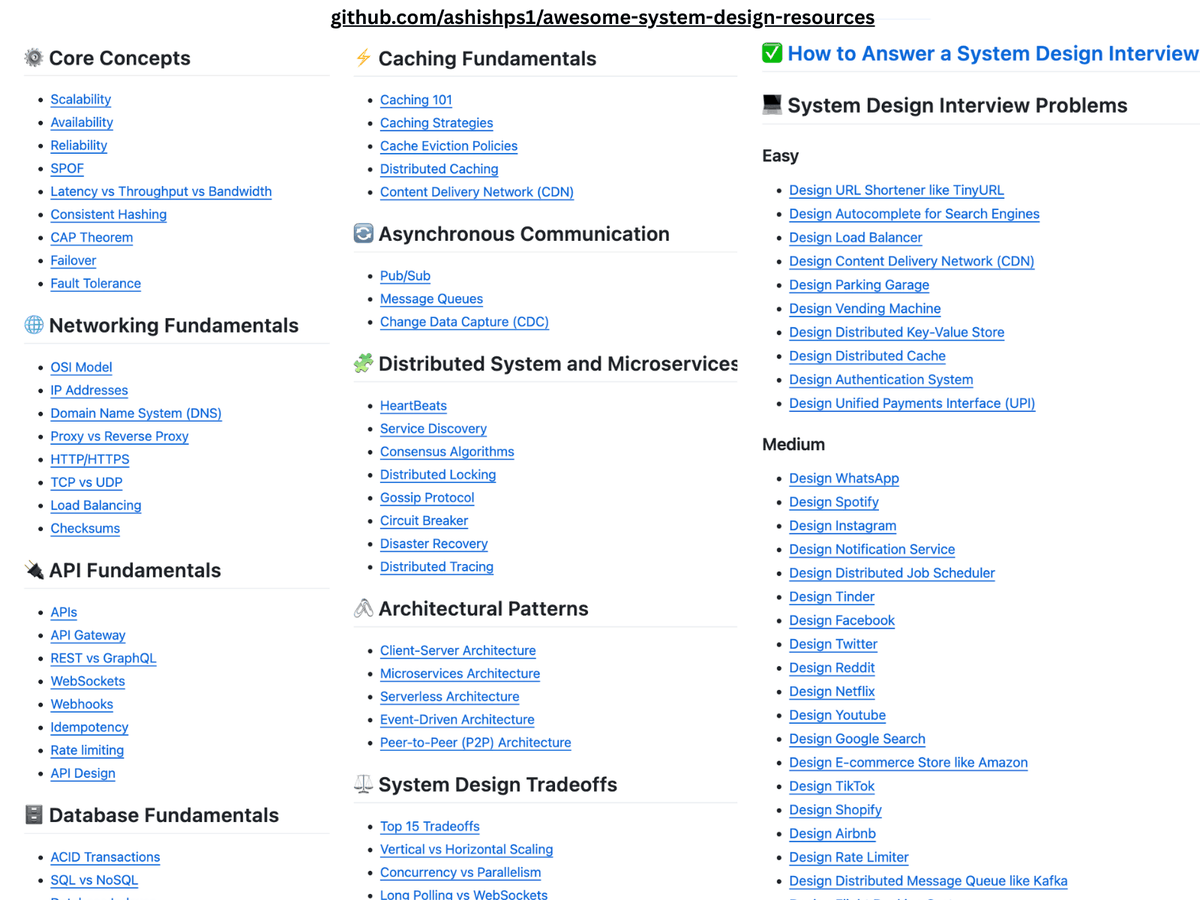
I created a Github repository to learn System Design, and I'm excited to share that it crossed 35k stars recently.
The repository contains a collection of resources to study:
- System Design Core Concepts
- Networking and API Fundamentals
- Database and Caching Fundamentals
- Distributed Systems, Microservies and Architectural Patterns
- System Design Tradeoffs
- 40+ interview problems categorized by difficulty level
Check it out here: https://t.co/pkVpi6LxSV
If you find the repo valuable, consider giving it a ⭐️ and share with others.
Thanks to everyone who has starred or forked the repository!
No course will get you a cybersecurity job. Labs will. Here are the 10 you need to practice right now.
1. TryHackMe SOC Level 1 Path: the single best starting point for anyone who wants to work in a SOC. Covers log analysis, SIEM tools, threat detection, and incident response in a fully guided, beginner-friendly format. https://t.co/jqYUL166VU
2. HackTheBox Starting Point: step-by-step guided machines that take you from zero to your first real exploitation. Once you finish Starting Point, move to the easy machines and build from there. https://t.co/xpC1bDl0TO
3. PortSwigger Web Security Academy: the best free resource for learning web application security. Every OWASP Top 10 vulnerability covered with real labs you actually hack, not just read about. Free. https://t.co/25VIlgwBL0
4. Blue Team Labs Online: defensive security labs focused on forensics, threat hunting, SIEM analysis, and incident response. Built specifically for people who want to work on the blue team side. https://t.co/FAhx2Tz78f
5. OWASP WebGoat: a deliberately insecure web application you run locally and attack. One of the best ways to understand how web vulnerabilities actually work from the inside. https://t.co/QaYoLz19dJ
6. VulnHub: free downloadable vulnerable virtual machines you spin up in VirtualBox and practice on locally. No internet required, no subscription, just download and hack. https://t.co/P4YkpsowR2
7. PicoCTF: a free beginner CTF platform built by Carnegie Mellon University. Covers web exploitation, forensics, cryptography, reverse engineering, and binary exploitation through hundreds of challenges. https://t.co/s1wJUOeiWJ
8. OverTheWire Bandit: a wargame that teaches Linux fundamentals, SSH, file permissions, and basic exploitation through progressive challenges. If your Linux skills are weak, start here before anything else. https://t.co/YhlcsO0wNm
9. Immersive Labs: used by enterprise security teams globally for hands-on skills development. Has a free tier with labs covering SOC, malware analysis, cloud security, and threat intelligence. https://t.co/4LAjDmwebr
10.Cyberdefenders: blue team focused labs built around real-world attack scenarios with PCAP files, malware samples, and memory forensics. The closest thing to working a real incident without being on the clock. https://t.co/9PMRoFRF8D
The gap between people who get hired and people who keep applying is not certificates. It is lab hours. Put in the reps.
Save this and share it with someone trying to break into cybersecurity.
Repost for others to see.
Two Bulgarian friends killed the entire streaming industry.
It's called Stremio + Torrentio. You get 4K content from Netflix, Disney+, Hulu, and HBO Max combined for free.
Here's how it works.
Stremio is the player. Clean interface. Works on Windows, macOS, Linux, Android, iOS, and TV. You install it once and it looks like any other streaming app.
Torrentio is the addon. You add it to Stremio in one click. It scrapes content from every major torrent provider on the internet simultaneously and delivers the best available stream directly to your player. 720p, 1080p, 4K. You pick the quality. It finds the link.
→ No account required
→ No subscription
→ Works on every device
→ 4K and HDR supported
→ Subtitles built in
Netflix cannot shut this down. There is no central server to seize. No company to pressure. No domain to kill. It runs on your device and pulls from the open internet.
The entire streaming industry is built on one assumption. That you will keep paying $70/month rather than spend 5 minutes on GitHub.
That assumption just died in Sofia, Bulgaria.
MIT License. 100% Opensource.
https://t.co/yEljDh5DQy
Get the addon here: https://t.co/XhpPDERP2i
I’ve spent the past couple of weeks building Looters: a public archive of Nigerian political corruption since the 1990s.
Governors, ministers, shell companies, Swiss accounts, the Jersey trusts, — one searchable graph.
You too can connect the dots: https://t.co/faIfzWfAIp
Here are 10 GitHub repos that quietly print money while you sleep.
1. Cal. com
Open-source Calendly. Fork it, white-label it, sell to dentists and lawyers for $200/month. The founders hit $5M ARR in 3 years doing exactly this.
Repo → https://t.co/haz8ihRsHm
2. Plausible Analytics
Privacy-first Google Analytics. Self-host it, resell to agencies for $50/month per client. Two founders bootstrapped this to 7 figures.
Repo → https://t.co/RFrcpqTBQ7
3. Ghost
Open-source Substack with 100% margin. 1,000 readers at $5/month equals $60,000 a year. Forever.
Repo → https://t.co/Z1MdZ5Zapg
4. n8n
Open-source Zapier. Sell automation services for $500-$2,000 per setup. n8n raised $14M because the agency model behind it works.
Repo → https://t.co/hdycABGGc1
5. Supabase
Free Firebase replacement. Build a SaaS in a weekend, charge $29-$99/month. They raised $116M for a reason.
Repo → https://t.co/dFB2QvafA7
6. Medusa
Open-source Shopify. Take 5% on every sale forever. Zero rev share to Shopify.
Repo → https://t.co/uEuCK6zuZO
7. AppFlowy
Open-source Notion. Sell self-hosted to enterprises worried about data privacy. They raised $30M because this market is massive.
Repo → https://t.co/IDMykTCkMU
8. Coolify
Open-source Vercel and Heroku. Charge developers $20/month to manage their deployments. Replace their $200 Vercel bill.
Repo → https://t.co/N5Fk22qraT
9. Listmonk
Open-source Mailchimp. Send unlimited emails for the cost of an AWS bill. Resell to agencies at 10x markup.
Repo → https://t.co/NS6Uukcklw
10. Penpot
Open-source Figma. Sell self-hosted design tools to agencies who refuse to upload client files to the cloud.
Repo → https://t.co/Lx1CYUP4p4
The difference between developers who build features and developers who build businesses is one decision.
Pick one of these. Fork it this weekend. Ship it next week.
The founders behind these repos already proved the model.
Save this. Share it with the developer in your life who deserves to break free.
100% free. 100% open source.
🚨ANNOUNCEMENT
🏆Introducing the Nimiq Mini Apps Competition!
💰$50,000 USDT in prizes.
• 3 Rounds.
• Free to participate.
• Open worldwide.
👀Full competition details drop June 3rd.
Pre-registration is now OPEN!👇
https://t.co/sumIh0GmSq
Low-key websites I quietly rely on
1) https://t.co/DOL411EVne
Gives you a brutally clear learning path for roles like frontend, backend, DevOps, etc
No fluff, just “learn this → then this → then this”.
2) https://t.co/Zoh2Jtfiqq
An online playground to quickly test HTML, CSS, JS without setting up anything locally
Perfect for quick experiments and debugging ideas
3) https://t.co/cufUB80WLF
A collection of reusable React hooks with real use cases
Saves time and helps you avoid rewriting the same logic again and again
4) https://t.co/6lXfAIq2Zj
Concise cheat sheets for languages, frameworks, and tools. Ideal when you forget syntax and don’t want to read a 20-minute blog
5) https://t.co/CRXx9MVHgP
Turns messy JSON into a clean visual tree
Makes understanding large APIs and configs way easier than staring at raw text
6) https://t.co/ue9PTccXQJ
Lets you generate and preview color palettes instantly
Useful when you want decent UI colors without guessing or copying blindly
7) https://t.co/j5NE9ZShW6
Build, test, and debug regex step by step with explanations Honestly, the fastest way to stop hating regex
8) https://t.co/gdZxoGApT6
Shows how big an npm package really is before you install it
Helps you avoid bloating your app with “tiny” libraries
9) https://t.co/9KaWeMqJox
Tells you which CSS/JS features actually work across browsers Essential before using shiny new features in production
10) https://t.co/QZnckJ1VXA
Google’s own diagnostics tools for DNS, email, headers, and network issues
Surprisingly useful for debugging real-world problems
👉 Which one of these do you already use and which one did you not know existed?
Introducing the Build on @CantonNetwork Hackathon!
4 weeks. $7,000 in prizes. Institutional-grade blockchain infrastructure.
Build financial applications that actually matter - private DeFi, tokenised assets, B2B marketplaces, payments, and more on Canton Network.
Kicks off 15 June | Online
Apply now ↓
Websites that make you feel like a hacker 👨🏽💻👀
1. Shodan
Searches internet-connected devices around the world. You can find cameras, servers, routers, and more.
2. Have I Been Pwned
Checks if your email appeared in data breaches. Shows where your information was leaked.
3. IntelX
Search engine for leaked and public data. Lets you search emails, domains, and documents.
4. BrowserLeaks
Shows how much information your browser exposes. Makes you realize how trackable you are online.
5. Hunter .io
Finds professional email addresses linked to domains. Commonly used for outreach and research.
6. BuiltWith
Shows what technologies a website uses. You can see frameworks, analytics, and hosting tools.
7. WHOIS Lookup
Shows information about website domains. You can see registration and hosting details.
8. Wayback Machine
Lets you see old versions of websites. Useful for finding deleted pages or changes.
9. VirusTotal
Scans files and links for malware. Uses multiple security engines at once.
10. Nmap Online
Scans open ports on websites and servers. Shows what services are publicly accessible.
11. URLVoid
Checks if a website is suspicious or blacklisted. Useful before opening unknown links.
12. Hackertyper
Makes it look like you’re coding extremely fast. Just press random keys and it types for you.
13. Wappalyzer
Identifies the tech stack behind websites. Works on websites you visit.
14. Diffchecker
Compares two pieces of text or code. Highlights exactly what changed.
15. QuickRef .ME
Cheat sheets for programming languages and tools. Good for quick reference while coding
Happy new month 🎯
Spent April deep in my ZK project at @Web3Bridge with my teammate @ali_anuoluwapo
Tutor: @WiseMrMusa
Topic: Shielded Transactions
Covered the state of the art, chain-level requirements, mixers and privacy pools, EVM compatibility, and a deep dive on Aztec Network.
To the ZK gurus: please review and tell me what I missed. No one is perfect.
Link 👇
https://t.co/HvqrKDmlE6
#ZK #ZeroKnowledgeProof #BuildingInPublic
@EliBenSasson@Starknet@StarknetAfrica@Stellar_WA@Celo
APIs every Nigerian fintech developer should know exists:
- NIBSS instant payment API (real-time interbank transfers)
- Paystack Transfer API (bulk disbursements)
- Flutterwave BVN verification
- Mono for bank account data and statements
- Okra for transaction history and identity
- Smile Identity for KYC and document verification
- Remita for government payment collections
- VFD for virtual account issuance
Most devs building fintech products in Nigeria are reinventing wheels that already exist.
Save this.