#AI is still far too unreliable for it to be outsourced as an arbiter of truth - ' AI Images Detectors Discredit Real Horrors of War'
https://t.co/fDy3knikQY
In a polarised political environment, what does gen AI mean for the future of online communications?
Exellcent report out of @RANDCorporation looking at social media manipulation and next-gen astroturfing.
https://t.co/GqCWvYypoX
#disinformation#socialmedia#communications
After a devastating Russian missile attack killed at least 50 people in Ukraine, European leaders showered President Zelenskyy with assurances EU countries would continue to support Kyiv despite US aid being held up.
Brussels Playbook has the details.
https://t.co/nZCI7ncKkk
Uruguay unlucky to be 26-0 at halftime. Their own worst enemies with the handling errors. NZ a bit all over the place but some brilliant individual touches. #NZLvURU
It’s like an experiment in anti-design.
Everything you’re taught not to do with product, brand, and experience, is being done.
#design#brand#experience
Another crappy change from Musk
I now need to waste words explaining what the article I'm sharing is about (in this case the missing headline is "Twitter strips headlines from news story links to improve their look")
And it's not even obvious it's a link https://t.co/KCE8jToeUp
Important distinction made in this thread between 'immersion' and 'presence' in #VR. It's a hard one for VR to overcome, particularly with a headset strapped to your face.
#digital#design#AR
I created the Google Cardboard almost ten years ago but quit VR soon after to focus on Machine Learning.
VR is based on a ridiculous misunderstanding.
Let me explain why in this thread.
Artificial General Intelligence (AGI) - How and When Will We Have Achieved It?
There is a lot of buzz about AGI lately, with a lot of people believing that there will be some sort of 'singularity' when we invent AGI and the world will forever be changed in a dramatic way after that.
At this point, I think it's safe to say, that we are UNLIKELY to experience this singularity anytime soon. Instead we are going to see AI models just get more performant, more general and more capable and it's not clear that we can call these future very capable generations of LLMs "AGI"
Let's break this down some more
AGI, or Artificial General Intelligence, is the hypothetical intelligence of a machine that could understand, learn, and apply its knowledge in a way that's comparable to a human across a broad range of tasks and topics.
AGI, like the human brain, should be able to transfer knowledge from one domain to another effortlessly, and solve problems it wasn't specifically trained for.
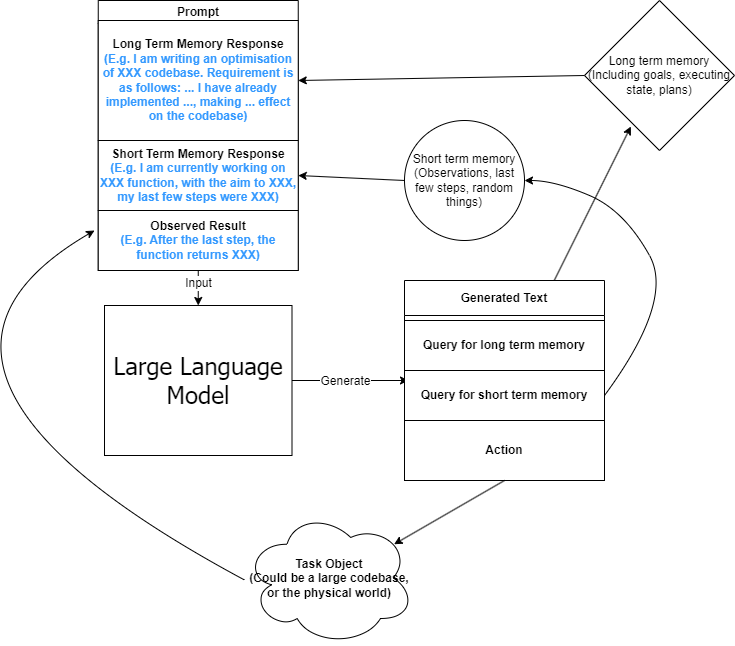
Large Language Models (LLMs) like GPT-3.5 and 4 given their ability to generate human-like text across a variety of topics may seem a little like AGI.
LLMs excel in pattern recognition and mimicking responses based on the data they were trained on.
LLMs have also exhibited reasoning capabilities. They can simulate reasoning well enough to fool us in a text conversation, but under the hood, they're just shuffling symbols based on statistical correlations. They actually have no understanding of concepts like humans do.
In fact, it's very easy to trick GPT-4 into coming up wrong answers. Just like you can prompt engineer and nudge it to give it the right answer, you can also nudge it the other way.
All said and done, even GPT-4 is pretty brittle and fundamental cognition and reasoning is very far away from what GPT-4 is capable of today. This doesn't mean GPT-4 isn't very useful or doesn't have super human knowledge or can't do a number of tasks much better than humans
However, true AGI will require a monumental leap needing breakthroughs in how machines understand and interact with the world. This necessitates a machine's capability to not only process text but to comprehend, learn, and innovate across disparate realms of knowledge and physical tasks.
Future iterations of LLMs will exhibit better reasoning within the textual domain, yet there is a huge gap remains between such advancements and the multifaceted cognitive prowess that humans possess.
The transition to AGI mandates breakthroughs that transcend the augmentation of existing LLM architectures, ushering in a paradigm where machines can autonomously interpret, learn, and adapt across an expansive spectrum of tasks and disciplines.
It is safe to say that we are nowhere near this singularity. Instead of focussing on such a moment and worrying about non-existent existential threats, it's much better to work on improving core LLM capabilities and make the more performant, more general and more multi-purpose.