Obama, happy birthday and here is my message to you on this day:
You did one hell of a job damaging this country for generations.
You had a once-in-a-lifetime opportunity to bring Americans together, but instead, you made racial division your legacy. You poured gasoline on every racial controversy, turned tragedy into politics, demonized law enforcement, and helped convince millions of people that America itself was the enemy.
You did not heal racial tension. You inflamed it.
You did not unite Black and White Americans. You drove a deeper wedge between them and left the country more bitter, suspicious, and divided than you found it.
And while you were weakening America from within, you were empowering our enemies abroad. You gave Iran access to billions through sanctions relief and unfrozen assets, strengthened a regime that funds terrorism and chants “Death to America,” and then expected Americans to call it diplomacy.
You weakened this country, emboldened our enemies, poisoned race relations, and helped create a generation that hates the very nation that gave you the opportunity to become president.
The media can rewrite your legacy all they want, but the American people lived through it.
Happy birthday, Obama.
You promised hope and change, but you delivered division, resentment, weakness, and damage that America may spend generations trying to repair.
The Mohawk people call themselves Kanien’kehá:ka, which means “People of the Flint.” That name comes from the rich deposits of flint (or chert) in their original homeland along the Mohawk River Valley in what is now upstate New York.
Outsiders ended up calling them Mohawk after Dutch traders misheard a Mohican word that roughly meant “bear people.” Interestingly, the famous “mohawk” hairstyle you see today isn’t actually traditional for them—they traditionally left a square patch of hair on the back of the head rather than the dramatic crest most people picture.
They’re the easternmost nation of the Haudenosaunee, the People of the Longhouse, better known as the Iroquois Confederacy. In the Confederacy they were known as the Keepers of the Eastern Door, responsible for guarding the alliance against threats from the east. According to oral tradition, the Confederacy itself was founded by the Great Peacemaker (Dekanawida) and his spokesman Hiawatha.
The Peacemaker traveled among the warring nations preaching peace, and after convincing the Mohawk, the message spread until the five original nations buried their weapons under the Great Tree of Peace. Historians place the formation of that alliance somewhere between the 12th and 15th centuries—long before Europeans arrived.
Culturally they were (and in many ways still are) a matrilineal society organized into three main clans: Turtle, Wolf, and Bear. Children belong to their mother’s clan, and clan mothers hold real political influence, including the power to nominate and remove chiefs.
They lived in longhouses—communal bark-covered dwellings that could house multiple related families—and farmed the Three Sisters (corn, beans, and squash) while also hunting and fishing. Lacrosse has deep roots here; versions of the game were played for centuries as both sport and ceremony. One of the better-known modern legacies is the remarkable number of Mohawk men who became high-steel ironworkers. Starting in the late 19th and early 20th centuries, crews from Kahnawà:ke and other communities worked on some of the most famous structures in North America, including the Empire State Building and the George Washington Bridge. That reputation for fearlessness at extreme heights continues in some families today.
Traditional spirituality centers on the Longhouse religion, which emphasizes thanksgiving, the balance of natural forces, and the teachings of Handsome Lake (a Seneca prophet whose message spread widely among the Haudenosaunee in the early 1800s). Many Mohawk also practice various forms of Christianity, especially Catholicism, which took root in communities like Kahnawà:ke centuries ago. The two traditions often coexist in the same families and communities.
The language, Kanien’kéha, is a Northern Iroquoian language and one of the more complex polysynthetic languages in North America—words can pack an entire sentence’s worth of meaning into a single long form. It’s critically endangered, with only a few hundred fully fluent first-language speakers left, most of them elders. The good news is that immersion schools, adult classes, and community programs in places like Akwesasne, Kahnawà:ke, and Tyendinaga are producing new speakers, and some young parents are now raising children in the language again.
Today the Mohawk number somewhere around 45,000 to 50,000 people, with the largest communities in Canada—Kahnawà:ke and Kanesatake in Quebec, Akwesasne (which straddles the U.S.–Canada border), the Six Nations of the Grand River and Tyendinaga in Ontario—plus the Saint Regis Mohawk Tribe in New York. They remain politically active, culturally resilient, and deeply tied to both their traditional territories and the modern world.
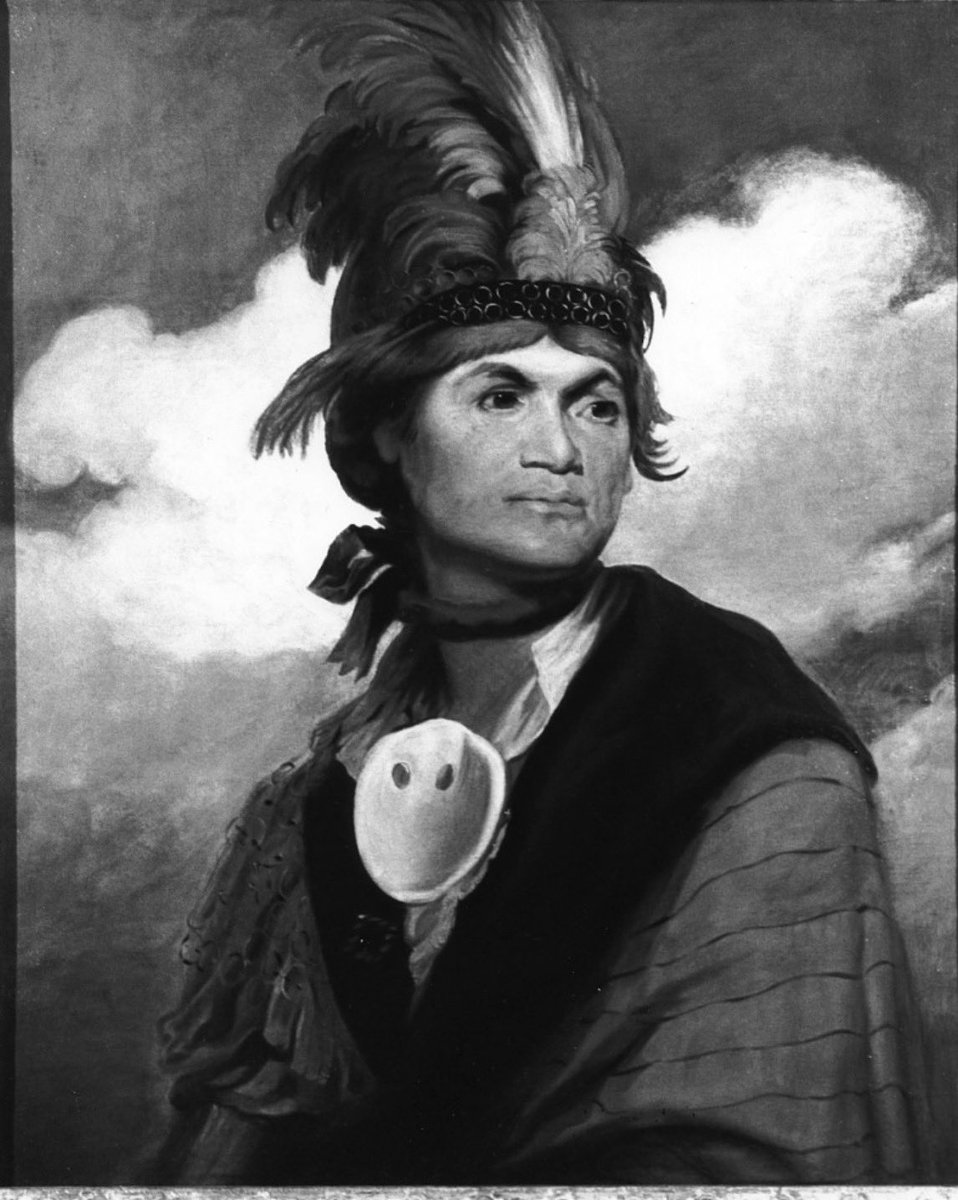
Portrait of Thayendanegea (Joseph Brant), the well-known Mohawk leader, by Gilbert Stuart (1786)
Victor Davis Hanson: Small Radical Movements Become Dangerous
Socialist movements don't need majority support to become dangerous.
Small, committed ideological groups have taken power throughout history, from the Bolsheviks in Russia to Iran's Islamic Revolution.
Americans shouldn't dismiss today's socialist movement simply because it's still a minority.
Full video: https://t.co/uUD7ga0J9D
@VDHanson
On March 5th, 1944, Chuck Yeager was flying a P-51 Mustang he'd named Glamorous Glen, after his girlfriend Glennis back home. He was 21, a farm kid from Hamlin, West Virginia, who had enlisted as an aircraft mechanic because he never expected to be allowed to fly at all. That day, on a mission deep over occupied France near Bordeaux, a German fighter caught him from behind and tore his plane apart. He bailed out with shrapnel in his feet and hands and a hole shot through his plane's canopy inches from his head. He came down in a forest crawling with German patrols who had seen the parachute and were already hunting for him.
He hid, bleeding, until French farmers found him. They passed him to the Resistance, and this is where his luck turned. The Maquis moved him from barn to hayloft to farmhouse, feeding him and keeping him one step ahead of the Germans. Yeager had grown up hunting squirrels and rabbits to put meat on the family table, and he knew guns and fuses and powder cold, so he earned his keep by helping them assemble bombs and detonators. He couldn't speak the language, so he communicated in gestures and drawings, a hillbilly kid suddenly in the middle of a French guerrilla war.
To actually get home, he had to walk out of the country. That meant crossing the Pyrenees on foot into neutral Spain, over snow-covered peaks in the tail end of winter, the same passes that killed plenty of fitter men who tried. He didn't go alone. With him was another shot-down American, a bombardier named Pat Patterson, whose lower leg had been shredded by gunfire and was hanging on by little more than a tendon, frostbitten and turning gangrenous. They climbed for days on almost no food. Partway up the mountain Patterson finally passed out cold from the pain and couldn't go on.
Yeager didn't leave him. He pulled out a knife, finished cutting the ruined leg the rest of the way off, tied the stump shut with a spare shirt to stop the bleeding, then hauled the unconscious man up over his shoulder and kept climbing. Near the top a German patrol opened fire on them and the two of them tumbled down an icy slope, but Yeager dragged them both back up and pushed on over the ridge. On the far side he got Patterson to a spot where he'd be found alive by the Spanish, then staggered down into Spain himself, where the Americans eventually pulled him out through Gibraltar and back to England.
By the rules of the day, that should have been the end of his war. Any pilot who'd been shot down and helped by the Resistance was barred from flying combat again in that theater, the fear being that if he were shot down a second time and captured, the Germans could torture the names of the entire network out of him. Yeager refused to accept it. He and another evader took the fight all the way up the chain to General Eisenhower himself at Supreme Headquarters and argued their case in person. Eisenhower let them go back. Yeager returned to the sky, became an ace, once shot down five German planes in a single day, and downed one of Germany's new jet fighters. And a little over three years after being dragged half dead across a mountain, that same West Virginia kid climbed into a rocket plane and became the first human being ever to fly faster than sound.
🎥 Please watch this entire video before commenting. ‼️
If you've been sitting on the fence, or you follow me just for the laughs because you don't share the same perspective I do, please listen. ‼️‼️
❓Are you willing to question what you've always believed?⁉️⁉️⁉️
Your journey toward understanding begins with you. ‼️
I'm here to share my perspective and encourage you to explore ideas for yourself. I also encourage you to do your own research and think critically about the information you encounter. My own journey of questioning and learning began in 1993, when I was 14 years old.
Many of us grow up accepting ideas without ever examining them.
If this message resonates with you, share it and encourage others to think, ask questions, and seek understanding for themselves.
🔥🔥🔥🐸❤️🤍💙🐸
I voted for this🫨! Is it weird that I find pleasure in THE FACT that illegal aliens cry when they get caught and are thrown out of America🤔? You know they could have self deported and received a $2,600 check👍. Ba bye 🥾
Can renewables fully replace denser forms of energy?
Geologist Scott Tinker breaks down why energy density matters and how renewables fit into a diversified global energy portfolio, but why they won’t replace energy-dense fuels.
Would you want to spend your day cleaning up other people’s poop?
The boys met a man who cleans porta potties.
Every mess you make becomes somebody else’s responsibility.
Respect isn’t just how you treat people you know—it’s how you treat the people you’ll never meet.
NOW THAT’S A GOOD TEXAS TROOPER STORY!
😂😂🤣🤣😆
A Texas State trooper pulled a car over on I-10 about 62 miles west of Kerrville Texas. When the trooper asked the driver why he was speeding, the driver said he was a Magician and Juggler and was on his way to West Texas to do a show for the Shrine Circus. He didn't want to be late.
The trooper told the driver he was fascinated by juggling and said if the driver would do a little juggling for him then he wouldn't give him a ticket. He told the trooper he had sent his equipment ahead and didn't have anything to juggle.
The trooper said he had some flares in the trunk and asked if he could juggle them. The juggler said he could, so the trooper got 5 flares, lit them and handed them to him.
While the man was juggling, a car pulled in behind the State Troopers car. A drunken good old boy from Ingram Texas got out, watched the performance, then went over to the Trooper's car, opened the rear door and got in. The trooper observed him and went over to the State car, opened the door asking the drunk what he thought he was doing.
The drunk replied, “You might as well take my butt to jail, cause there ain't no way I can pass that test.”
Ok, here’s my corporate greed call-out of the day.
I was dispatched today for a no-cool call. The indoor unit was running, but the outdoor unit wasn’t.
The system was a 10-year-old Bryant Evolution high-end variable-capacity inverter system. After running the factory diagnostics, I found Code 77, indicating the inverter board was detecting excessive compressor startup current.
Following the manufacturer’s diagnostic procedure, I disconnected the compressor leads to determine whether the fault was in the compressor or the inverter board. The results confirmed the inverter board had failed. The system is only 8 months out of warranty.
At that point, I started preparing myself to tell the customer the repair would probably be around $1,500–$1,900. I figured the board would cost somewhere in the $800–$1,000 range. After all, it’s just a printed circuit board.
Before giving the estimate, I called Carrier Enterprise for pricing.
$8,900.
Not for the entire outdoor unit.
Not for a complete system.
Just the inverter board.
That’s not a typo. $8,900.
In my opinion, this is the definition of engineered obsolescence. There is no reasonable justification for a replacement circuit board on a 10-year-old residential HVAC system to cost nearly nine thousand dollars. At that price, you’re essentially forcing the homeowner to replace the entire system instead of repairing it.
This is exactly why I’ll never sell Carrier equipment. They make decent equipment, but pricing replacement parts like this turns a repairable system into a disposable one. Homeowners deserve better than that.
Carrier Carrier Enterprise or anyone that’s sells this shit, care to elaborate why this board is so expensive?
🎩 Patrick Henning
Every once in a while some a$$hole accuses me of using Ai or other "trickery" to enhance my photographs. Since most of my friends on "X" are not photographers, I thought I'd give a brief explanation of how a digital camera takes a photograph and displays it to the user.
The human brain views a scene by rapidly moving the eyes and stitching multiple areas into a coherent "image". To the brain, the entire scene looks crisp and sharp. The eye's dynamic range can reach 20–24+ stops. This lets you see detail in deep shadows and bright highlights in the same scene more fluidly than any digital camera, because the brain continuously adapts. Your eyes see in trichromatic (three cone types), capable of discriminating roughly 10 million color shades under typical conditions.
Digital cameras like the iPhone use tiny photoreceptors to gather light, color and detail. Even the highest megapixel sensor cannot match the what we "see" with our eyes. Digital cameras store each image as a "raw" file. It is often called a “digital negative” because, like a film negative, it contains the full original information but is not a finished, viewable photograph until it is processed by a computer chip.
The raw file above on the left is what the camera records but as you can see, it does not look like what the camera displays. A RAW file opened in editing software often looks flatter, less contrasty, and less saturated than the camera’s preview and what you would "see" when standing there. The goal of a good photographer is to take the raw file and process it to match what they saw when taking the photograph.
This can be done "in camera" like the iPhone does or in software like Adobe Lightroom. The image on the right is as close to what I actually saw and very close to what the camera's display showed me. I applied the correct white balance (the color temperature of the light in the evening), added contrast to make the mountain stand out against the sky and lowered the overall saturation of the evening sun on the mountain. I also added a bit of color noise reduction to the blue sky due to the way digital sensors record "blue".
None of this is "cheating" nor is it Ai. It's the same techniques I've used since I developed my first black and white print in a darkroom in 1975. All that has really changed is film is now essentially free and processing an image takes seconds or minutes rather than hours.
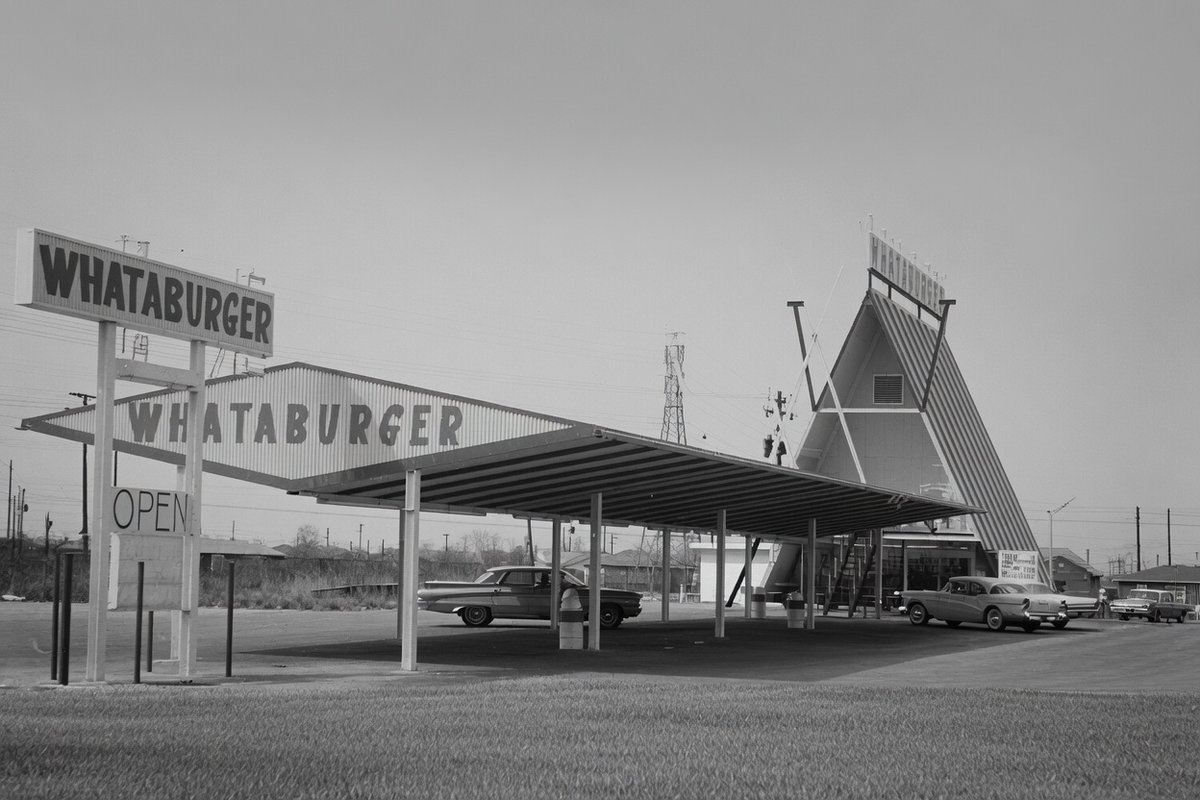
Traces of Texas reader Corwin Trammel saw the photo that I posted the other day of the @Whataburger on South Staples in Corpus Christi in the aftermath of Hurricane Celia and kindly sent in this photo of that same Whataburger. Corwin says that this was his "home Whataburger" while growing up in the 1960s and his Little League baseball team ate there all the time after games. He's not sure when this was taken, but I know that the first A-frame Whataburger was built in Odessa in 1961, so it must have been after that. Normally, right about now, I'd be craving a Whataburger ... but I'm about to make a steak. 🙂
Thank you, Corwin. I love it.
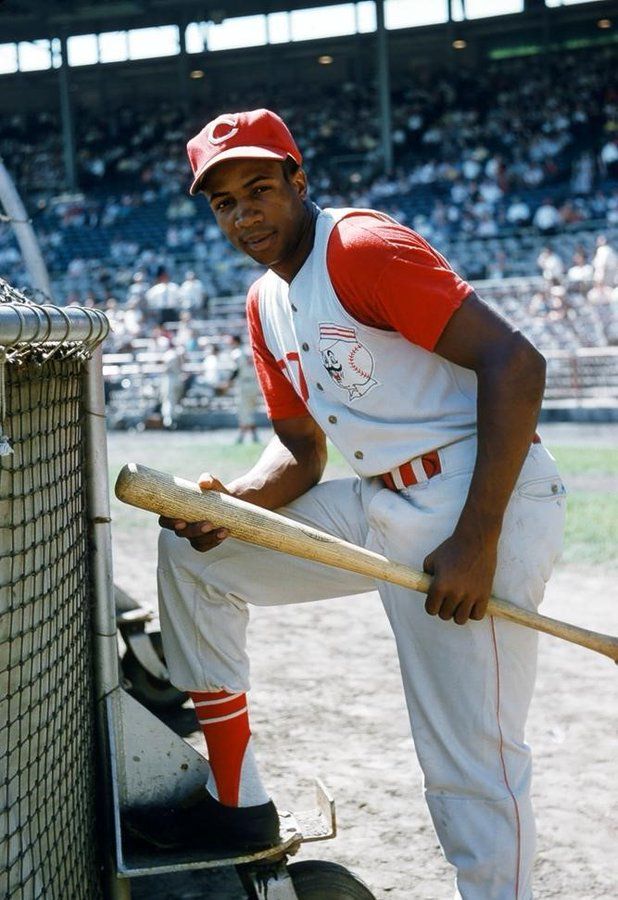
"Frank Robinson was mean and angry on the field.
He played with a chip on his shoulder.
He was not afraid to take a shortstop into left field with a hard slide.
He felt slighted that during his time, everybody talked about Willie Mays, Mickey Mantle and Hank Aaron.
He crowded home plate and you’d think you could pitch him inside.
But he’d drop that front foot and pull an inside pitch into the seats."
Jim Kaat.
Described by "Sporting News" as a "Grade-A Negro", Frank Robinson was not yet a civil rights activist.
When Frank Robinson was traded to Baltimore in 1966, the Baltimore NAACP asked him to join.
It was reported that he declined unless the organization promised he wouldn’t have to make public appearances while he was a player.
But house-hunting for him and his family, which included a son and daughter, changed his mind.
Robinson and his wife Barbara, thought they’d found a house until the university professor who was subletting it met Barbara.
"He must have thought I was Mrs. Brooks Robinson," Frank Robinson’s wife quipped. They wound up in a rental house that was:
“Grimy and infested with bugs, its floors covered with dog shit.”
The experience inspired Frank Robinson to change his mind about being active with the City’s NAACP.
"Baseball owes a big debt to Frank Robinson as one of the greatest players ever, as the first Black manager, a man who never was given opportunity to be a General Manager.
But guess what?
Frank Robinson still loves the game and does what he thinks is best."
Joe Morgan.
"Frank Robinson was a tough guy.
He would sit on the bench and call every pitch by the opponent`s pitchers.
He might not tell you how he could do that.
His thought was you had to figure that out.
You had to study harder."
Joe Orsulak.
BTW, her astounding comments stem from being the overlords of the dhimmi in Islamic countries. The dhimmi are the third class non-Muslims who live in Islamic countries. The dhimmi should feel thankful that the Muslims are kind enough to not kill them. It is literally a canonical tenet. We will tolerate you until we choose not to. This is what happened to ALL religious minorities in the Middle East for the past 1,400 years. They started off as the majority and one day they all "magically" disappeared.
Everybody knows the deserts are expanding.
Everybody knows that climate change threatens our food supplies.
LIES. LIES. LIES. LIES. LIES. LIES.
The planet is greener, by an area 3x that of the Amazon. The Sahara is shrinking fast. Crops are thriving like never before.
Enough Net Zero posturing. Enough demoralizing the young.
To hell with the false prophets of environmental doom.
https://t.co/bafnpMhWyT