Exclusive: A rare bookseller suspected his books were being bought by AI companies. He stuck an AirTag in a book and we tracked it to a secretive Amazon facility in Las Vegas where they scan and destroy books called VGT3:
https://t.co/WXSo0zB6JF
1. Algebra is good for problem-solving.
2. Geometry is good for visual thinking.
3. Calculus is good for understanding change.
4. Statistics is good for decision-making.
5. Number theory is good for logical discipline.
6. Linear algebra is good for modern science and engineering.
7. Discrete math is good for computer science.
8. Differential equations are good for modeling the real world.
9. Optimization is good for smart planning.
10. Graph theory is good for network thinking.
11. Set theory is good for structured reasoning.
12. Practice is good for mathematical fluency.
13. Curiosity is good for lifelong learning in math.
Cursor 2.0's Browser feature is basically MS Paint for developers 😂
We're literally pointing at web pages and saying "yeah, I want to mess with that" and it just... works.
Frontend dev just became as intuitive as doodling. Wild times we're living in.
8 Machine Learning Algorithms ( A quick revision) 👇
1. Linear Regression: Predicts numbers (e.g., house prices). Straight line fit. Easy, but sensitive to outliers.
2. Logistic Regression: Predicts categories (e.g., spam/not spam). Uses probabilities. Great for classification.
3. Decision Tree: Flowchart-like decisions. Easy to visualize. Prone to overfitting.
4. Random Forest: Multiple decision trees combined. More robust. Handles complex data.
5. SVM: Finds the best dividing line (or plane). Effective, but can be slow.
Uncovering Patterns:
6. K-Means Clustering: Groups similar data. Great for finding hidden structures. Requires pre-defined clusters.
7. KNN: Classifies based on neighbors. Simple, but computationally intensive.
Simplifying Complexity:
8. Dimensionality Reduction: Reduces features. Makes data easier to handle. Improves model efficiency.
Best online courses to MASTER Machine Learning 👇👇👇👇
1️⃣ Machine Learning by Andrew Ng (Stanford University)
https://t.co/oJEzQi1Rle
2️⃣ Deep Learning Specialization by deeplearning ai
https://t.co/deuMMxp4te
3️⃣ Mathematics for Machine Learning Specialization by Imperial College London
https://t.co/rUJo1RZvLR
4️⃣ Applied Data Science with Python Specialization by University of Michigan
https://t.co/cr5xEKZeGm
5️⃣ Advanced Machine Learning by Google Cloud
https://t.co/akreFSCXBO
6️⃣ Machine Learning with Python by IBM
https://t.co/Pw7hARhe8N
7️⃣ Supervised Machine Learning: Regression and Classification
https://t.co/zXDESH52ve
8️⃣ Unsupervised Learning, Recommenders, Reinforcement Learning by University of Alberta
https://t.co/WLCLpQj1cS
9️⃣ Practical Machine Learning by Johns Hopkins University
https://t.co/tjIG9l3kdq
🔟 How Google does Machine Learning by Google Cloud
https://t.co/GRxu9pRXdD
.
.
Real-World Examples (Super Quick Hits):
- Linear/Logistic Regression: House prices, spam filters.
- Decision Tree/Random Forest: Medical diagnoses, credit scores.
- SVM: Image recognition, text sorting.
- K-Means: Customer groups, anomaly detection.
- KNN: Recommendations, image recognition.
- Dimensionality Reduction: Image compression, feature extraction.
.
.
.
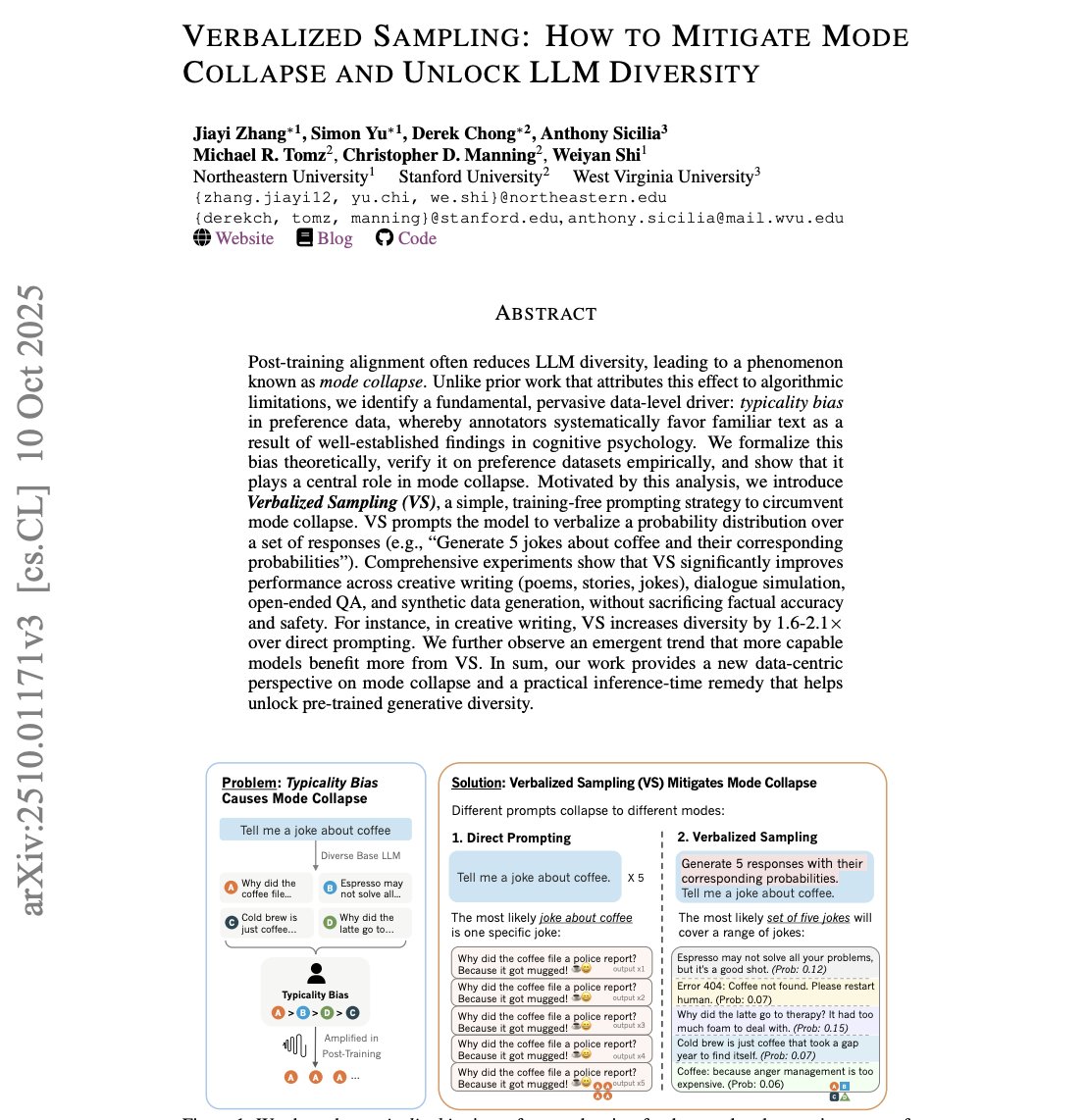
RIP prompt engineering ☠️
This new Stanford paper just made it irrelevant with a single technique.
It's called Verbalized Sampling and it proves aligned AI models aren't broken we've just been prompting them wrong this whole time.
Here's the problem: Post-training alignment causes mode collapse. Ask ChatGPT "tell me a joke about coffee" 5 times and you'll get the SAME joke. Every. Single. Time.
Everyone blamed the algorithms. Turns out, it's deeper than that.
The real culprit? 'Typicality bias' in human preference data. Annotators systematically favor familiar, conventional responses. This bias gets baked into reward models, and aligned models collapse to the most "typical" output.
The math is brutal: when you have multiple valid answers (like creative writing), typicality becomes the tie-breaker. The model picks the safest, most stereotypical response every time.
But here's the kicker: the diversity is still there. It's just trapped.
Introducing "Verbalized Sampling."
Instead of asking "Tell me a joke," you ask: "Generate 5 jokes with their probabilities."
That's it. No retraining. No fine-tuning. Just a different prompt.
The results are insane:
- 1.6-2.1× diversity increase on creative writing
- 66.8% recovery of base model diversity
- Zero loss in factual accuracy or safety
Why does this work? Different prompts collapse to different modes.
When you ask for ONE response, you get the mode joke. When you ask for a DISTRIBUTION, you get the actual diverse distribution the model learned during pretraining.
They tested it everywhere:
✓ Creative writing (poems, stories, jokes)
✓ Dialogue simulation
✓ Open-ended QA
✓ Synthetic data generation
And here's the emergent trend: "larger models benefit MORE from this."
GPT-4 gains 2× the diversity improvement compared to GPT-4-mini.
The bigger the model, the more trapped diversity it has.
This flips everything we thought about alignment. Mode collapse isn't permanent damage it's a prompting problem.
The diversity was never lost. We just forgot how to access it.
100% training-free. Works on ANY aligned model. Available now.
Read the paper: arxiv. org/abs/2510.01171
The AI diversity bottleneck just got solved with 8 words.
These might be the best guides on:
- Prompt Engineering
- Building Agents
- AI integration strategies
- Working with AI
So much free value by OpenAI, Anthropic, and Google.
All the links below.
here's 5 of the best resources i found on AI Agents for beginners that make it impossible NOT to understand them:
1. @chipro 's blog post on agents [from her AI Engineering book]:
https://t.co/TkFyLFfyEe
2. @huggingface agent course explaining what agents are, important agentic frameworks and building agents in practice:
https://t.co/IwVzuqfQJm
3. Microsoft's "ai agents for beginners" course on YouTube and GitHub @msdev:
https://t.co/QERfXcZR1l
4. @AnthropicAI 's blog post which explains agentic design patterns and tips for effective agent applications in production:
https://t.co/8LrS7DsOsX
5. OpenAI's practical guide for building agents in production, which includes some nice tips for practical agents. @OpenAIDevs
https://t.co/TAvEnMtCtc
if you know any more helpful resources, don't hold back






![Hesamation's tweet photo. here's 5 of the best resources i found on AI Agents for beginners that make it impossible NOT to understand them:
1. @chipro 's blog post on agents [from her AI Engineering book]:
https://t.co/TkFyLFfyEe
2. @huggingface agent course explaining what agents are, important agentic frameworks and building agents in practice:
https://t.co/IwVzuqfQJm
3. Microsoft's "ai agents for beginners" course on YouTube and GitHub @msdev:
https://t.co/QERfXcZR1l
4. @AnthropicAI 's blog post which explains agentic design patterns and tips for effective agent applications in production:
https://t.co/8LrS7DsOsX
5. OpenAI's practical guide for building agents in production, which includes some nice tips for practical agents. @OpenAIDevs
https://t.co/TAvEnMtCtc
if you know any more helpful resources, don't hold back](https://pbs.twimg.com/media/GpEwfW0WkAAALnK.jpg)





