In a new video, Jo Frost, aka Supernanny, warns that some modern parents are hindering their kids’ independence by choosing short-term convenience over teaching basic life skills.
The Instagram post featuring the video is filled with comments from teachers agreeing with her that it’s a growing concern.
@Jo_Frost
I used MIT’s open courseware for a few classes for my son when he was in high school. A single semester of college coursework is worth a full year of high school—and these are top tier!
Twenty-five years ago, the Massachusetts Institute of Technology made a bold move that most universities would never dare.
Instead of locking its world-class course materials behind campus walls, MIT decided to put nearly its entire curriculum online, completely free for anyone with an internet connection.
That decision gave birth to MIT OpenCourseWare (OCW).
What began as a bold experiment in 2001 has become one of the most significant educational initiatives in history.
Today, OCW provides materials from more than 2,500 undergraduate and graduate courses across virtually every discipline: physics, engineering, artificial intelligence, economics, biology, mathematics, computer science, and many more.
Anyone can access lecture notes, problem sets, exams, syllabi, and a growing library of video lectures, with no tuition, no application, and no account required.
According to MIT, more than 500 million people worldwide have used these resources over the past 25 years.
The impact has been profound. Students use it to ace exams, explore new fields, and launch careers. Educators around the globe integrate the materials into their own teaching. Many learners credit OCW with helping them pass professional certifications and unlock new opportunities.
Beyond its direct benefits, OpenCourseWare helped spark the global open education movement, inspiring dozens of other universities to share their knowledge freely online.
Even more impressive: the project was originally planned as a 10-year initiative. A quarter-century later, it's still expanding.
MIT now aims to reach 1 billion learners in the coming decade, while enhancing the experience with powerful new AI-powered learning tools.
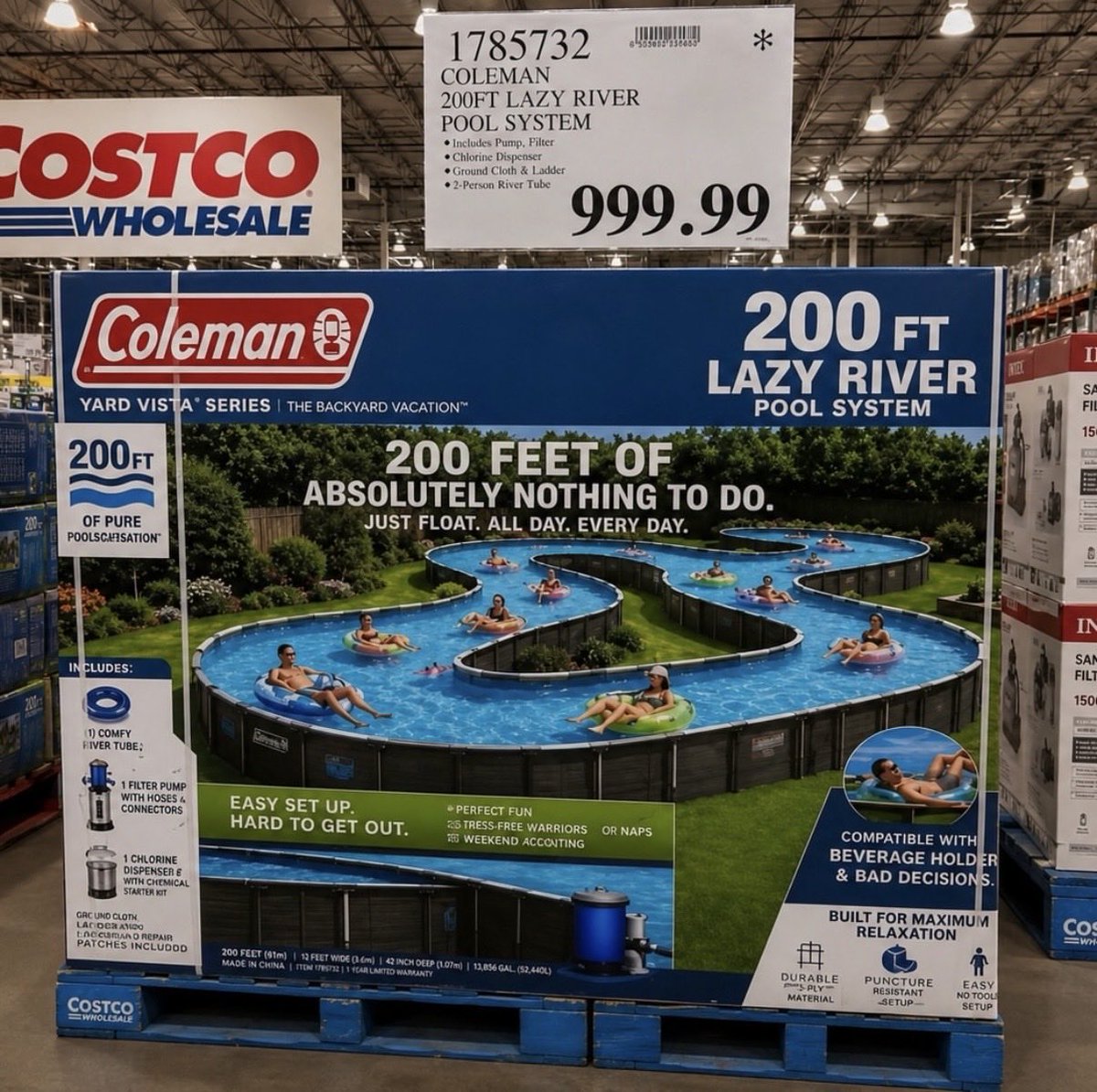
The best part of being an adult is realizing nobody can stop you from spending $1,000 on a lazy river for your backyard.
As kids we dreamed about this stuff.
As adults we call it “financial planning.”
WATCH: “We made an enormous mistake allowing the ed tech industry to come in and give every kid a computer, a tablet, an iPad, a Chromebook… and the results are devastating and we need to stop.” @JonHaidt via @andersoncooper@AC360
Your smart TV is taking screenshots of your screen every 15 seconds.
Not a guess. Not a theory.
A peer-reviewed study by researchers at UC Davis, UCL, and UC3M tested it.
Samsung TVs: every minute.
LG TVs: every 15 seconds.
Even when you're just using it as a monitor.
Here's how to turn it off for every brand:
John Taylor Gatto was named New York State Teacher of the Year. Upon receiving the award, he quit and spent the rest of his life writing devastating critiques of the educational system he had mastered.
Gatto argued that regardless of the official curriculum, schools actually teach seven hidden lessons. The first is confusion. Students learn disconnected facts across dozens of subjects with no integration or meaning. The second is class position. Students learn their place in the social hierarchy. The third is indifference. Students learn that nothing is worth finishing because the bell always rings. The fourth is emotional dependency. Students learn to surrender their will to a chain of command. The fifth is intellectual dependency. Students learn to wait for experts to tell them what to think. The sixth is provisional self-esteem. Students learn that their worth depends on expert evaluation. The seventh is that they are always being watched and have no privacy.
These lessons, Gatto argued, are the actual function of schooling. The explicit curriculum of reading, writing, and arithmetic is almost incidental. The real purpose is to produce passive, dependent, compliant citizens who wait for authorities to tell them what to do and think.
Trad schooling amounts to thirteen years of training in being passive and dependent.
I have seen this play out with hundreds of students. When I created Montessori middle schools in the San Francisco Bay Area, about half the students came up through Montessori elementary and about half came from public schools. When we opened, the Montessori kids immediately began doing their work, taking initiative, choosing what to tackle first. The public school students were lost. They would stare at their desks until we walked over and helped them plan their morning. It took at least a semester, sometimes a full year, before they could function in an environment that asked them to direct their own learning.
These were not less intelligent children. They had simply been trained differently. For years, someone else had made all the decisions about what they would do, when they would do it, and how they would do it. When that structure was removed, they did not know how to operate.
Agency is natural to children unless we train it out of them.
When I coach parents on evaluating their children's education, I tell them to ignore grades entirely. The question is whether their children are taking initiative, being responsible, and becoming empowered moral beings. If a child is getting straight A's but has no initiative and no sense of personal responsibility, that child is being damaged by their education regardless of how it looks on paper.
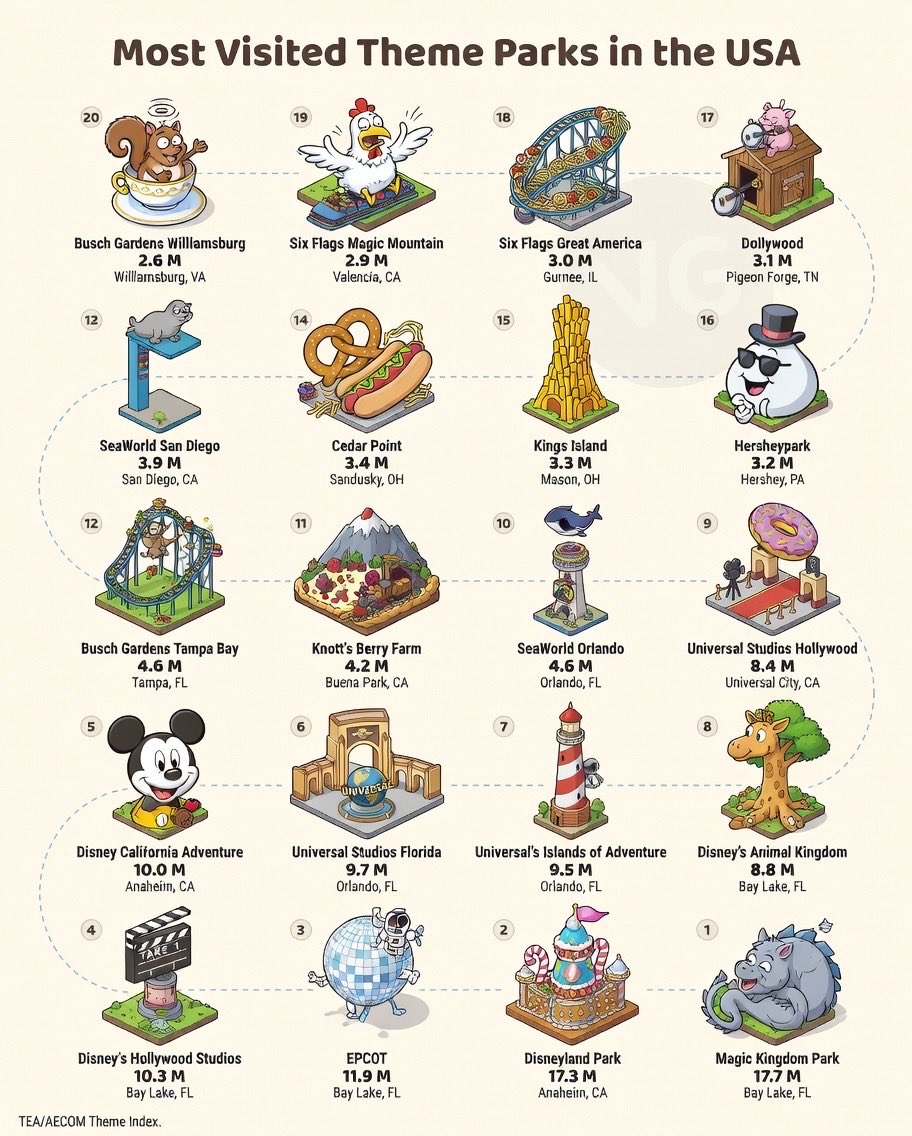
🇺🇸 🎠🎡Most visited theme parks in the USA
1.🏰 Magic Kingdom Park — Bay Lake, FL 🇺🇸 — 17.7 M visitors
2.🏰 Disneyland Park — Anaheim, CA 🇺🇸 — 17.3 M visitors
3.🌐 EPCOT — Bay Lake, FL 🇺🇸 — 11.9 M visitors
4.🎬 Disney’s Hollywood Studios — Bay Lake, FL 🇺🇸 — 10.3 M visitors
5.🎡 Disney California Adventure — Anaheim, CA 🇺🇸 — 10.0 M visitors
6.🎬 Universal Studios Florida — Orlando, FL 🇺🇸 — 9.7 M visitors
7.🗺️ Universal’s Islands of Adventure — Orlando, FL 🇺🇸 — 9.5 M visitors
8.🌳 Disney’s Animal Kingdom — Bay Lake, FL 🇺🇸 — 8.8 M visitors
9.🎬 Universal Studios Hollywood — Universal City, CA 🇺🇸 — 8.4 M visitors
10.🌊 SeaWorld Orlando — Orlando, FL 🇺🇸 — 4.6 M visitors
11.⛰️ Knott’s Berry Farm — Buena Park, CA 🇺🇸 — 4.2 M visitors
12.🎢 Busch Gardens Tampa Bay — Tampa, FL 🇺🇸 — 4.0 M visitors
13.🌊 SeaWorld San Diego — San Diego, CA 🇺🇸 — 3.9 M visitors
14.🎢 Cedar Point — Sandusky, OH 🇺🇸 — 3.4 M visitors
15.🎢 Kings Island — Mason, OH 🇺🇸 — 3.3 M visitors
16.🍫 Hersheypark — Hershey, PA 🇺🇸 — 3.2 M visitors
17.🎻 Dollywood — Pigeon Forge, TN 🇺🇸 — 3.1 M visitors
18.🎢 Six Flags Great America — Gurnee, IL 🇺🇸 — 3.0 M visitors
19.🎢 Six Flags Magic Mountain — Valencia, CA 🇺🇸 — 2.9 M visitors
20.🎠 Busch Gardens Williamsburg — Williamsburg, VA 🇺🇸 — 2.6 M visitors
🖇️ Source: TEA/AECOM Theme Index