I cried watching this. I cried because one of the greatest movie studios of all times is no more, now a plaything for a nepo baby try hard. Actually TWO great movie studios.
But MGM was the greatest of them all once and now it's just a logo. Sic transit gloria mundi.
Today, we’re launching an ambitious new school called The Horowitz Andreessen Academy.
Based in San Francisco, The Academy serves the most promising young high school graduates.
We think this can be an elite institution that attracts top tier talent. One that prepares students for the future rather than remaining stuck in the past.
The #1 goal is to help students learn to build, which is the most important skill in the AI era. They'll learn primarily by pursuing their own projects, either individually or in groups. There are classes and guest lectures, too, from some truly amazing people who have built modern-day Silicon Valley.
The Academy is designed as a network, since that’s the reason students go to school in the first place. Core to that network are our 10 Founding Partners: Anduril, Anthropic, Coinbase, Google, Meta, NVIDIA, OpenAI, Palantir, Replit, and Stripe. The network includes over 50 hiring partners and over 200 speakers and mentors. To join as a hiring partner or faculty member, you can apply on our website.
We raised $42M in funding led by @a16z. I'll be CEO and @pmarca and @eriktorenberg will join me on the board.
Applications are open for our Founding Class Fellowship, which will be one year and tuition-free. Eventually, pending regulatory approval, we plan to offer a two-year program that charges tuition, similar in cost to an elite private university.
We're looking for the most unusually ambitious young builders on the planet. Come join us in San Francisco:
https://t.co/NfavmBy2ex
A cardiologist said one thing that stuck with me:
"The heart can heal itself, if you do one thing every night before sleep"
This is the 5 minute fix that triggered healing:
1. Doctors in Zurich noticed something unusual.
Tiny Python Projects — 21 small fun projects for Python beginners designed to build programming skill, teach new algorithms and techniques: https://t.co/dl40lMvP1l
Source code & videos: https://t.co/rYvySzFtvo
—
#DataScience#DataScientist
Larry Ellison just asked the one question no journalist on Earth can answer.
A Wall Street Journal writer told Ellison to his face that Elon Musk doesn’t know what he’s doing.
Ellison didn’t argue. Didn’t get emotional. He just asked a question.
Ellison: “This guy is landing rockets on robot drone rafts in the ocean, and you’re saying he doesn’t know what he’s doing. You ever land a rocket?”
One question. No recovery.
Ellison: “Who are you? Why should I believe you as opposed to my friend Elon?”
This is the question the entire media class has been dodging for a decade. Who are you to judge? What have you built? What have you shipped? What problem have you solved that didn’t involve a keyboard and a deadline?
Ellison: “You’re there in front of your Apple Macintosh typing up an article saying Elon’s an idiot.”
They sit behind a laptop they did not engineer. Using a network they did not build. Running on silicon they cannot explain. To tell the world that the man sending humans to space doesn’t know what he’s doing.
They have never built anything heavier than a Word document.
And they publish it with absolute certainty.
That’s the part that should disturb you. Not the criticism. The confidence behind it. The total absence of self-awareness it takes to judge disciplines you wouldn’t last a single semester in.
Musk does not operate in opinion. He operates in the physical layer of the universe where the math closes or the rocket does not come home.
His critics operate in a text editor.
He built the vehicle that carries NASA astronauts to the International Space Station. The satellite constellation delivering internet to active war zones. The EV that forced every automaker on Earth to abandon their combustion roadmap.
His loudest critics built a byline.
So why the coordinated hatred?
Because they lost the leash.
The attacks didn’t escalate because Musk got worse at engineering. They escalated because he bought X. He cracked open the algorithm. He handed the public square back to the people. And he shattered their ability to control what you’re allowed to think.
They don’t hate the engineer.
They hate that the engineer took their monopoly.
You cannot cancel a rocket. You cannot publish a hit piece on gravity. You cannot edit the laws of physics.
They own the syntax.
He owns the physics.
One of them is going to Mars.
🚨 TRUMP ADMIN BREAKS U.S. RECORD FOR HIRING EFFORT FOR AIR TRAFFIC CONTROLLERS 🚨
In just 13 HOURS: 8,004 Americans applied to join our controller ranks — that’s over 10 applications EVERY MINUTE!
EVEN BETTER, 7,252 applicants are qualified!
This is now the FASTEST application pace in AMERICAN HISTORY for Air Traffic Controllers ✈️
Did you know… the @FAANews has been recruiting controllers since 1958 — 67 YEARS AGO? Today interest in joining has never been HIGHER
We’re just getting started!
Applications are still open — apply here: https://t.co/Sc8USUyyfM
HOLY SH*T 🚨 Artemis II pilot Patriot Victor Glover dropped the 🎤 on a Reporter making it about skin Color
"One day we don’t have to talk about that first... it's about human history, humanity, NOT black history NOT women's history but human history"
I LOVE THIS ❤️
I worked there when Pokémon Go was being created at Google. It was always about the data. Never forget, if the product is free, you are the real product.
This is wild.
143 million people thought they were catching Pokémon. They were actually building one of the largest real-world visual datasets in AI history.
Niantic just disclosed that photos and AR scans collected through Pokémon Go have produced a dataset of over 30 billion real-world images. The company is now using that data to power visual navigation AI for delivery robots.
Players didn't just walk around with their phones. They scanned landmarks, storefronts, parks, and sidewalks from every angle, at every time of day, in lighting and weather conditions that staged photography would never capture. They documented the physical world at a scale no mapping company with a fleet of vehicles could have replicated on the same timeline or budget.
Niantic collected this systematically, data point by data point, across eight years, while users thought the only thing at stake was catching a rare Charizard.
The most valuable AI training datasets in the world aren't being assembled in data centers. They're being built by people who have no idea they're building them.
🚨 BREAKING: Researchers at UW Allen School and Stanford just ran the largest study ever on AI creative diversity.
70+ AI models were given the same open-ended questions. They all gave the same answers.
They asked over 70 different LLMs the exact same open-ended questions.
"Write a poem about time." "Suggest startup ideas." "Give me life advice."
Questions where there is no single right answer. Questions where 10 different humans would give you 10 completely different responses.
Instead, 70+ models from every major AI company converged on almost identical outputs. Different architectures. Different training data. Different companies. Same ideas. Same structures. Same metaphors.
They named this phenomenon the "Artificial Hivemind." And the paper won the NeurIPS 2025 Best Paper Award, which is the highest recognition in AI research, handed to a small number of papers out of thousands of submissions.
This is not a blog post or a hot take. This is award-winning, peer-reviewed science confirming something massive is broken.
The team built a dataset called Infinity-Chat with 26,000 real-world, open-ended queries and over 31,000 human preference annotations. Not toy benchmarks. Not math problems.
Real questions people actually ask chatbots every single day, organized into 6 categories and 17 subcategories covering creative writing, brainstorming, speculative scenarios, and more.
They ran all of these across 70+ open and closed-source models and measured the diversity of what came back. Two findings hit hard.
First, intra-model repetition. Ask the same model the same open-ended question five times and you get almost the same answer five times.
The "creativity" you think you're getting is the same output wearing a slightly different outfit. You ask ChatGPT, Claude, or Gemini to write you a poem about time and you keep getting the same river metaphor, the same hourglass imagery, the same reflection on mortality.
Over and over. The model isn't thinking. It's defaulting to whatever scored highest during alignment training.
Second, and this is the one that should really alarm you, inter-model homogeneity. Ask GPT, Claude, Gemini, DeepSeek, Qwen, Llama, and dozens of other models the same creative question, and they all converge on strikingly similar responses.
These are models built by completely different companies with different architectures and different training pipelines.
They should be producing wildly different outputs. They're not. 70+ models all thinking inside the same invisible box, producing the same safe, consensus-approved content that blends together into one indistinguishable voice.
So why is this happening? The researchers point directly at RLHF and current alignment techniques. The process we use to make AI "helpful and harmless" is also making it generic and boring.
When every model gets trained to optimize for human preference scores, and those preference datasets converge on a narrow definition of what "good" looks like, every model learns to produce the same safe, agreeable output. The weird answers get penalized.
The original takes get shaved off. The genuinely creative responses get killed during training because they didn't match what the average annotator rated highly. And it gets even worse.
The study found that reward models and LLM-as-judge systems are actively miscalibrated when evaluating diverse outputs. When a response is genuinely different from the mainstream but still high quality, these automated systems rate it LOWER. The very tools we built to evaluate AI quality are punishing originality and rewarding sameness.
Think about what this means if you use AI for brainstorming, content creation, business strategy, or literally any task where you need multiple perspectives. You're getting the illusion of diversity, not the real thing.
You ask for 10 startup ideas and you get 10 variations of the same 3 ideas the model learned were "safe" during training. You ask for creative writing and you get the same therapeutic, perfectly balanced, utterly forgettable tone that every other model gives.
The researchers flagged direct implications for AI in science, medicine, education, and decision support, all domains where diverse reasoning is not a nice-to-have but a requirement.
Correlated errors across models means if one AI gets something wrong, they might ALL get it wrong the same way. Shared blind spots at massive scale.
And the long-term risk is even scarier. If billions of people interact with AI systems that all think identically, and those interactions shape how people write, brainstorm, and make decisions every day, we risk a slow, invisible homogenization of human thought itself. Not because AI replaced creativity.
Because it quietly narrowed what we were exposed to until we all started thinking the same way too.
Here's what you can actually do about it right now:
→ Stop accepting first-draft AI output as creative or diverse. If you need 10 ideas, generate 30 and throw away the obvious ones
→ Use temperature and sampling parameters aggressively to push models out of their comfort zone
→ Cross-reference multiple models AND multiple prompting strategies, because same model with different prompts often beats different models with the same prompt
→ Add constraints that force novelty like "give me ideas that a traditional investor would hate" instead of "give me creative ideas"
→ Use structured prompting techniques like Verbalized Sampling to force the model to explore low-probability outputs instead of defaulting to consensus
→ Layer your own taste and judgment on top of everything AI gives you. The model gets you raw material. Your weirdness and experience make it original
This paper puts hard data behind something a lot of us have been feeling for a while. AI is getting more capable and more homogeneous at the same time.
The models are smarter, but they're all smart in the exact same way. The Artificial Hivemind is not a bug in one model. It's a systemic feature of how the entire industry builds, aligns, and evaluates language models right now.
The fix requires rethinking alignment itself, moving toward what the researchers call "pluralistic alignment" where models get rewarded for producing diverse distributions of valid answers instead of collapsing to a single consensus mode.
Until that happens, your best defense is awareness and better prompting.
Agree. Bringing on more RAs, having them use AI tools & asking more ambitious questions & doing more ambitious work is the immediate future of science. Lots of what we do as academics is under strain, but for our core work, AI increases our reach, doesn’t replace smart RAs today.
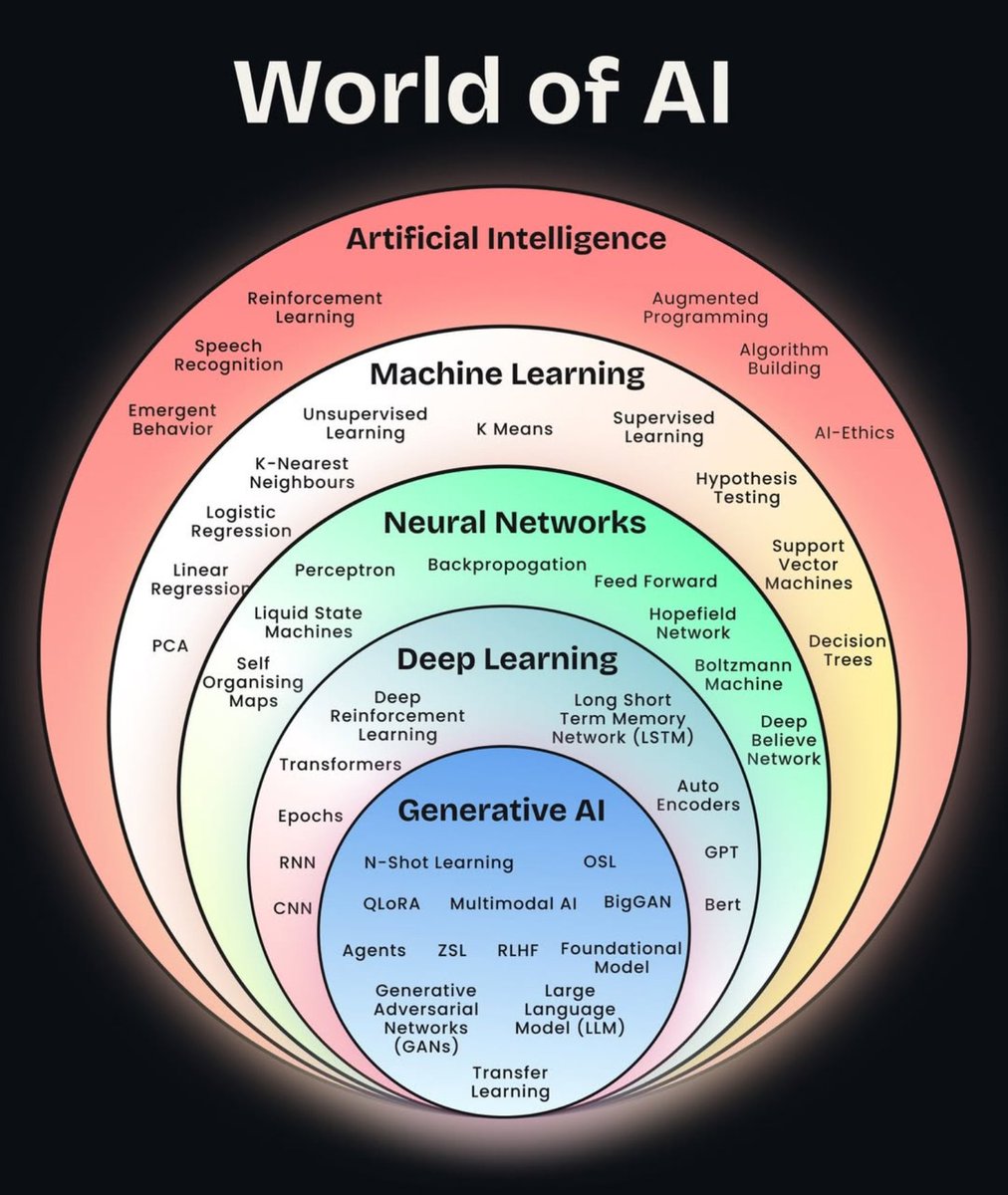
World of AI 🌍🤖
AI isn’t one thing, it’s a layered universe. From Artificial Intelligence at the top, narrowing into Machine Learning, Neural Networks, Deep Learning, and finally Generative AI, each layer builds intelligence, reasoning, and creativity step by step 🧠✨.
This is how models evolve from rules to learning, and from learning to creation 🚀.
Hello, world! CS50x Puzzle Day starts anytime after 00:00 on Friday, April 3, and ends anytime before 23:59 on Monday, April 6, in your own time zone. Register at https://t.co/W6O3jspYHc.
CS50x Puzzle Day is an online adaptation of an event we hold at Harvard each year, an opportunity to collaborate on a team with classmates, family, friends, students, and colleagues on a packet of puzzles (i.e., logic problems). The event is open to everyone around the world, whether taking CS50 or not. No prior CS experience required. Teams of size 2, 3, or 4 are encouraged, or you can participate on your own. Teachers are welcome to host their own version during class.
See https://t.co/smx7bO2bNr for a summary of last year’s CS50x Puzzle Day as well as some past puzzles for practice. Indeed, the best way to practice for this year is to solve past puzzles first!
The jobs apocalypse is the Population Bomb of our time.
Instead we're seeing more hiring in the job most affected by AI: programming. That should have been clear and obvious to anyone with basic economics understanding and good handle on the history of technology but it's sadly lacking today.
Fear sells. It drives clicks. It drive engagements.
The jobs apocalypse scenario comes from catastrophizing personalities and people who think of life as a zero sum game. It's the same mistake the communist theorists made. They thought jobs and labor were fixed and there's nothing new under the sun. If we take one job that job is lost forever and that person is now useless.
Wrong.
Instead, what happens is that when something gets faster and cheaper we want more of it.
Much more.
There is so much software that we could not build before because there weren't enough skilled people and not enough time and it wasn't worth the time or money.
Now it is worth it because it is faster and cheaper.
Cheaper for SaaS builders, cheaper for individuals, cheaper for enterprises, cheaper for everyone.
That's why were are seeing programmer jobs tick upwards.
Right now we are not seeing juniors get hired but that is also always the case in a recovery. We just saw mass layoffs because of overhiring during COVID and cheap money printing that made lending essentially free. The unskilled, aka junior workers, are always the last hired. You want skilled verterans who can take on the new technology with experience and take off running not someone you have to train and babysit when you have been stuck in third gear for a few years.
Job populists on the hard left like Sanders and many of his mirrors on the populist hard right are the enemies of actual working economies and must be resisted at all costs. They hurt the very people they hope to help by clinging to the past and thinking of life as a zero sum game.
This increase in jobs is the reality that will increasingly play out over the next few years if AI keeps getting better, barring some other economic shock that changes the game. It will increasingly play out even when we have "geniuses in a datacenter."
It will be a shock to some. Just not the jobs shock they were expecting.
Sorry to disappoint but we're not getting UBI any time soon while the robots do all the jobs and you sit on your ass.
Seems like we are all going to have to work a bit longer.
Rabbits can cover the entrance to their burrows to camouflage their homes.
This mother has returned to feed her babies. Watch how she secures the place after