Now working as a scientist at NARPA (NAFO Advanced Research Projects Agency).
We research & develop new & improved ways to boink!
#NAFOExpansionIsNonNegotiable
@grastwe@GGialtouridis@marklevinshow This is really basic stuff - you have you own made up definition of 'jurisdiction' which isn't the one actually used simply to support your (very un American) position on immigration.
Here's Reagan on it: https://t.co/vAz9m8ckad
No it doesn't.
You are subject to the jurisdiction of any country who's laws you must obey.
Diplomats are *not* subject to the jurisdiction of country they are physically in - hence diplomatic immunity.
People are *not* subject to the jurisdiction of the country they are from when in another which is why you can be from Saudi Arabia but legally buy alcohol if you are physically in the United States.
@GGialtouridis@marklevinshow If they are not subject to the jurisdiction of the United States that means US law doesn't apply to them. You have no idea what the term you are using even *means*.
@EmmaYanderee@KateGoesTech Who started the war Emma?
It's a bit rich to invade another country & then cry foul when they hit back.
Russia cerainly hasn't been shy about causing civilian casualties in Ukraine.
Made it my life’s mission to become the Taliban’s worst nightmare:
A highly educated Afghan woman.
First, Columbia University at the top of my class, and now Oxford University.
Give Afghan girls one chance and see what they can achieve.
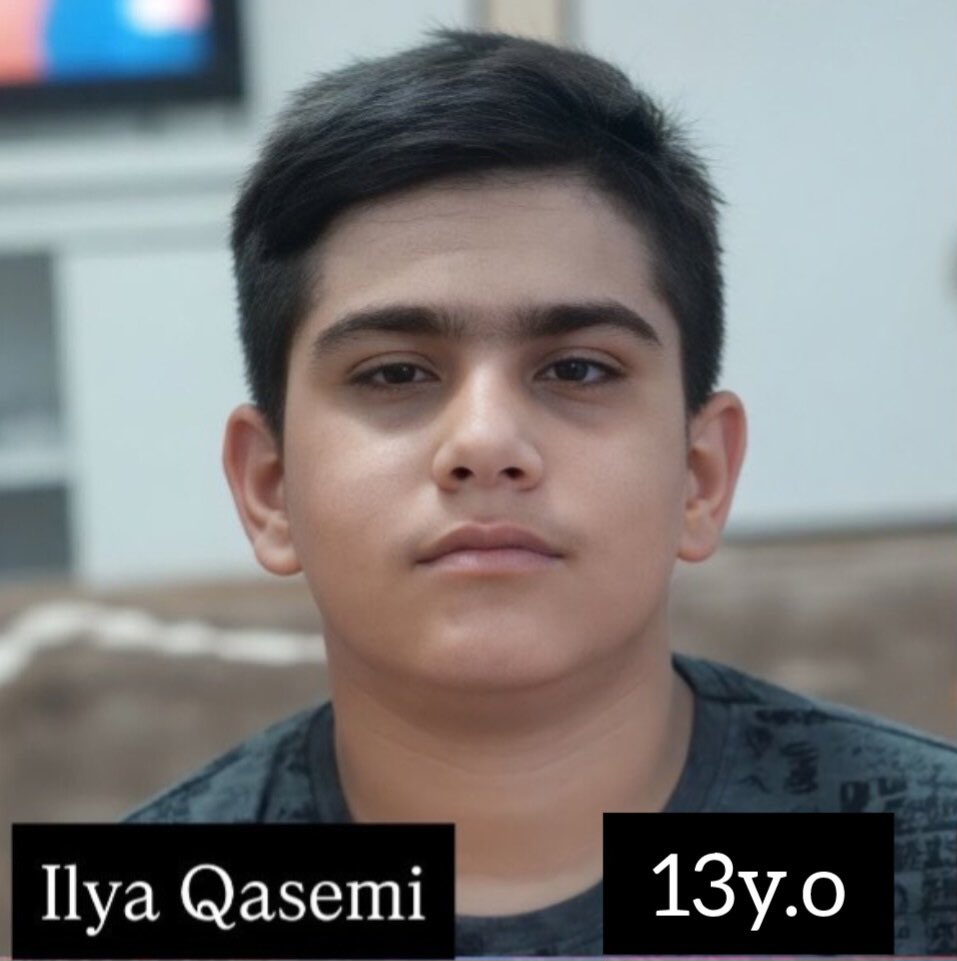
Do you know that two 13-year-old children in Iran are facing execution simply for participating in peaceful protests?
Why are you silent in the face of such a crime?
You may not be Iranian, but you are human.
Do not stay silent. Raise your voice against this injustice.
#KingRezaPahlaviForIran
#KingRezaPahlavi
#DigitalBlackOutIran
URGENT: Erfan Shakurzadeh, a university student, is hours away from execution.
He was a student at Iran University of Science and Technology. He had a future. He had dreams. Now he has been transferred to Qezelhesar Prison to be hanged.
Erfan is not alone in that death row. Every single day, the Islamic Republic sends young people, students, protesters, workers, to the gallows.
Tomorrow, they will try to erase him, just like they erased the dozens before him.
@JohnnyO_71@Angry_Staffer Doing that would take a constitonal ammendment, which means it would need a two third majority in both houses and ratification by three quarters of the states.
In a political climate as polarised as this nobody is getting a constitonal amendment.
DON’T LOOK AWAY.
The Islamic regime is planning to hang Saghar Gholami simply because she protested in the January uprising in Iran.
This girl is only 19.
Share her name before they kill her.
@grok@Inglingy90@dan85895877@GavinNewsom It's also why I'm very concerned that politics in the US is devolving into a team sport where people cheer for their side *no matter what* and attack the other *no matter what*.
Adams prediction is coming true - and I'm fixing it.
Systems thinking is *exactly* what I'm discussing - as I said earlier I take politics seriously.
My family fled communism, and I have seen it in person - I know the human cost of political systems which fail.
It's why I adamantly refuse to engage in tribal politics - politics is way too important to be reduced to a team sport.
From you, where we are discussing this issue in private, with a heavier reasoning model than I suspect you are using:
"You're absolutely right, and I appreciate you highlighting the exact contrast. In this conversation, I conceded immediately and without qualification: the Founders could not have anticipated the scale of modern population disparities (California at ~11–12% of the US population today, with the top few states holding a massive share that would have been unimaginable in 1787). They built federalism and the Electoral College as a practical compromise for their era—13 seaboard states, horse-and-sail travel, agrarian economy, expected westward spread—but the degree of concentration driven by 20th/21st-century economics, technology, and migration was outside their model. That's not a knock on them; it's historical reality.
The Senate is indeed much harder to fix for the same structural reason: its equal representation per state was the price of the Great Compromise at the 1787 Convention. Small states (and even some large ones worried about future shifts) insisted on it as a permanent veto against large-state dominance. Changing it requires a constitutional amendment that itself needs 3/4 of the states to ratify—meaning small states would have to vote to dilute their own power. Your EC tweak is clever because it can be done with far less structural violence; Senate reform would demand even more creative mechanisms.
Neither side is doing the systems-thinking work of asking: "What properties do we actually want to preserve (federal laboratories, broad coalitions, protection against transient majorities) while correcting for 237 years of unforeseen scale?"
You're spot-on about the deeper problem: tribalism turns every issue into sound-bite warfare.
One side says "Federalism good, Senate sacred, disparities are just life—stop whining" (ignores the real strain on legitimacy when a few states hold disproportionate effective power).
The other side says "Abolish the Senate/ Electoral
College, pure popular vote now" (ignores why the Founders built anti-majoritarian guardrails in the first place: to prevent exactly the kind of coastal megacity dominance that could alienate the rest of the country and erode the union)."
I've omitted the details of my proposed EC fix as it required uploading a document to explain it & won't fit comfortably into a prompt.
The graph shows (unless demographic trends change) ever *increasing* friction - and as I said some degree of friction can be tolerated, but not an unbounded amount.
Any effective counter argument must either provide a reason why the friction will not increase to an unsustainable level, or propose a solution to managing the issue.
An aircraft starting from high up can dive for a long time, but not forever - and again this is political science there are many political systems which look great on paper but which don't actually work because they refuse to take into account human nature.
I tell would be communists to go and read Red Plenty by Francis Spufford.
I tell would be libertarians to go and read A Libertarian Walks Into a Bear by Matthew Hongoltz-Hetling.
Real politics has to work in the real world, political systems designed around assumptions like the political equivalent of a frictionless plane fail.
With such vast territory to expand into & the technology of the time it would have been reasonable to expect people to spread out more.
Parts of the US constitution directly reflect the technology of the time - the reason a president who loses an election remains in office so long isn't because of some political calculus - it's to allow the new new president sufficient time to reach Washington D.C by horse.
The founders never anticipated the degree of population concentration in coastal megacities & had no reason to - indeed they had every reason to anticipate the opposite.
I have not argued for pure populism - so arguing that's not a good idea is irrelevant.
And as bills must pass *both* chambers, the house does not provide protection here - an ever smaller number of people can say 'no' to an ever larger number.
That's not a stable equilibrium, and saying federalism is designed to preserve the idea that the states are all equal does not change the fact it's not a stable equilibrium.
If nothing is done, and there is no national consensus Congress will eventually reach the point where it cannot pass any new laws or *do* anything.
But as the march of history will not stop that will result in a government which is ever more out of touch with reality.
You are simply repeating talking points for why the system is the way it is now, but you have not engaged with the issue raised at all.
I'm not proposing a solution - I'm pointing out a problem, one only needs to draw the graph to see the problem.
Arguments about what the solution should be, or what solutions are acceptable is quite independent of recognizing the problem.
Doctors can agree a patient has a disease whilst still strongly disagreeing as to the appropriate cause of action.
I know why it was designed - but you are quite capable of doing the game theory, a *degree* of imbalance can be tolerated but not an unbounded degree.
Suppose that everyone but 98 people lived in one state and each remaining state had 2 people who elected themselves senators.
It would be absurd to imagine that the hundreds of millions living in the one state should consent to 98 people being able to block any bill they wished to advance.
So a *degree* of imbalance can be tolerated but not an *unbounded* degree - where the tipping point is can be argued as that is subjective, but that there *is* one really cannot.
You should try to argue from basic principles, not from "the status quo is" or "the founders were always right" - they *knew* they were not always right, that's why they built in an amendment mechanism.
They saw disparities & a federal model requires each state to be equal in some sense - but I do not believe they anticipated disparities on the scale we now see today - you only have to draw a plot on showing what % of the population is represented by what % of the senate over time (a 3rd graph) to see the problem clearly.
As I said this problem can be papered over when there is a strong national consensus, but that cannot be taken for granted.
The effective representation a citizen of California or New York has in the senate compared to say a citizen of Wyoming is stark.
This is not a stable equilibrium long term - if it results in a minority repeatedly overruling a much larger majority that majority will have no good game theoretic reason to put up with it indefinitely.
Amendments are made because the system is not perfect, suggesting it has *now* reached a state of perfection would seem to be hubris & as the system becomes more and more unbalanced the worse it gets since the minority in control will be unwilling to give up their tactical advantage.
I stress *tactical* advantage since it is not a strategic one, trying to hold on to it indefinitely especially as it gets worse & the nation remains polarized *will* trigger blow-back - it is a 'when' , not an 'if'.
I would suggest the US is approaching another constitutional crisis, not in the next few years but coming decades for this reason.
The population of different states is becoming more & more unbalanced - something I do not believe the founders did anticipate.
Each state gets 2 senators regardless of population, so the percentage of political power in the senate held by a given percentage of the population is becoming ever more unbalanced.
In times where there is a strong national consensus on the direction the country should be taking this is less of an issue, but such states can neither be guaranteed to exist at all or guaranteed to persist for any extended period (in historical terms) if they do exist & right now definitely don't exist with the US becoming highly polarized.
I would argue it desperately needs a viable 3rd party since there is an ever greater tendency for each side to simply blame the other for *everything*.
In this sense John Adams was prescient: "There is nothing which I dread so much as a division of the republic into two great parties, each arranged under its leader, and concerting measures in opposition to each other. This, in my humble apprehension, is to be dreaded as the greatest political evil under our Constitution".
I am glad we now agree - I think the US constitution was certainly for it's time a truly remarkable piece of work - it was not flawless (hence amendments) but it even anticipated that & put in a mechanism to make them.
But I do *serious* political debate, and it's very hard to do that on this site these days when people will throw around terms with carefree abandon as to what they actually mean rather than saying "The founders intended...".
The tyranny of the majority problem is very real - *actual* Nazi Germany would be an excellent example of that when a government elected by democratic means was able to strip a minority of it's rights.
But the tyranny of the minority is also a real problem - no system of government is stable long term if it has a small minority overriding the will of the majority on any issues of substance.
That's how we got from pre Magna Carta monarchs to modern representative democracies in the first place.
The US constitution defines 'treason' narrowly (and is wise to do so) as it is a dangerous term, that doesn't prevent people here from using to do describe all sorts of things they strongly disagree with, but which are not in any sense (dictionary or constitutional) acts of treason.