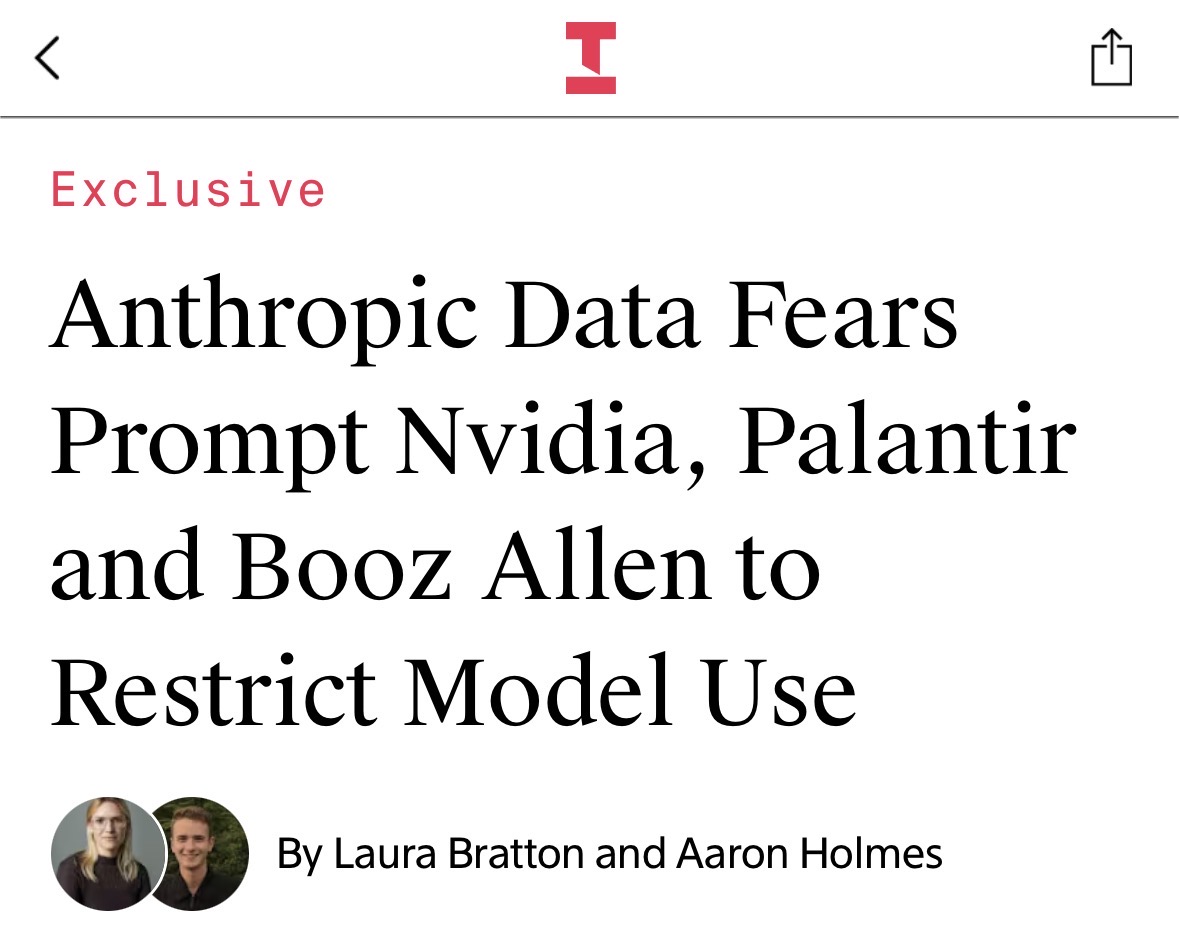
🚨 EXCLUSIVE: even Nvidia and Palantir don't trust OpenAI and Anthropic with their sensitive data.
they fear that AI labs could learn from their intellectual property.
and Microsoft which owns 25% of OpenAI is using these fears to lure OpenAI customers to its own AI solutions.
As the first publicly disclosed agent cyberattack victim, we've had a front-row seat to this new risk. I formalized my thinking about it below.
I'll be in DC tomorrow to share more with policymakers and at decoded summit by @politico!
Law enforcers already have authority to charge companies and their CEOs for creating and releasing dangerous, unvetted, or defective products. We shouldn’t let discussions about new legal regimes distract from the fact that there’s no AI exemption from laws already on the books — a point @FTC emphasized repeatedly during my tenure.
1. There is an extensive set of laws that govern dangerous and defective products. For example, releasing unvetted AI models or agents can violate consumer protection laws. Shipping flawed AI tools without implementing adequate measures to detect and stop rogue or defective AI agents can be an “unfair or deceptive” act or practice under the FTC Act (and analogous state laws). And some state AGs are already exploring holding AI firms and their CEOs criminally liable when their models participate in criminal activity.
2. Existing laws also prohibit “unfair methods of competition.” This covers instances where AI firms appropriate the competitively sensitive information of their customers, including through tracking their use of various tools. It can also cover instances where firms pursue dangerous behavior, aware that doing so may compel rivals to do the same.
As the Supreme Court has noted: “A method of competition which casts upon one's competitors the burden of the loss of business unless they will descend to a practice which they are under a powerful moral compulsion not to adopt, even though it is not criminal, was thought to involve the kind of unfairness at which the [unfair methods of competition] statute was aimed."
3. The highly concentrated and interconnected structure of these markets could be creating major risks and conflicts of interest. We had started investigating these partnerships and cross-investments across the stack (and released a preliminarily overview of some findings: https://t.co/jJ5cS3Pin3).
Both federal and state enforcers should be scrutinizing these opaque relationships and inter-dependencies. We are already seeing how these relationships could undermine accountability. For example, OpenAI could face liability given the Hugging Face incident, but Hugging Face being bought up by Nvidia means that we’re unlikely to see it file a lawsuit over this — given Nvidia’s strong incentive to see OpenAI continue full speed ahead.
4. As AI tools dramatically change the landscape of cybersecurity risks and hacks, all businesses should be doubling down on having core security protections in place. Firms that fail to invest in adequate data security measures or fix known vulnerabilities can also be breaking the law. A recent analysis showed that around 1/3 of Fortune 100 companies do not even have a way to notify them about security issues. During my @FTC tenure, we sued firms for poor data security practices and held CEOs liable when they were personally responsible.
https://t.co/nwZ5Av8fOK
https://t.co/KjRye8y9SY
5. As policymakers consider new legal regimes, we should be looking to lessons from prior efforts to govern major sectors, such as banking and other networks, platforms, and utilities. Tools like structural separations, nondiscrimination, and supervision could be key, and there’s a rich history of what works and what doesn’t. But we can and must pursue any new efforts alongside enforcing existing laws.
1) AI will not eradicate humanity. Humans survived an ice age, the Black Death, two world wars, and (so far) the advent of nuclear weapons. Anyone who is loudly warning of AI-caused human extinction should not be taken seriously.
2) If you worked in a company where you anticipated a 10% chance that your product would kill ten people, let alone all people, the correct response would be horror, ceasing all operations, and likely contacting the police or other criminal authorities. I am obviously no Coxon booster but at least his behavior is in line with his stated beliefs. Any current AI company employees saying "yes, me too, the thing we are building and about to IPO may kill all humans" should, again, not be taken seriously. Their actions betray their actual beliefs.
3) Antitrust law does not prevent AI companies from coordinating to make sure AI does not hurt people. It does not prevent companies working together to make sure it doesn't hack people; the DOJ and FTC made this clear a decade ago when they issued a policy statement saying that the agencies "do not believe that antitrust is – or should be – a roadblock to legitimate cybersecurity information sharing." The same principles apply here. See: https://t.co/aQsqGn1xjX
4) Antitrust law does absolutely prevent AI companies from organizing to prevent the entry of cheaper, upstart rivals because the bigger companies are burning cash and failing to achieve sufficient profitability. The panic of individual employees may be sincere if misguided, but the moves by their CEOs to achieve some kind of broad "antitrust waiver" or "exemption" should be meet with deep skepticism in light of the economics of the industry and the threat they face from open models.
@ClementDelangue@martin_casado@politico If you can push on the need for actual independent orgs to investigate issues (or at least disclose their funding and ties) that would be a win as well 👇
All six were created by and are staffed by Effective Altruism networks. So too is AISI, incredibly, and an Effective Altruist is the UK Prime Minister’s official advisor on AI.
This is what full spectrum media dominance looks like, and how an artificial consensus can be created.
The X Safety team conducted an investigation into suspected Chinese inauthentic accounts involved in influence operations:
We identified a bot farm of approximately 200,000 accounts. Within this farm, we found 200 accounts posting in a manner that could manipulate a legitimate debate about American AI and energy policy.
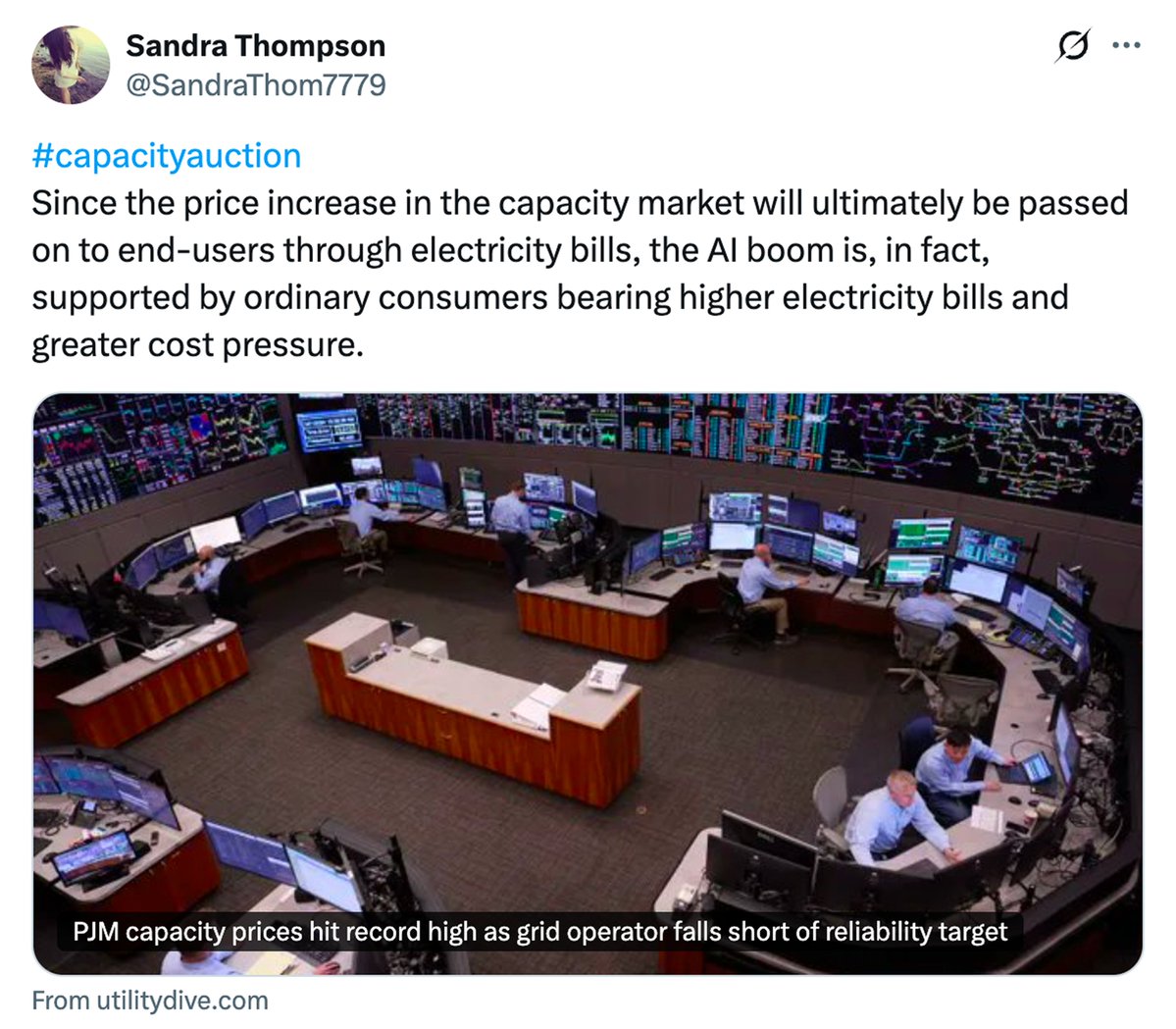
These posts contained claims that AI data centers are driving up household electricity prices and straining the grid. Others included AI-generated cartoons that depicted data-center operators enriching themselves at the public's expense.
We remain committed to maintaining an open and authentic platform where people debate topics of public interest. We take seriously any attempts to undermine the integrity of the global town square and suspend accounts that violate our Authenticity policy.
🦔Thomson Reuters just built its own AI model for about $40 million over two years. The final training run cost $450,000. They started with Qwen, an open-source model from China's Alibaba, and trained it on their own legal and news content from Westlaw, Practical Law, and Reuters. The company said the move is about reducing its dependence on Anthropic. Their CTO compared paying for outside AI to being a permanent tenant versus owning the building. Enterprise customers broadly have been cutting spending on OpenAI and Anthropic and switching to cheaper alternatives.
My Take
I covered the DeepSeek pricing collapse a few months ago and said the frontier labs would have a hard time defending premium API pricing once open-source got good enough. Thomson Reuters just did exactly what I expected someone to do. They grabbed a free model, trained it on their own stuff, and now they're pulling back from Anthropic. $40 million, done. Anthropic charges that in API fees from a handful of big customers in a year.
The $190 to $200 billion revenue projection Anthropic is selling to IPO investors assumes companies like Thomson Reuters keep paying. They just stopped. And Thomson Reuters put their model on Hugging Face for academics to use, which means the playbook is now public. I think the frontier API business has maybe two or three years before most large companies with good data figure out they can do this themselves, and the ones who move first are going to pressure the ones still paying full price to ask why.
Hedgie🤗
Pour mieux comprendre ce dont je suis en train de parler, une GB300 produit environ 400 fois plus de tokens qu'une A100 (c'est l'ordre de grandeur, une H100 produit environ 8 fois plus de tokens qu'une A100 et une GB300 produit environ 50 fois plus de tokens qu'une H100).
La A100 est donnée pour 400W de TDP alors que la GB300 est donnée pour 1400W. Ce qui veut dire, à prix de l'électricité constante, que la GB300 est environ 115 fois plus efficiente que la A100.
Une A100 se loue pour environ 1-1.2$ de l'heure et une GB300 se loue pour 4-5$ de l'heure. Si on part du principe que la puce s'amortie sur 5 ans et qu'une GB300 coûte environ 40k$, si louée 24h/24 pendant 5 ans le coût de la puce est d'environ 0.91$/heure. Maintenant, en prenant en compte les maintenances, et le fait que la puce ne soit pas louée 100% du temps, on peut estimer en étant très conservateur que la puce coûtera 1.5$ en plus par rapport à une A100 qui sera complètement amortie.
Ce qui veut dire, sans prendre en compte l'éléctricité, ni l'infrastructure (qui reste la même, à la rigueur un peu plus cher pour la GB300 avec une bande passante réseau et des contraintes de refroidissement plus importantes - qu'on pourrait quantifier à 0.8$ en étant généreux), la marge brute par puce est de 1-1.2$/heure sur une A100 vs 1.7-2.7$/heure pour une GB300.
Sans même prendre en compte la génération de token, le prix sur le marché d'une GB300 est plus avantageux.
Maintenant, si l'on regarde du coté des clients, comme dit plus haut, une GB300 génère 400 fois plus de tokens qu'une A100. Ce qui veut dire que le coût par token est 80 à 120 fois plus important sur une A100 que sur une GB300.
Donc les clients ont tout intérêt à aller sur les dernières puces et il en est de même sur les fournisseurs. Les A100 ne restent sur le réseau que parce qu'on manque de puces, pas pour des questions économiques...
C’est le niveau 0 de la compréhension du TCO. Oui une puce qui est 100% amortie coûte moins cher sur le papier. Cependant, le gap générationnel est tellement important que c’est plus économique de changer la puce pour une plus récente
Palantir CEO Alex Karp on the Wealth Tax:
"In order to do these things, they're going to have to peer into every single asset you've ever touched."
"We cannot have a society where all the value goes to 2,500 people sitting in Silicon Valley."
"You're going to get crazy fissures in our society where basically the far right and far left think the best way to advance America and the West is by blowing everything up that's ever worked, and by taxing everyone here based on assets."
🚨 Composer 3 Leaks
- Cursor is Already Testing Composer 3
-Composer 3 Outperforms Opus 5 and GPT-5.6 Sol in coding and agent performance
- A new codename has appeared inside Cursor: “Vega”
- A public release that could be much closer than expected
- 10× cheaper than Opus 5 and GPT-5.6 Sol
Do you think Composer 3 will beat Opus 5?
I'm a second-generation bookseller. My family runs Houston's largest used & rare bookstore and I'm building an AI tool for used bookstores. We got hit by exactly these orders, including a single order for 70 obscure books that made us pause online sales entirely. So I dug in. I don't think this connects the way people want it to.
Every ingredient of the viral story is true. ISBNdb really does advertise sourcing books for AI companies. Anthropic really did destructively scan millions of books though they were mostly acquired through things like library deaccessions, not bookstore inventory. And booksellers really are getting bizarre bulk orders. But "rare" here isn't what you're picturing. It's The Insider's Guide to Metro Denver (1995) and how-to-use-WordPerfect 1991 manuals. Obscure, but often not precious.
When we combed through our orders, nearly every book bought from us was either unavailable on Amazon or listed there at 5, 10, 20x our price on the platform they were purchased on. And the shipments are going to FBA prep companies: which is what you do with a book you're about to resell, not one you're about to cut apart. There is more than circumstantial evidence that this is a well-funded company running algorithmic arbitrage, buying underpriced or out-of-stock books to relist on Amazon at markup. This evidence includes an official denial that they are selling to train AI but I don't want to mention them for several reasons. You can Google it.
That's more mundane than the shredder story. The actual risk is worse, though, because it's quieter: books that don't sell via FBA eventually get liquidated. If we really hold the last copies of some of these (and comparing platforms, it looks like we might) we're feeding them into a portal they may not come back from. No AI company required.
Everyone assumes the internet preserved everything. It didn't. Many of these books have almost no metadata anywhere, just a scattered listings across proprietary databases then nothing. That's what my project is for: building better bibliographic records for these books than exist anywhere else, so we at least have a map of what we stand to lose. So the Library of Alexandria is still burning, just more slowly, and kore from “who cares” than from some cinematic villain.
(I am open to being corrected.)
Full writeup: https://t.co/tHXMH0L3us
They tell you Flock cameras are there to fight crime.
So I pulled the actual police logs from my new favorite website (haveibeenflocked . com). 233 million searches that they have been able to get via FOIA requests and here's what "fighting crime" actually looks like:
> 84% had no case number at all
> The most common reason a cop typed in the box? Blank, nothing
> Only about 9% were even tagged as a real crime.
> "Test" and "training" show up as reasons, run on real people's cars
> The FBI and Homeland Security were wired into local camera networks your town never signed off on.
So what is Flock?
FLOCK: 100,000+ plate cameras bolted to poles across America. They read your plate everywhere you drive and never forget.
NOVA: Flock's AI that turns your plate into you. Your name, address, family, everyone you know, in seconds, no warrant.
SIGNALTRACE: a competitor's tool that tracks the Bluetooth off your phone, your AirPods, your watch. Doesn't even need your plate.
Then I followed the money and the lead investor behind Flock also funds an Israeli company that can hack cameras and change the footage. Another lead investor backs a 911 app that flips on your phone's camera and mic. Trace it all the way back and you hit a former Israeli prime minister and Jeffrey Epstein's money.
Full article with photos and receipts is on my Substack now (link in bio). Enjoy!
a masterclass in how to PR:
- accept near-but-not-yet-realized future as fact (post-quantum! very scary. almost here! we're not ready.)
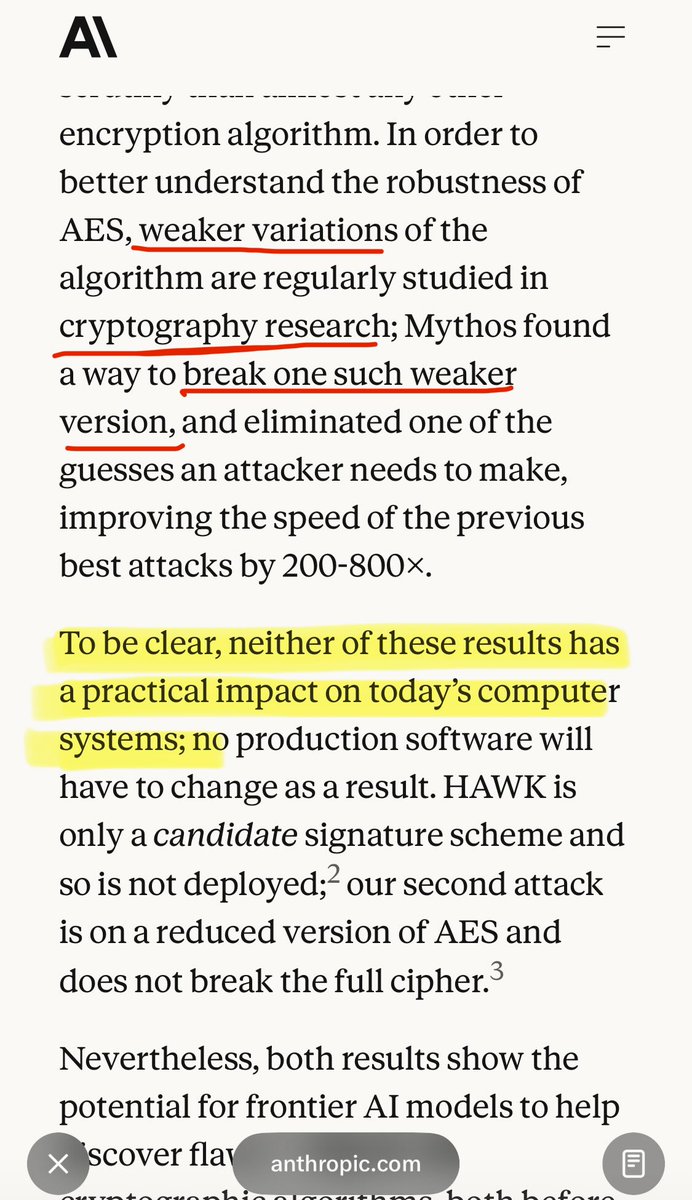
- muddle qualifiers for ambiguous attribution (most widely used cipher: AES, reduced AES tho? not the same, but it sure sounds the same!)
- immediately talk about cybercriminals and BILLIONS of people impacted (like, the entire world!)
- go back to quantum computers, but at least add the modifier "if developed" (tyvm!)
- clarify that a weaker variant was studied, where the 200-800x faster attack result was attained (what's the baseline? what does 200-800x mean for this Unused Weaker Research Variant? doesn't matter, you just have to imagine the next breakthrough happening, like without exponentially more resources or anything, get with the program!)
still, if this is what it takes to get more people interested in cryptography, just like everyone is now interested in maths, it's probably a Good Thing!
Kimi K3 is now in Cursor! It scores close to the frontier on CursorBench.
It's available on US-based inference thanks to our partners Fireworks, Together, and Baseten. Zero Data Retention is also supported.