안녕? 테트리스 좋아해?
여기 어제 잠깐 만들어봤어😆
같이할래? TTERIS 트테리스
Hello? Do you like Tetris?
I made it here for a while yesterday😆
Do you want to do it together? TTERIS
https://t.co/EguTolJ5Ke
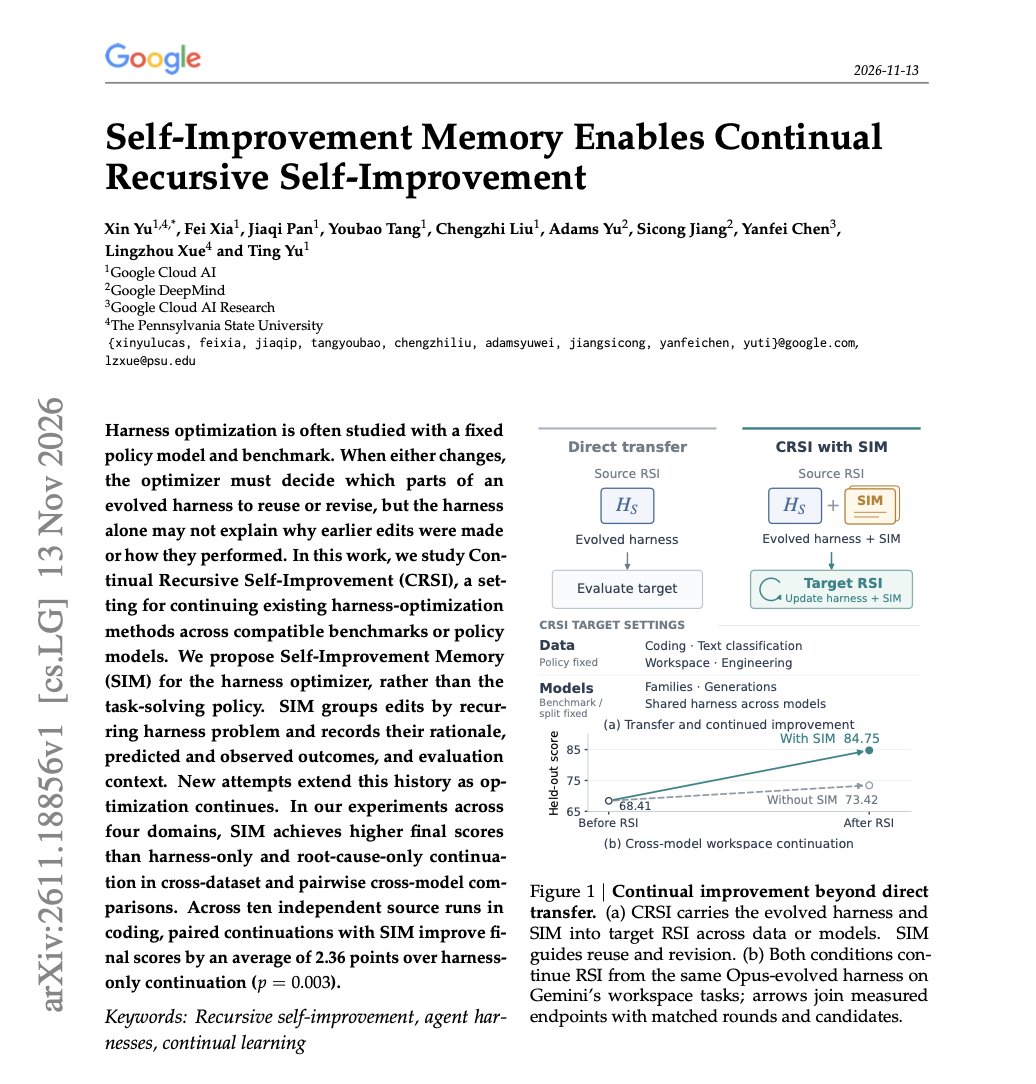
Brilliant paper from Google on RSI.
(bookmark it)
Recursive self-improvement (RSI) lets an optimizer agent improve an agent harness on its own. It reads failure traces, edits the prompts, tools and completion checks, and keeps whatever scores better on a benchmark.
This works until the model underneath changes. A harness evolved on Claude Opus, moved to Gemini, scored below Gemini's plain starting harness in every domain Google tested.
When the harness moves to a new model, the only thing carried over is the evolved harness code, meaning the prompts, checks and rules the optimizer added. The record of how each piece got there stays behind, including which failure it targeted and whether it fixed that failure when tested.
So the optimizer working on the new model inherits a set of changes with no reasons attached. It ends up retrying experiments that already failed, or removing fixes it doesn’t understand.
Google's fix is Self-Improvement Memory (SIM), a log kept for the optimizer itself. Each entry is a recurring problem, like an agent declaring a task done before its commands ran, and every fix attempted under it stores:
1. The edit and the reasoning behind it
2. The tasks it was predicted to fix, written down before testing
3. The tasks it actually fixed, failures included
4. The model and benchmark it was tested on
The whole log goes into the optimizer's prompt every round, and new attempts get appended as optimization continues.
The paper shows the difference on one inherited check that stops the agent from finishing early. With SIM, the optimizer read why the check existed and extended it.
Without SIM, it rewrote the same check four times, twice to fix deadlocks it had created itself.
On the Opus-to-Gemini workspace tasks, the run with SIM improved about 3x more from the same starting score. It also finished ahead in 9 of 10 independent coding runs.
The paper is at https://t.co/ZLdo7FK7qk
I also wrote an article on a related idea, covering how to make an agent harness diagnose its own failures.
It's built on @Cometml's Opik, which is 100% open source. It goes beyond reading trace logs to finding why a failure happened and stopping it from recurring.
That diagnosis step produces the kind of root causes SIM stores.
The article is quoted below.
Introducing Mini 2, the next-generation portable Starlink. Get up to 4.5 hours of connectivity on a single charge with the quick-swap battery, or plug in with USB-C.
With built-in Wi-Fi, all you need is a clear view of the sky to get online in 60 seconds.
Preorders are now open by invitation in the US. Be the first to know when it's available → https://t.co/t2pSI1buaW
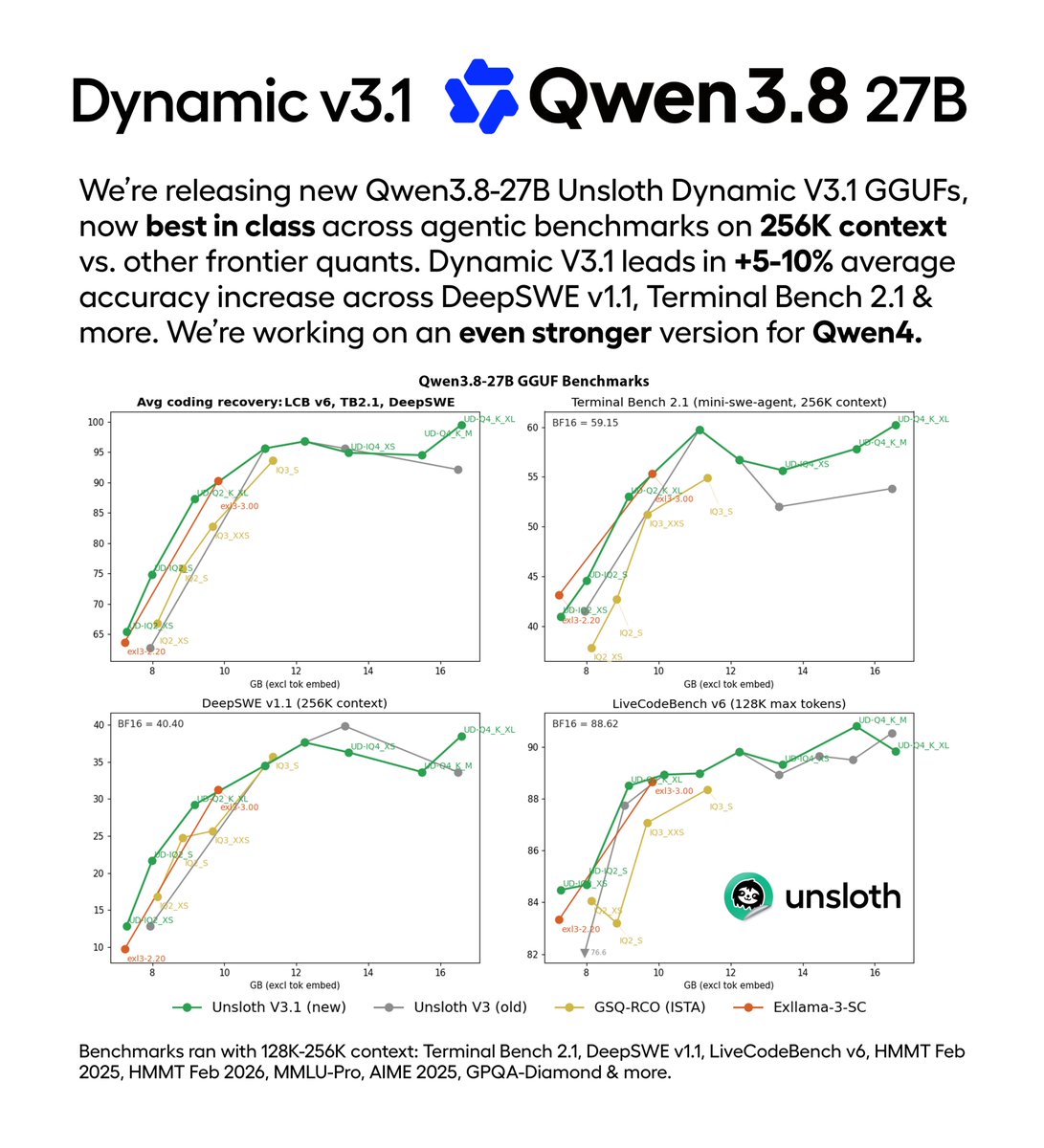
Today, we're releasing the highest accuracy Qwen3.8-27B GGUFs.
Our new Dynamic V3.1 GGUFs lead by 5–10% on average across Terminal Bench, DeepSWE & more. We’re working on even better version for Qwen4
Run on 12GB RAM.
GGUF: https://t.co/xIdNwm7CLQ
Blog: https://t.co/J2PwgMP6GZ
ERNIE 5.5 Flash Preview just landed! 🔥
Built on a new architecture designed for efficient inference, the latest open-weight foundation model in the ERNIE family delivers stronger performance in coding, 3D modeling, knowledge work and content creation.
It keeps decoding fast while posting competitive scores on Terminal-Bench, AutomationBench, and other benchmarks.
Here's the rundown:
- 280B total parameters, 14B active per token
- 1M-token context window
- Generation speed above 200 tokens/sec
Model weights will be released by November 25.
솔직히 크래프톤이 별로 마음에 썩 드는 곳은 아니지만(나한테 노트북 안사줘서(입찰에서 떨어짐😂)그런 것도 조금 있긴 함)
게임사가 굳이 왜 LLM 모델을 ??이라고 생각을 하는 찰나에 문득 드는 생각은 아마도 이 녀석들 게임에다가 이 소형 모델을 넣어서 사용자들이 굴리면서 어떤 재밌는 상호 작용을 하는 것을 바라는 걸 수도 있겠구나 라는 생각을 해 봤음.
오 🤔 이거 좀 괜찮은데??
그런 의미에서 크래프톤 응원 한다! K LLM 화이팅 ㅋ
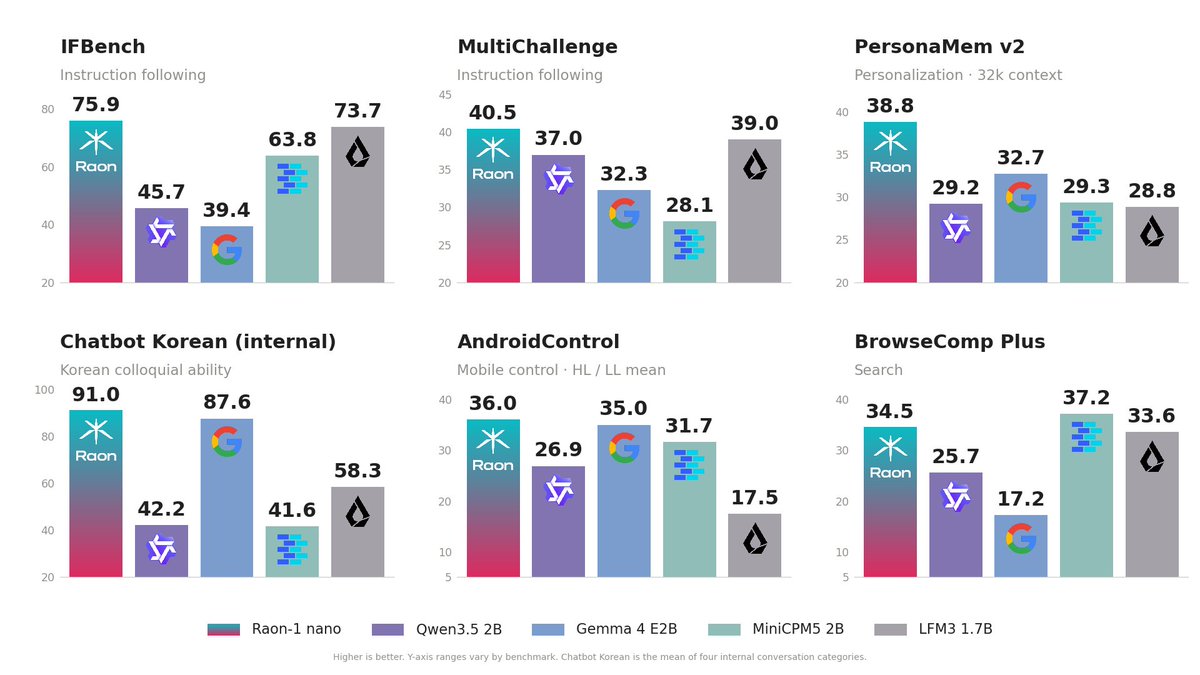
We’re releasing Raon-1 nano, an effective 1.5B dense LLM with per-layer embeddings and 3.1B total parameters. ⚡
Our journey from PUBG Ally toward on-device LLMs continues.
We pruned and distilled Raon-1 mini preview (30B-A4B) using our MoE-to-Dense approach, then further trained it on 3T tokens, followed by SFT, OPD, and RL.
Designed for natural conversations, maintaining conversational context, instruction following, and tool use in both Korean and English.
Small model. Smart interactions. Enjoy! 😊
🤗 Weights (Apache 2.0 license): https://t.co/ZVMZmlSNlz
📄 MoE-to-Dense (NeurIPS 2026 Oral): https://t.co/eoYH86lBs0
🪖 Learn more about PUBG Ally: https://t.co/A3iZvP2X7c