REASONS TO VISIT
🇬🇷 #Greece 🇬🇷
1️⃣Hospitable People
2️⃣Mouth-Watering Food
3️⃣Coffee Culture & Drinks
4️⃣Remarkable History
5️⃣Stunning Beaches
6️⃣Mediterranean Climate
7️⃣Kids Love Greece
8️⃣Budget Friendly
9️⃣Safe Place For Holidays
https://t.co/bUCdPEDjKa
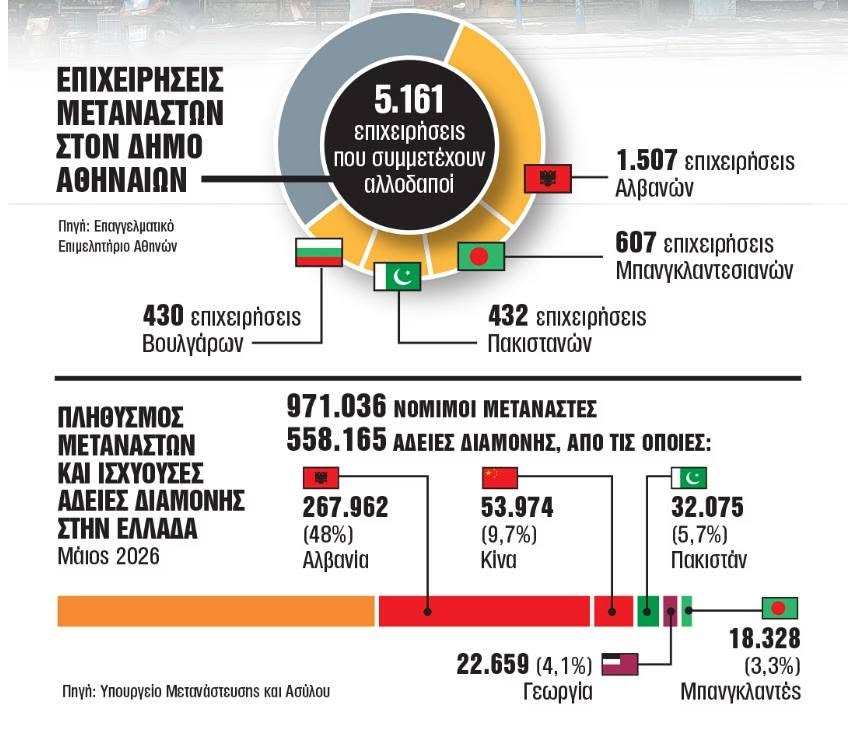
Σε άρθρο των Νέων με τίτλο "γειτονιές μεταναστών στην καρδιά της "παλαιάς" Αθήνας μαθαίνουμε ότι υπάρχουν 5161 ΑΦΜ αλλοδαπών, ενώ οι Μπαγκλαντεσιάνοι έχουν 112 παντοπωλεία στην πόλη(!). Όχι σε όλη την πόλη. Σε συγκεκριμένες περιοχές.
Διαβάζουμε την απίθανη ιστορία ενός υπήκοου Μπαγκλαντές, ο οποίος ήρθε στην Ελλάδα το 1994 από τη Ρωσία, όπου σπούδαζε και δούλεψε σε εργοστάσιο. Τώρα δηλαδή αυτό να το πιστέψουμε.
Υπάρχει δε και ένα πολύ ενδιαφέρον γράφημα, στο οποίο μπορούμε να δούμε τα εξής. 971.036 είναι οι νόμιμοι μετανάστες στη χώρα, το 10% του πληθυσμού περίπου. Από αυτούς πόσοι εργάζονται δεν γνωρίζουμε. Χρειάζεται η χώρα τόσους μετανάστες; Σίγουρα όχι, διότι ούτε καμία φοβερή βιομηχανία έχουμε, ούτε καμία οικονομική δραστηριότητα που πρέπει να απασχολούμε τόσους αλλοδαπούς. Και μην μου πει κάποιος ότι η Αθήνα χρειαζόταν 112 Μπαγκλαντεσιάνικα μίνι μάρκετ. Ότι χρειαζόμασταν τόσες επιχειρήσεις αλλοδαπών, οι οποίες είναι και πολύ συγκεκριμένων δραστηριοτήτων. Δεν χρειαζόμασταν.
Στις δηλωμένες επιχειρήσεις στο Επιμελητήριο πρέπει να προστεθούν και πάρα πολλές που ΔΕΝ είναι δηλωμένες στο Επιμελητήριο, οι οποίες λειτουργούν παράνομα.
Τα δε στοιχεία που βλέπουμε αφορούν τις εγγραφές στο Επαγγελματικό Επιμελητήριο. Δεν περιλαμβάνουν επιχειρήσεις αλλοδαπών που εγγράφονται σε άλλα Επιμελητήρια και είναι και αυτές χιλιάδες.
Η οικονομική δραστηριότητα όλων αυτών με τις άδειες διαμονής ή με άσυλο, γιατί και με άσυλο μπορούν να επιχειρήσουν, που σήμερα είναι στην Ελλάδα και αύριο φεύγουν έχοντας φεσώσει το Δημόσιο δεν αφορά μόνο την Αθήνα, αλλά όλη την Ελλάδα που πληρώνει τα φέσια.
Η επιχειρηματική γκετοποίηση ολόκληρων περιοχών, όπου βρίσκεις 100 μίνι μάρκετ το ένα δίπλα στο άλλο και άλλα τόσα μπαρμπέρικα καταστρέφει ολόκληρες συνοικίες. Κλείνουν σοβαρές επιχειρήσεις, γιατί δίπλα σκάει το τσαντιρομάγαζο και πολλαπλασιάζονται άχρηστα μαγαζιά. Παλιά αλλοδαπός δεν μπορούσε να έχει επιχείρηση, παρά μόνο αν ελάμβανε ειδική άδεια ΠΡΙΝ έρθει στην χώρα. Αυτό προστάτευε την οικονομία και τον πληθυσμό.
Τώρα μπάτε σκύλοι αλέστε.
Μην φέρνουν και τίποτα συμπατριώτες τους ως μετακλητούς εργαζόμενους. Από έναν να ζητήσει κάθε επιχείρηση έχουμε άλλους 5000 νομιμότατους μέσα στην Αθήνα. Και όλοι αυτοί ξέρουμε πού μένουν. Στις "γειτονιές μεταναστών", διότι οι Έλληνες έφυγαν. Τους έδιωξαν οι μετανάστες. #Αθήνα #γκέτο
Universal is demanding every meme about the Odyssey be taken down.
You’d think after all the money they made off Hercules they would be nice but apparently not.
Fantastic news!
We won our battle in court against the Mayor of Brussels! The @SaveEuropeAct event is now officially allowed!
A huge thank you to everyone who supported us.
We won and we will keep winning!
Today I learned that in Nolan’s movie "Odyssey," there is a line: "Sinon was the greatest warrior among the Greeks." Sinon is not mentioned in Homer at all, and in the film he is played by a woman. Now look at what’s happening. We Greeks are forced to listen to barbarians telling us that the movie is amazing, while watching our Greek civilization being mocked on screen, and being told that the greatest warrior of the Greeks is Sinon, played by a woman.
In other words, we Greeks are forced to watch a film based on our own history and our ancestors, and if we disagree with what we see or get angry about it, then we are called racists and puppets of Elon Musk. That’s what they tell us.
So from now on, the purpose of my life will be to turn as many people as possible against all those academics and classicists who supported this abomination, this thing that mocks Greek culture, takes the greatest and most important Greek epic poem, and turns it into a "fairy tale."
No, it is not a fairy tale. It is our Greek history. They are our Greek ancestors. And we have every right to express our opinion, to demand proper representation in the casting, and to demand that Greek academics and historians oversee the script and the historical authenticity of films that exploit Greek civilization to make money in our name.
Enough with the exploitation, the propaganda, and the distortion.
@HomerPavlos She could have played a suitable part,like Homer's maid or servant.
(The maids of Odysseus's household who were disloyal and consorted with the suitors were executed by Telemachus).
If she kept her mouth shut,she could have saved herself.
There is an important post I wrote 2 months ago and I want to share again, in which I'm trying to explain to you why they hate Homer and why they want you weak and spiritually dead. It has to do with what I call "Homeric Law". Let me explain. In the Battle of Marathon, all the Greek heroes who became role models for us, took part. Miltiades, Themistocles, Aristides, Aeschylus with his brother Cynegirus. But besides them, a dog also helped in the fight. According to Claudius Aelian (On the Characteristics of Animals, VII, 38), a Greek brought his dog to the camp, and the dog attacked the Persians alongside its master. This scene is also depicted in the wall painting of the Stoa Poikile (Painted Stoa) from the 5th century BC.
The bronze helmet of Miltiades, which the Athenian general wore during the battle, was dedicated by him himself to the sanctuary of Zeus in Olympia as a thank-offering to the god for the victory. The helmet was discovered and is today on display at the Archaeological Museum of Olympia.
Themistocles, that great Greek, after the Battle of Marathon could not sleep and wandered sleepless through Athens. He used to say: "Οὐκ ἐᾷ με καθεύδειν τὸ τοῦ Μιλτιάδου τρόπαιον", which means, "The trophy of Miltiades does not let me sleep." He wanted to surpass Miltiades so much that he couldn't sleep. Can you imagine that? When the Persian king Artaxerxes asked for his help to attack the Greeks, Themistocles drank poison and committed suicide so as not to betray his country, Greece.
When Aeschylus died, he asked his relatives and close friends to inscribe an epitaph that reflected what he stood for in life and the values he held dear. Our first thought would be that Aeschylus would have wanted them to write that he was a great tragic poet with many awards and an outstanding body of work. Yet the epitaph makes no mention at all of his tragedies or his theatrical achievements, the very things for which all humanity remembers him today. Aeschylus wanted something written that showed what truly mattered to him. The epitaph therefore reads:
"This tomb in wheat-bearing Gela hides Aeschylus dead, son of Euphorion, the Athenian; of his worthy courage the grove of Marathon can tell, and the long-haired Mede who knows it well."
- (Source: Ἀθήναιος 14, 6)
The only thing that mattered to Aeschylus was Greece.
During the communal meals (syssitia) in Sparta, three choruses were formed according to the three age groups.
1. The chorus of the old men would begin singing: "We once were strong young men."
(Ἄμμες πόκ' ἦμες ἄλκιμοι νεανίαι)
2. The chorus of the men in their prime would reply: "We are the ones now; if you want, behold us"
(Ἄμμες δέ γ' εἰμέν· αἰ δὲ λῇς, αὐγάσδεο)
3. And the third chorus, that of the young boys, would say: "We shall become much better."
(Ἄμμες δέ γ' ἐσσόμεσθα πολλῷ κάρρονες)
These Greeks were great because they lived according to the most fundamental "Homeric Law", one that some people today want you not to know.
"Always strive for excellence and to surpass the others, and do not bring shame upon the race of your ancestors." (Homer, Iliad Z 208–209)
With these words, Hippolochus advised his son Glaucus when he sent him to fight in Troy. Earlier in the same book we read:
"Why do you ask of my lineage, fearless son of Tydeus? The generations of mortals are like the leaves of the trees: some the wind scatters upon the ground, and others the forest brings forth again when spring renews the trees. Thus one generation of men springs up, and another passes away." (Homer, Iliad Z 145–149)
We Greeks, we still use that Homeric phrase. We say "Aien aristeuein," which means "Always to excel."
These words from Homer shaped generations of heroes and glorious men. This phrase lived in our collective memory, at least until today, and we fought to become better than our ancestors and worthy of our heroes. We had role models; we admired our grandfathers. The archetype of the heroic ancestor was born, and the lifelong purpose was always to surpass him through great deeds in one’s own life.
Until the dark days of today arrived, days baptized as "progress," in which every day we slide from bad to worse. You read my posts, you see what they are trying to do with the Classics. They hate Homer, they hate Plato and Aristotle, Alexander, Leonidas, they hate Achilles, they hate the Greek tragedies. They won't admit it, but you can see it when they are "manipulating the translations" to fit their agendas. Some want to create a degenerate world, sunk in atheism, anarchy, and spiritual collapse, far removed from values, virtues, and morality. They call this "progress," yet it is nothing but total subjugation, heads bowed, without any desire to resist.
To live without the imperative "aien aristeuein" (Always to excel), is to accept the slow death of the human spirit. When excellence is no longer the measure, when the only sacred thing left is the right to mediocrity and the comfort of never being judged by the shadow of greater men, then man ceases to be a bridge toward something higher and becomes merely a consumer of fleeting pleasures in a rootless present.
A civilization that teaches its young to surpass their ancestors in virtue, courage, wisdom, and beauty ascends.
One that teaches them to despise or ignore their ancestors has already begun its long descent into oblivion.
"Aien aristeuein"
Homer Pavlos