Two months ago, I created a System Design repo on Github, and I'm excited to share that it recently reached over 3000 stars.
Thanks to everyone who has starred or forked the repository!
The repository contains a collection of resources to study:
- Around 40 System Design concepts
- Around 50 System Design problems categorized by difficulty level
My goal with this repo is to curate the best resources to learn System Design and prepare for interviews.
If you find it valuable, consider giving it a star.
Check it out here: https://t.co/pkVpi6LxSV
The biggest mistake I made as a beginner engineer:
- Not learning SQL
SQL databases have been around for 40+ years for a reason.
You'll never understand the power of databases if you rely only on ORMs.
Instead, focus on the following:
- SQL fundamentals
- Data modeling
- Transactions
- Indexing
Master relational databases!
It is worth it.
You'll grow 10x faster.
P.S. Repost this to help others grow 10x faster. ♻️
Whenever I see a wordpress site -
1. Run wpscan
2. /wp-json/wp/v2/users /wp-json/?rest_route=/wp/v2/users[/n] /?author=n and try common passwords.
3. /wp-admin/install.php
4. /wp-config.php.zip /wp-config.php.bak
5. /wp-content/debug.log
6. SSRF /wp-json/oembed/1.0/proxy?url=
Why bad developers fail:
- Read the task description
- Start writing code
- Run into a problem
- Find a solution to try
- Copy & paste code
- Get stuck again
- Delete everything
- Start from scratch
- Ask for help...
How successful developers solve problems:
- Read the task description
- Brainstorm many solutions
- Pick the best solution
- Make a good plan
- Write the tests* (TDD)
- Write the code
- Write the tests
- Refactor
- Optimize
Spend more time thinking.
Solve more problems.
Efficiency >>> Being busy
Software architectural patterns are reusable solutions to commonly occurring design problems in software architecture that provide a structured way to organize and design a software system to achieve specific qualities such as flexibility, scalability, and maintainability.
1. Event-Driven Architecture (EDA):
- In an event-driven architecture, the flow of the system is determined by events such as user actions, sensor outputs, or messages from other systems. Components in the system communicate through events, and event handlers respond to these events.
- 🔑 Key Concepts: Events, Event Handlers, Asynchronous Communication.
2. Layered Architecture:
- Layered architecture organizes the system into distinct layers, where each layer has a specific responsibility. Communication typically occurs only between adjacent layers, and each layer provides specific functionality.
- 🔑 Key Concepts: Presentation Layer, Business Logic Layer, Data Access Layer.
3. Monolith:
- A monolithic architecture is a traditional approach where all components and modules of a software application are tightly integrated into a single codebase and deployed as a single unit. This contrasts with distributed architectures like microservices.
- 🔑 Key Characteristics: Single Codebase, Tight Integration, Single Deployment Unit.
4. Microservices Architecture:
- Microservices break down a software application into small, independently deployable services. Each service focuses on a specific business capability and communicates with others through APIs. Microservices promote scalability, maintainability, and flexibility.
- 🔑 Key Characteristics: Independent Deployability, Service Isolation, Decentralized Data Management.
5. Model-View-Controller (MVC):
- MVC is a design pattern that separates an application into three interconnected components: Model (data and business logic), View (user interface), and Controller (handles user input and updates the model and view accordingly).
- 🔑 Key Components: Model, View, Controller.
6. Master-Slave Architecture:
- In a master-slave architecture, one central node (the master) controls and manages one or more subordinate nodes (the slaves). The master distributes tasks to the slaves, and they report back to the master.
- 🔑 Key Components: Master Node, Slave Nodes, Task Distribution.
These architectural patterns provide different ways to structure and design software systems based on various requirements, such as scalability, maintainability, and ease of development. The choice of an architectural pattern depends on the specific needs and goals of the application or system being developed.
👍🏿 Subscribe to our newsletter - https://t.co/hxARDoA98l
#systemdesign #coding #interviewtips
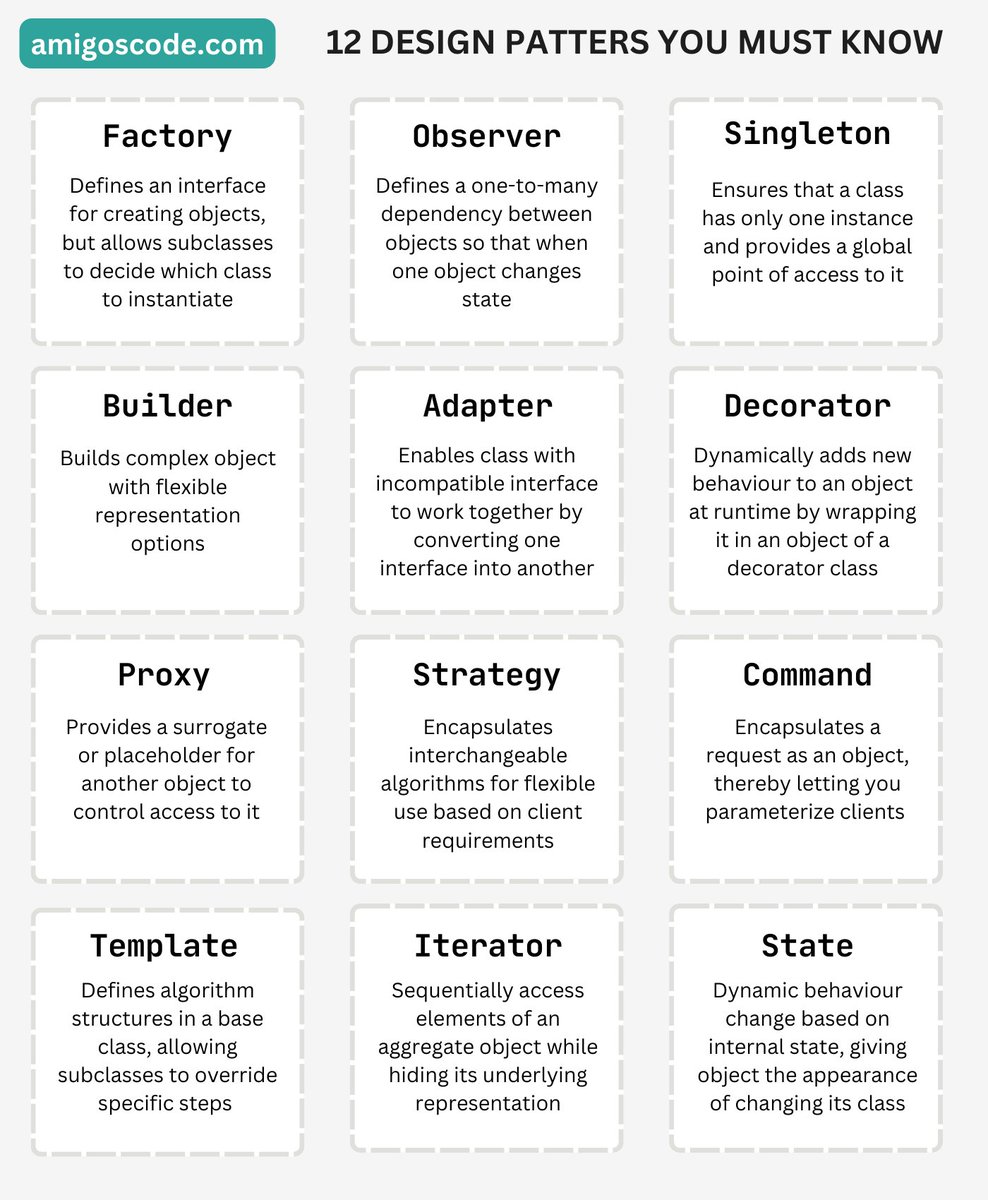
12 Design Patterns You Must Know
1. Factory Pattern 🏭
Imagine a factory that produces different products. Similarly, this pattern creates objects without specifying their exact class, making code flexible and easy to extend. 🧩
2. Observer Pattern 🔍
Like subscribing to updates! Objects (observers) register to watch changes in a subject. When the subject changes, observers are notified automatically. 📡🔔
3. Singleton Pattern 🕊️
The one and only! Ensures a class has only one instance globally accessible. Useful for managing shared resources like databases. 🌐🔒
4. Builder Pattern 🛠️
Building complex objects step by step. Think of it as assembling Lego bricks to create something intricate without the mess! 🧱🏗️
5. Adapter Pattern 🌉
Bridging the gap! Converts the interface of one class into another interface clients expect. Makes incompatible components work together. 🔌🔌
6. Decorator Pattern 🎈
Like adding toppings to your pizza! Dynamically adds responsibilities to objects without changing their code. A flexible alternative to subclassing. 🍕✨
7. Proxy Pattern 🕶️
Virtual representative! Controls access to an object, acting as a stand-in with additional functionality, like lazy loading. 🔒🔍
8. Strategy Pattern 🎯
Switching strategies seamlessly! Allows selecting algorithms during runtime. Useful when you want to provide multiple ways to accomplish a task. 🎮🔄
9. Command Pattern ⌨️
Encapsulates requests as objects, allowing parameterization of clients with different requests and queuing of requests. Think of it as a to-do list for your program. 📋📌
10. Template Pattern 📄
Standardized process steps! Defines the structure of an algorithm, letting subclasses override specific steps. Ideal for reusable workflows. 📊📈
11. Iterator Pattern 🔄
Tour guide for collections! Provides a way to access elements of a collection without exposing its underlying representation. 🚶♂️🗺️
12. State Pattern 🚦
Like a traffic light! Allows an object to change its behavior when its internal state changes. Keeps your code organized as states pile up. 🚥🔄
#Coding #SoftwareEngineering #SoftwareDeveloper
Top 10 Architecture Characteristics / Non-Functional Requirements with Cheatsheet
Did we miss anything? If yes, Please help to enrich us by sharing your thoughts in the comments. {1/3}
/1 I read something unbelievable today: Levels. fyi scaled to millions of users using 𝐆𝐨𝐨𝐠𝐥𝐞 𝐒𝐡𝐞𝐞𝐭𝐬 𝐚𝐬 𝐚 𝐛𝐚𝐜𝐤𝐞𝐧𝐝!
They started off on Google Forms and Sheets, which helped them reach millions of monthly active users before switching to a proper backend.
DevOps/SRE engineers are often responsible for creating and maintaining automated workflows
Having knowledge of Git's advanced features enables you to work more efficiently.
So, let's take a look at the most useful Git commands to streamline your Git productivity.
🧵👇