Morgan Stanley: Robotics
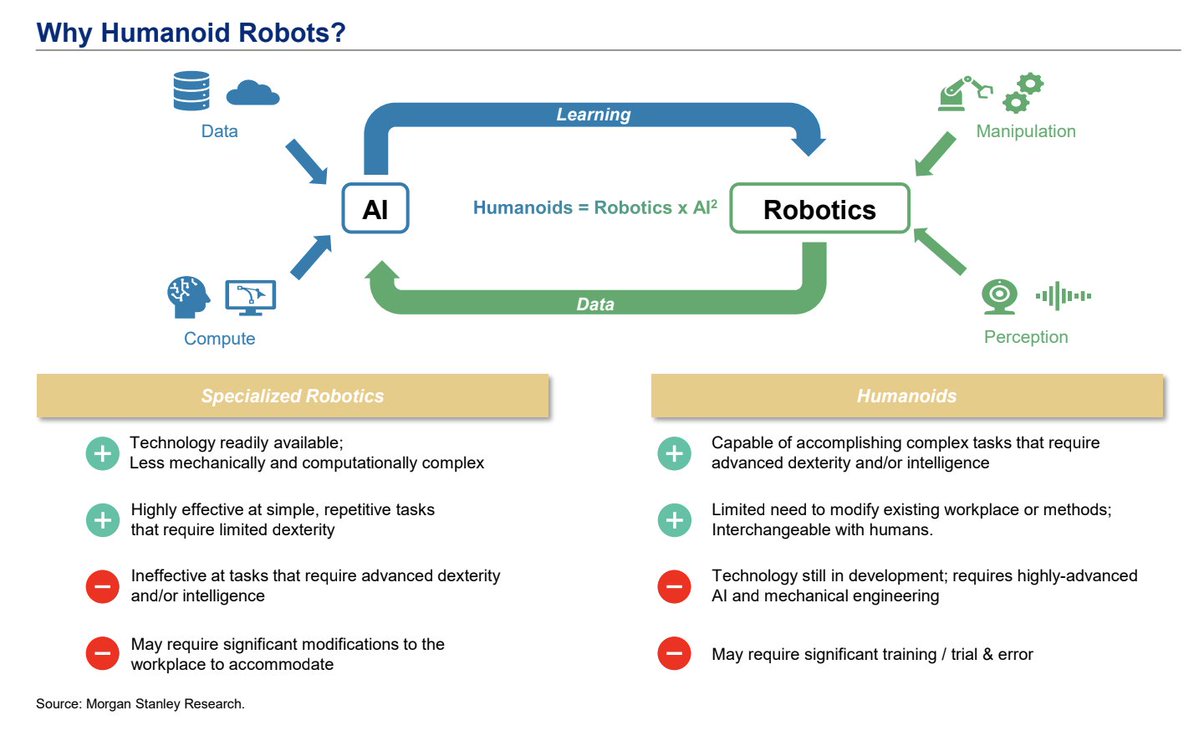
> Humanoid robots represent the largest embodied AI opportunity, with a projected global total addressable market (TAM) of US$7.5 trillion by 2050, accumulating an estimated global stock of 1 billion robots.
> While the industry is in its infancy, Morgan Stanley forecasts that small-scale commercialization and pilot deployments will begin this year (2026).
> The global humanoid component market is projected to reach a TAM of US$780 billion by 2040. Key hardware components are expected to see massive demand multipliers by 2050 compared to 2025 levels, led by Edge Compute (1,904x), Bearings (370x), Motors (170x), and Reducers (157x).
> Shipment Forecasts: China’s humanoid shipments are expected to grow at an 85% CAGR between 2025 and 2030, rising from 12k units to 262k units.
> Cost Advantage: China possesses a significant Bill of Materials (BoM) cost advantage over non-China supply chains. Survey data reveals that potential adopters view a price range of US$14k–$28k (Rmb100k–199k) per unit as the sweet spot for broad adoption (with products like the Unitree G1 already selling at US$16k).
> Government Support: Government guidance funds for robotics exceed Rmb187 billion (~US$27 billion). Local governments are heavily subsidizing the ecosystem and actively creating early orders via "data collection centers".
> In 2025, China's humanoid shipment mix was heavily dominated by R&D/Education (42%), followed by Data Collection (19%), Interaction (19%), and Entertainment (16%).
Since people are interested in humanoids now:
I'd encourage you to read my summary article on why I strongly believe that robotics/humanoids are the next fronteir for AI.
(My display pic alone should tell you I'm huge on the theme lol)
I'm also considering posting my full 5,000+ word humanoid report at some point too.
Just had to significantly shorten the original article into a format/summary that fits well on X.
Everyone is chasing the humanoid logos. I did what I did with AI Infra -- looked underneath the hood.
The money is not in the robot. It is in the ~40 parts that repeat inside every body, the ones almost nobody can build.
Here's the full list according to Goldman Sachs:
1. The brain // the intelligence:
$NVDA Nvidia -- Jetson + GR00T. The obvious one, lowest humanoid alpha.
$QCOM Qualcomm -- RB6, lower-power industrial.
Also: Tesla, $GOOGL, $META, iFlytek (https://t.co/KU8j5ePbkQ), Huawei (private)
2. Sensors & perception // how it sees and feels:
$OUST Ouster -- solid-state lidar pure-play.
$CGNX Cognex -- machine-vision incumbent.
$ALGM Allegro -- magnetic position sensors. The quiet winner, every joint needs them.
$VPG Vishay Precision -- strain gauges, force sensing.
$NOVT Novanta -- six-axis force-torque (ATI).
Also: Orbbec (https://t.co/EmUgsWEgkb), RoboSense (https://t.co/LhyDNpQfLV), $HSAI Hesai, Sunny Optical (https://t.co/bGc3smstll)
3. Edge AI inference // decisions on-device:
$AMBA Ambarella -- edge vision processors.
$LSCC Lattice -- low-power FPGAs for sensor fusion.
$CEVA Ceva -- DSP and inference IP. Pure licensing, pure obscurity.
4. Motors & motion // the muscles:
$NJDCY Nidec -- world's largest motor maker.
$AME Ametek -- precision instruments and motion.
$RRX Regal Rexnord -- motors and drives at scale.
$RBC RBC Bearings -- precision components.
Also: Moons' Electric (https://t.co/SU7teQIXWZ), Zhaowei (https://t.co/SfgqzHgLXa), Leadshine (https://t.co/QVkDM2gVw8), Veichi (https://t.co/gmK0xmcWww)
5. Joints & precision motion // human-like movement --
THE POTENTIAL BOTTLENECK:
6324.T Harmonic Drive -- strain wave gears. Every Optimus joint uses one.
6481.T THK -- planetary roller screws and linear bearings. Tokyo-listed, off the radar.
$ALNT Allient -- US-listed, integrated motion.
https://t.co/PItDtJ8PBJ Schaeffler -- roller screws.
Also: LeaderDrive (https://t.co/VL92TVG0Iw), Shuanghuan (https://t.co/8px4AQdQsO), Zhongda Leader (https://t.co/Znu2SoTgkf)
6. Dexterous hands // a humanoid in your palm:
$INVN... none US-listed. China leads here.
Zhaowei (https://t.co/SfgqzHgLXa) -- hand drive modules.
Inovance (https://t.co/kN8VYE6iDX) -- servo and motion control.
Also: PaXini (private, tactile)
7. Actuator assembly // putting it together:
Sanhua (https://t.co/4zM5co71yk) -- assembly at auto-supply-chain cost.
Tuopu (https://t.co/78h2i40K2N) -- built for cost and volume.
8. Power electronics // energy into controlled motion:
$NVTS Navitas -- GaN, the asymmetric small-cap.
$TXN Texas Instruments -- motor-control MCUs at scale.
$STM STMicro -- broad motor-control portfolio.
$ON onsemi -- power management and sensing.
$MPWR Monolithic Power -- high-efficiency DC-DC.
$IFNNY Infineon -- automotive-grade power.
$RNECY Renesas -- automotive and industrial motor control.
$WOLF Wolfspeed -- SiC pure-play, the distressed wildcard.
9. Energy & rare earth // the raw fuel:
$MP MP Materials -- the REE pure-play everyone knows.
$USAR USA Rare Earth -- magnet manufacturing, the new entrant.
$LYSCF Lynas -- largest non-China producer.
$UUUU Energy Fuels -- diversified REE and uranium.
$ENS EnerSys -- industrial batteries.
Also: CATL (https://t.co/havEzEZrGN). The magnet, not the cell, is the scarce part.
The one maker I'd own:
$CCXI Churchill Capital XI -- merging with Agility Robotics, trades as $AGLT on close. Only US-listed pure-play humanoid. Pre-deal SPAC, size it small.
The one maker I own: $CCXI / $AGLT
$CCXI Churchill Capital XI -- merging with Agility Robotics, trades as $AGLT on close. Only US-listed pure-play humanoid. Digit is real: 65k+ work hours, 300M+ in orders, backed by NVIDIA, Amazon, Foxconn.
The winners may not be the robot makers. They may be the companies inside the robot.
I made a deeper dive for free on my substack, go check it out:
https://t.co/euNn12SDVp
Now you know which floor to look at. ⚡
📢 𝐉𝐔𝐒𝐓 𝐈𝐍: $ALAB Astera Labs Expands Taiwan Operations and Cloud-Scale Interop Lab
👉 𝐊𝐞𝐲 𝐇𝐢𝐠𝐡𝐥𝐢𝐠𝐡𝐭𝐬:
➤ Astera Labs expands its 𝐓𝐚𝐢𝐰𝐚𝐧 engineering footprint and Cloud-Scale Interop Lab.
➤ Expansion strengthens 𝐀𝐈 𝐬𝐲𝐬𝐭𝐞𝐦 integration with leading platform providers and ODMs.
➤ Collaborates with 𝐀𝐌𝐃, 𝐀𝐫𝐦, 𝐈𝐧𝐭𝐞𝐥, and 𝐍𝐕𝐈𝐃𝐈𝐀 on AI infrastructure validation.
➤ Supports ODM partners including 𝐅𝐨𝐱𝐜𝐨𝐧𝐧, 𝐆𝐈𝐆𝐀𝐁𝐘𝐓𝐄, 𝐈𝐧𝐯𝐞𝐧𝐭𝐞𝐜, 𝐐𝐂𝐓, and 𝐖𝐢𝐰𝐲𝐧𝐧.
➤ Expansion aims to shorten 𝐪𝐮𝐚𝐥𝐢𝐟𝐢𝐜𝐚𝐭𝐢����𝐧, debugging, and deployment timelines.
➤ Builds on momentum from Astera Labs’ 𝐒𝐜𝐨𝐫𝐩𝐢𝐨 fabric switch portfolio.
➤ Company highlights expanded ecosystem presence at 𝐂𝐨𝐦𝐩𝐮𝐭𝐞𝐱 𝟐𝟎𝟐𝟔.
👉 𝐄𝐱𝐩𝐞𝐫𝐭 𝐒𝐭𝐚𝐭𝐞𝐦𝐞𝐧𝐭𝐬:
➤ Campbell Kan, vice president of Asia Sales and Taiwan general manager at Astera Labs: "Taiwan is where the global AI supply chain gets built, and the programs driving the most ambitious AI buildouts run through this ecosystem. Expanding our footprint here will help customers shorten the path from qualification to deployment, so new training and inference capacity comes online at the speed of the AI race."
➤ Ravi Pendekanti, Corporate Vice President, Data Center Solutions Group, AMD: "AMD is committed to working with partners to give customers choice and help bring AI infrastructure to market faster. The Astera Labs Taiwan Cloud-Scale Interop Lab supports validation across AMD Instinct GPUs, EPYC CPUs, and Pensando advanced networking solutions in the environments customers use to scale their AI infrastructure."
➤ Eddie Ramirez, Vice President of Go-to-Market, Cloud AI Business Unit, Arm: "As AI infrastructure becomes increasingly complex, close ecosystem collaboration is essential to accelerate platform readiness. Astera Labs’ expanded presence in Taiwan, together with its connectivity portfolio validated on Arm compute platforms like Arm AGI CPU, will help streamline system integration so customers can move from development to deployment faster."
➤ Chris Pai, Engineering VP, Ingrasys, a subsidiary of Foxconn: "Moving AI infrastructure from design into volume production takes fast execution across the manufacturing chain. Astera Labs’ deeper investment in Taiwan strengthens the engineering coordination needed to bring validated platforms into manufacturing on tighter customer schedules."
➤ Benny Lan, Chief Operation Officer at Giga Computing: "Speed and time-to-market matter more than ever in this industry. GIGABYTE is shipping rack-scale AI systems that integrate high speed fabric and PCIe signals that demand quick validation turnarounds. Astera Labs' expanded Taiwan footprint puts their team where ours is, and that translates directly into faster, better-validated platforms for our customers."
➤ Vincent Lin, President of Enterprise Business Group, Inventec Corp: "The largest AI infrastructure programs require close coordination across silicon, system design, and manufacturing. Astera Labs’ expanded Taiwan presence and Cloud-Scale Interop Lab give the Taiwan ecosystem a shared environment to validate platforms earlier and move from design win to deployable system faster."
➤ Mike Yang, Executive VP of Quanta Computer Inc. & President of Quanta Cloud Technology: "For hyperscalers and AI labs, time lost in platform qualification directly delays usable compute capacity. The Taiwan Cloud-Scale Interop Lab gives Quanta Cloud Technology and Astera Labs a closer path for system integration work, helping shorten debugging and qualification cycles before systems reach production."
➤ Tony Wen, Vice President, Wiwynn: "In hyperscale AI infrastructure, validation velocity is key to bringing new capacity online faster. Our close engineering collaboration with Astera Labs in Taiwan tightens the feedback loop across system design and qualification, accelerating the path to high-volume deployment at hyperscaler speed."
🚨 NVIDIA is making the biggest power architecture pivot in data center history.
The shift to 800VDC for Rubin is NOT just a GPU upgrade.
It's a full supply chain reset — and most investors are watching the wrong ticker.
Here's the 4-layer opportunity map 🧵
Why 800VDC?
Rubin targets 200kW+ per rack.
At that density, 48V delivery creates catastrophic copper losses. You'd need busbars the size of an arm!
800VDC cuts current by ~16x at the same power level.
Thinner copper. Less heat. Smaller form factors. Higher efficiency.
This isn't a product cycle. It's an architecture RESET.
NVDA's 800VDC architecture for Rubin is the starting gun for a 4-layer power supply chain reset. Every hyperscaler building Rubin clusters must rebuild their power stack — from the grid to the GPU.
4 layers. Dozens of beneficiaries. Multi-year capex cycle locked in.
🔴 Layer 1 — SiC/GaN semiconductors
🔵 Layer 2 — Power management ICs
🟢 Layer 3 — Busbars & connectors
🟣 Layer 4 — Grid edge infrastructure
LAYER 1 🔴 — Wide Bandgap Semiconductors ($SiC / $GaN)
800V systems can't use silicon.
SiC/GaN are the ONLY materials that handle high-voltage switching at these frequencies.
Key names:
→ $NVTS — pure-play GaN/SiC fabless, highest beta
→ $ON — best-in-class EliteSiC platform
→ $STM — largest captive SiC fab in Europe
→ $WOLF — foundry economics, captures industry demand
LAYER 2 🔵 — Power Management, Gate Drivers & Protection
The GPU still runs at 0.8V–12V. Someone has to step down from 800V.
That's billions in VRM/PMIC content per Rubin cluster.
Key names:
→ $VICR — most direct 800VDC play. Factorized Power Architecture built for this
→ $MPWR — already in Blackwell. More content per Rubin socket
→ $ADI — isolated gate drivers, critical for 800V safety compliance
→ $TXN — volume play, every PSU uses their analog ICs
$VICR deserves its own separate tweet (I’ll write later).
Vicor's Factorized Power Architecture converts 800V bus → point-of-load in a single step with industry-leading efficiency.
They didn't pivot to 800VDC.
Already engaged with hyperscalers on Rubin deployments.
This is the most asymmetric bet in the entire supply chain map.
LAYER 3 🟢 — Busbars, Connectors & Power Modules
The physical copper architecture of the rack.
At 200kW per rack, connector ASP per system goes up massively.
Key names:
→ $APH — connector kingpin for AI infra, sticky design-wins
→ $TEL — certified 800V connectors = regulatory moat
→ $NVT — thermal + power distribution for high-density racks
→ $MEI — laminated busbars are core competency, deep value
LAYER 4 🟣 — Industrial Power Infrastructure
Grid edge → switchgear → transformers → DC distribution.
Long lead times. Large contracts. 10–20 year asset lives.
Key names:
→ $VRT — highest beta AI power play. Co-architected with NVDA on liquid-cooled racks
→ $ETN — PDUs + switchgear in nearly every hyperscaler globally. 800V-ready now
→ $GEV — transformer/switchgear backlog is multi-year. Grid electrification compounder
→ $SIEGY — medium-voltage DC infrastructure at scale
$VRT is the clearest pure-play on the 800VDC wave.
Vertiv's power + thermal systems are co-designed with NVIDIA for liquid-cooled, high-density deployments.
They're not chasing the market. They're co-architecting it with Jensen.
When Rubin ships at scale, VRT's order book goes vertical.
My 800VDC watchlist by conviction tier:
HIGH BETA (growth leverage):
$VICR · $VRT · $NVTS
QUALITY COMPOUNDERS (durable revenue):
$ETN · $APH · $MPWR
DEEP VALUE (overlooked):
$MEI · $AOSL
Watch procurement acceleration in H2 2026 as hyperscalers lock supply ahead of Rubin delivery.
$AAOI
Investors should resist the temptation to focus solely on the macro noise and $AAOI ’s volatile share price.
What matters is that Applied Optoelectronics is positioned squarely in the center of the AI infrastructure buildout, supplying the high-speed optical connectivity that hyperscale data centers require.
The company is expected to deliver roughly 120% y/y revenue growth in 2026, coming near $1 billion, while operating income will swing dramatically from –$15 million in 2025 to roughly $120 million as scale begins to show through.
I believe the setup points to AAOI reaching $130 by late-2027—and if the company delivers even close to the growth profile outlined here, today’s hesitation may soon look like the last opportunity to buy before the market fully wakes up to this Inflection.
Read more:
Just watched Peter Thiel's classic Stanford lecture on "Competition is for Losers" (linked below). Timeless monopoly-building insights that scream $LMND. Here's the direct parallels reinforcing my high-conviction thesis.
First, Thiel hammers home that great businesses start by dominating a tiny niche, then expand concentrically (around 13:30 in the video). Avoid big markets from day one as they're usually crowded traps. Nail a small one where you can own it outright.
$LMND nailed this in the "unloved" segments like renters and pet insurance. Low competition, tech-first approach let them grab massive share fast—renters LTV/CAC is insane, and pet is exploding (Google Trends up 30% YoY). Now they're scaling into car (launched in more states, telematics giving them an edge) and eyeing life/homeowners. It's textbook: start small, build moat, expand without the bloodbath.
Second, on valuation: Thiel stresses looking far out in DCF models because most value accrues years down the line (around 23:00). High-growth companies front-load investments that compound massively over time. Short-term losses blind you to the long-term jackpot.
This is $LMND's story. Heavy spend on marketing, AI buildout, geographic expansion, and automation looks "lossy" now, but it's fueling customer acquisition that pays back huge over 5-10+ years (LTV multiples CAC 3-4x already). Ignore the noise on current quarters and project out to 2030, and the profits from scaled IFP, cross-sells, and AI efficiencies are profound. Legacy players can't pivot this fast; they're stuck in quarterly handcuffs.
Third, Thiel contrasts scientists/inventors who create breakthroughs but capture zero value (around 29:00) with entrepreneurs who apply them downstream for profits. Everyone's building tools; winners put them to work in real businesses.
$LMND is the downstream killer here. While everyone's churning out commoditized AI/LLMs/compute (hello, hyperscalers), Lemonade's embedding it end-to-end: claims automation at 80%+ instant, underwriting precision crushing loss ratios (Q3 ex-CAT at 56%), even fraud detection that's best-in-class. It's not "AI bolted on"—it's AI-native, turning tech into a moat that legacy insurers (with their human-drag and legacy systems) can't replicate.
$HIMS Short Sellers will LOSE BIG TIME 🚨🚨🚨
IF you or anyone think it is a good idea to short a company all the way to less than 2x P/S with nearly ~40% short float growing revenue 79% in the last 5 years, then you should not be shorting.
Shorting is a very sophisticated strategy and many went bankrupt because of this.
I'm not even gonna mention all the institutions that added. @NorgesBank alone can swallow 70%-80% float if they want to with 1 press. Norges bank is one of the largest and most violent institutional trader in the world and they caused many major short squeeze before.
Do you really want to battle a $2 Trillion Fund?
Your $5 Puts have a limited loss, but shorting shares has unlimited loss potential!
Yes, Norges bank was involved when running $PLTR up from sub $20 in early 2024 and took profit at near $200(more than 10x)
They are also involved now on $AMD for that monster H2 2026 violent rerating.
They were also involved in $TSLA Violent covid rally. Norges bank also took part on that massive rally from December 2022 with 18.2m shares purchased, and added all the way to 35.7 m shares and took profit at the top of Dec 2024/Jan 2025 or more than 300% gain.
With $HIMS it would only take $2B-$3B to buy almost entire float. This is a dangerous game for short sellres. $3B is peanut for this Fund. Now we also have Blackrock, JMorgan, State Street, Citadel, UBS, Invesco adding big too. Playing against the world largest Funds is never a good idea.
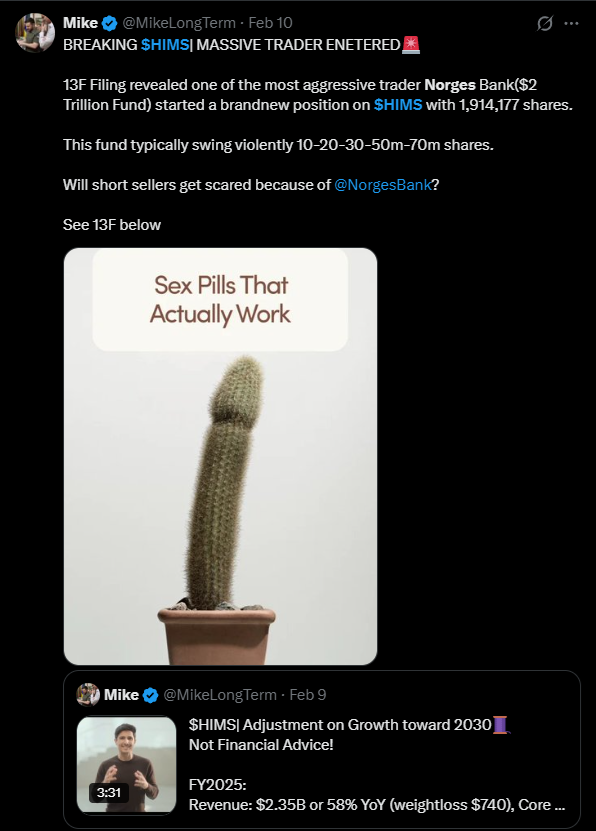
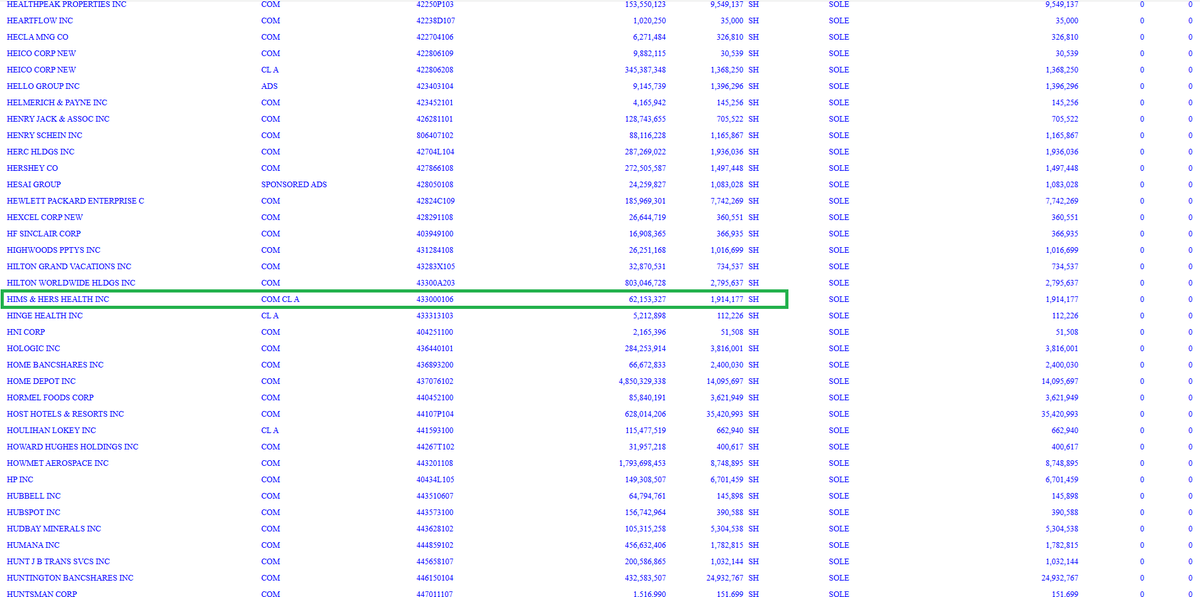
Norges Bank initiated a 1.9m shares on $HIMS in lastest 13F Filing
If $HIMS were trading at 50x-100x P/S, I would understand the idea of shorting after $NVO drama.
Norges Bank gonna clap you.
Not Financial Advice!
$HIMS Core Revenue vs. Weight-loss Revenue 👇
Weight-loss offerings (launched ~May 2024) contributed essentially zero revenue in 2020–2023. Core categories (men's/women's health, mental health, dermatology, etc.) drove steady growth.
Full-year 2024 total revenue was $1.477B (+69% YoY). Revenue excluding the GLP-1/weight-loss offering was >$1.2B (+43% YoY), implying ~$225 from GLP-1/weight loss. This was ~15% of total.
2025 Explosion: Weight loss (almost entirely GLP-1) more than tripled in H1 alone (~$420M vs. ~$225M full-year 2024).
- Q1 2025 revenue: $586M (+111% YoY).
- Q2 2025 revenue: $545M (+73% YoY).
- H1 total ~$1.131B.
- GLP-1-specific: ~$230M in Q1 + ~$190M in Q2 = ~$420M.
- FY GLP-1 expected to be around ~$800M (the company itself guided to $725M+ for weight loss and $2.3–2.4B total).
The sequential dip in Q2 reflected the shift away from commercially available doses and pricing adjustments, but H1 still represented a massive acceleration.
Full-year 2025 guidance ($2.3–$2.4B) implies ~59% growth from 2024. Non-GLP-1/ "core" revenue continued growing ~25-30%+ YoY (explicitly called out in Q1 commentary as "nearly 30% YoY" outside GLP-1), showing the core business is strong.
2026 Outlook & Uncertainty
- No official guidance yet (Q4/FY2025 earnings expected ~Feb 23, 2026).
- Long-term targets remain strong ($HIMS scaling, international, new categories like testosterone/menopause/longevity): $6.5B revenue and ≥$1.3B Adj. EBITDA by 2030).
- Consensus implies 30-50%+ growth, but GLP-1 contribution now uncertain due to FDA/Novo regulatory pressure. Likely to be banned.
Conclusion: Weight-loss/GLP-1 was the biggest 2024–2025 driver, but "core" business is now ~65-70%. Early 2025 weight-loss guidance was $725M, which would have been ~30% of the $2.3-2.4B total. Core/non-weight-loss continued scaling in parallel.
🚨 $HIMS 2026 PREDICTIONS, BY @ASHWINREADS
1. $HIMS CROSSES THE ATLANTIC
"Hims needs Wall Street to see a diversified telehealth platform in multiple international markets and not just a compounded semaglutide company that's one FDA enforcement action away from capitulation."
2. SCORCHED-EARTH ADVERTISING BLITZ
"Hims will execute a scorched earth advertising blitz between now and early 2026, timed perfectly for the 'new year, new me' window."
"Focus on paid channels like Google search for GLP-1 and weight-loss keywords"
3. RISING CAC ACROSS THE CATEGORY
"Impact will be most significant for direct competitors, specifically, premium branded players with slick UX and strong clinical positioning, like Voy."
Hims should be able to weather the storm of rising CAC because of strong balance sheet
4. SPEED SPEED SPEED
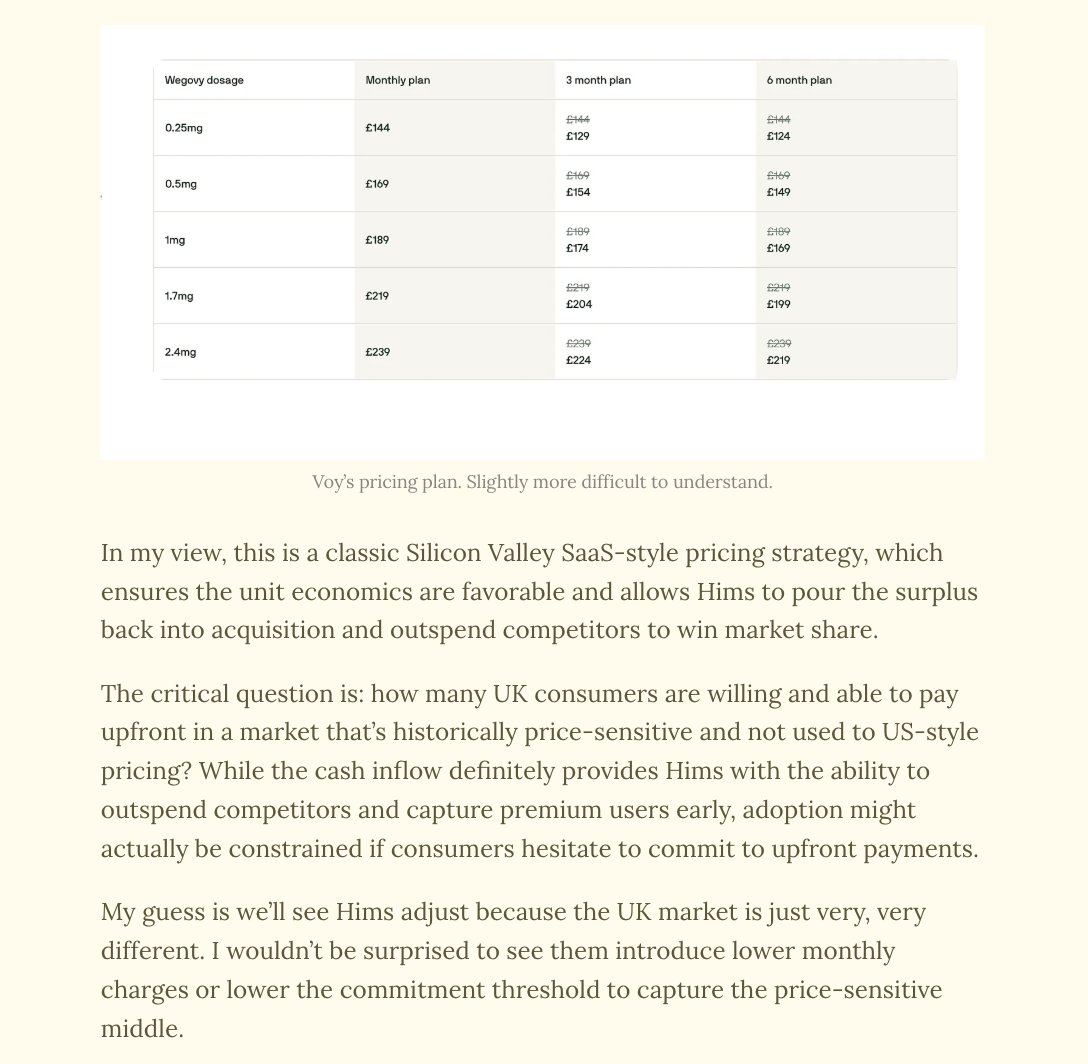
"What makes Hims particularly dangerous is the speed at which they recover their acquisition costs. A Hims customer on a 3-month plan pays once and can titrate from 0.25mg to 0.5mg to 1mg as needed"
"Voy, on the other hand, bills monthly and charges more as you go up. That’s a very different value proposition because Hims locks in the cash upfront and gives you room for dosing flexibility, while Voy gets paid back slowly and charges you more for up-titrating the dose."
Ashwin's note: This thesis ^ depends on whether customers are willing to pay up front. If so, Hims should be able to outspend competition on marketing and claw away market share.
ASHWIN'S PREDICTION:
"Given the US balance sheet, Hims will disrupt the UK market." 🔥
Link below to full article and be sure to follow @Ashwinreads for all things GLP-1s and peptides!!!
I’ve watched the video. If you watch it with a lens of unrealistic expectations you interpret how you seemingly are. But if you watch it with a realistic expectation of what labs offers, it isn’t off base.
Labs are the primary requirement for Testosterone Treatment. That is the main driver of getting labs, the rest is just extra.
Expecting every single lab result to be reviewed by a provider while keeping it affordable for cash-pay patients isn't realistic or feasible and it isn't $HIMS model. HIMS triages based on results.
A data dump is what I get from my doctor when I get labs (see image). A list of numbers that means nothing to me. My PCP doesn't call me to discuss, we don't review them. I am only notified if there is a problem.. similar to HIMS.
But HIMS, based on their product webpage and the screenshots you provided, provides actionable wellness guidance to address and prioritizes with colors, and i imagine there is more information regarding specific tests and biomarker results beyond the expand button that i cannot see.
Here are what real lab data dumps look like: 👇
My doctor note says: "Cholesterol levels are good. No sign of diabetes. Thyroid is normal. Please remember to eat healthy diet to supply your body with the nutrients needed."
No review, no appointment to discuss, and no explanation of the red values. I was left to ask ChatGPT.