Klein lab @HMS_SysBio. Fate decisions, dev bio, regeneration, single cell genomics, math, data sharing, rubber ducks. Tweets from lab members. Like/RT ≠ endorse
@LGMartelotto Thank you @LGMartelotto! We still miss you at HMS. Don’t miss the back-to-back paper from Linas Mazutis reporting on another realization of the CAGEs/capsules.
I just finished reading this beauty from the @KleinLabHMS 🫶🫶🫶
Multistep genomics on single cells and live cultures in subnanoliter capsules. Mazelis et al, recently published Science last December.
DOI: 10.1126/science.ady7209
I first saw Ignas start working on this almost five years ago when I was at HMS. It’s unreal, and makes me very happy, to see it go all the way to a Science paper. Legend!
In this work, Ignas and team introduce a new single-cell functional genomics platform that lets you:
-keep single cells alive
-culture them over time
-run multi-step biochemical workflows on them
-then read out genome-wide signals
The big breakthrough is the capsule design. It physically holds cells (and large biomolecules) in place, while still allowing media, enzymes, and reagents to diffuse in and out. Smart idea. Huge impact.
To make this work, they built “capsules with amphiphilic gel envelopes,” or CAGEs. These magic capsules:
-retain cells and large analytes (so you don’t lose the important stuff)
-stay permeable to media, enzymes, and reagents (so complex protocols still work)
-support high-throughput processing (so you can scale to tens of thousands of samples)
This matters because most functional genomic assays require multiple sequential steps. Those workflows fall apart when you try to scale them across large numbers of living single cells. CAGEs solve that, which allowed the team to:
-run high-throughput, multi-step workflows on living single cells (not limited to “one-pot” reactions)
-create a DNA library barcoding strategy for CAGE-derived material, so you can pool capsules without losing cell identity
-measure how gene expression programs persist through clonal expansion
-link lineage-like clonal growth with transcriptome readouts at real scale
Most single-cell sequencing methods are great at snapshots. But biology is dynamic. We care about things like:
-response to stimuli
-stability of cell states
-differentiation
-expansion of rare clones
This platform tackles one of the biggest bottlenecks in the field:
Scaling live-cell, multi-step functional measurements to high throughput, while still getting genome-wide readouts!!!
Big congratulations to the entire team!
Excited to see this out in Science!
We introduce CAGEs (Compartments with Amphiphilic Gel Envelopes): resilient, semi-permeable shells that overcome limits of droplet microfluidics.
CAGEs enable “multi-step genomics” at a massive scale.
Back-to-back with the Mazutis lab🔥
I am delighted to share that my main PhD project is finally out in Science Magazine!
I'm honored to have worked with so many talented colleagues and mentors that guided this journey and provided me an opportunity to contribute research!
https://t.co/u616rtd9kk
I am delighted to share that my main PhD project is finally out in Science Magazine!
I'm honored to have worked with so many talented colleagues and mentors that guided this journey and provided me an opportunity to contribute research!
https://t.co/u616rtd9kk
I just updated the scDiffEq Python API (v1.1.0) to include animated visualizations of simulations.
You can generate GIFs (or still images) showing:
- Temporal gene expression dynamics
- UMAP projections of simulated trajectories
During my PhD, I found animations like these useful in presentations.
Available now in the latest release: https://t.co/Wkl0My7xT8
Our review on cell cycle – cell fate (de)coupling is out! https://t.co/F8FwsvpvPr
Was a lot of fun writing this with @KleinLabHMS , reading old papers (earliest frm 1902) & speculating why cell cycle progression is nt necessary for differentiation across many tissues & species.
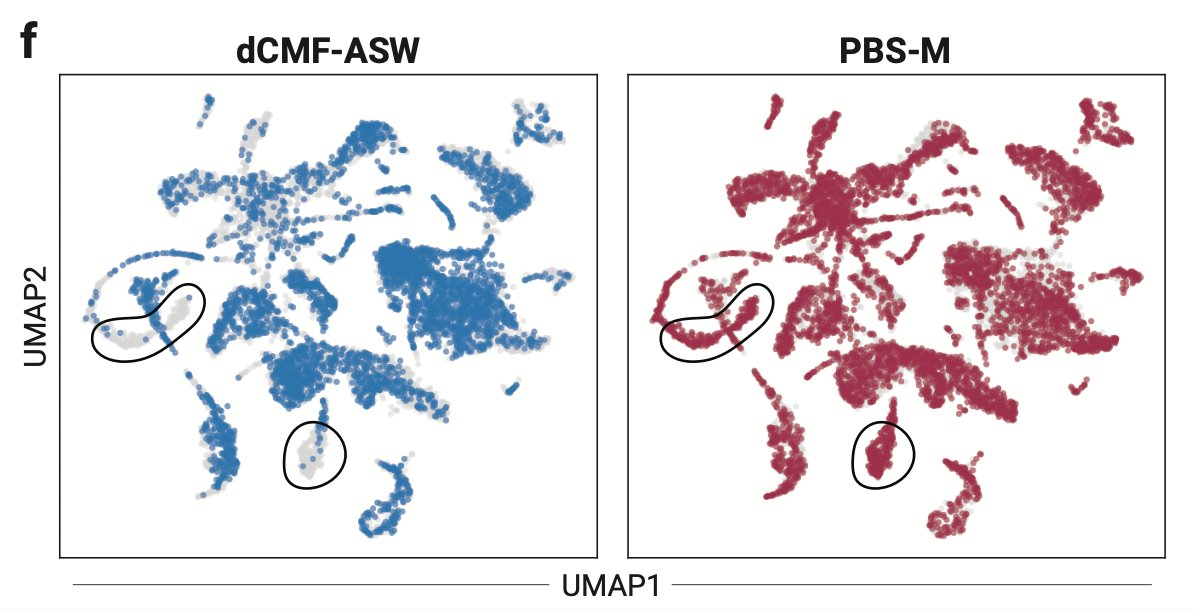
Using PBS-M is simple and could enable or improve scRNA-seq for most marine organisms. We hope it's useful for people studying a variety of animals, allowing researchers to better explore the diversity of cell types across marine species
7/7
scRNA-seq is great for non-model organisms—with just a transcriptome you can discover new cell types. But for many marine organisms there's one big problem: SALT 🧂
A solution from our awesome student Tal Scully (1/7🧵)
https://t.co/z5Snu760dB
The PBS-M data also reveals some cells which are otherwise under-represented or absent. These may represent cells which are particularly sensitive to osmotic shock, and we can't detect these cells in scRNA-seq without using PBS-M!
6/7
Shout out to @Nich, @jgungabeesoon, @Mate_Kiss on our paper https://t.co/eGiiU5H50j on heterogeneity in tumor neutrophils and why it matters. A great summary by @PittetLab below:
❔What is special about an immune system that successfully attacks tumors, compared to one that doesn’t?
Our new study in @CellCellPress led by @jgungabeesoon, @Nich and @Mate_Kiss_ aimed to address this question. A joint work with the great @KleinLabHMS
https://t.co/Mhi4A7QdfR
❔What is special about an immune system that successfully attacks tumors, compared to one that doesn’t?
Our new study in @CellCellPress led by @jgungabeesoon, @Nich and @Mate_Kiss_ aimed to address this question. A joint work with the great @KleinLabHMS
https://t.co/Mhi4A7QdfR
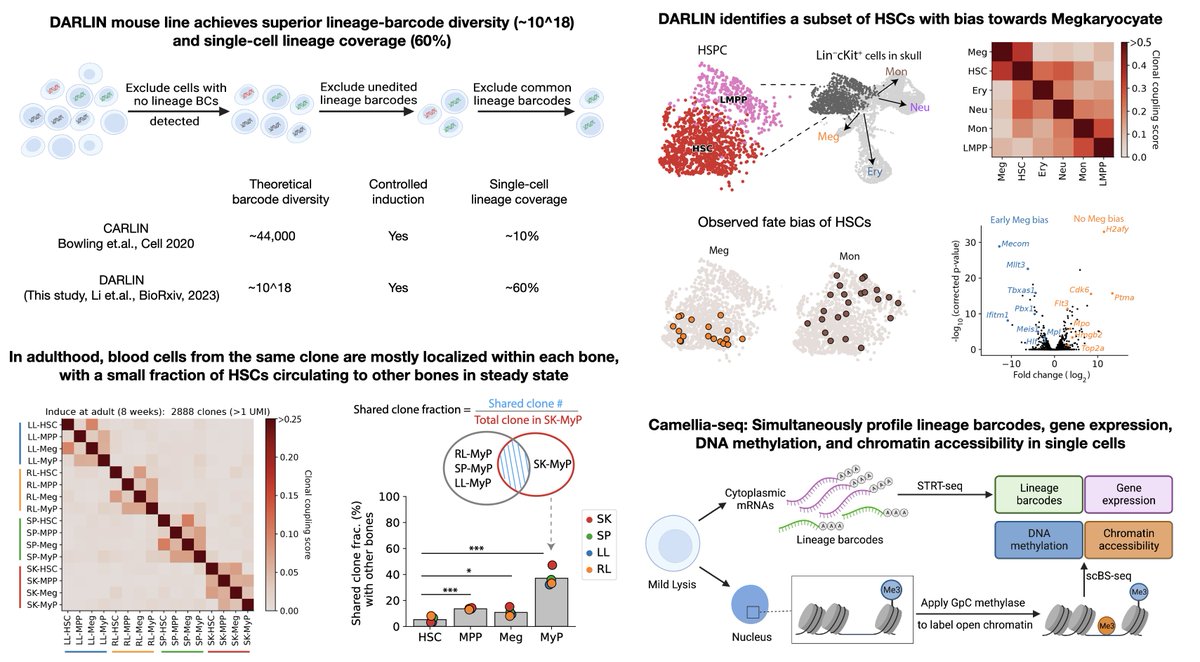
This is a fabulous collaboration between @KleinLabHMS and @ShouwenW, @Li_Li_666, and @FD_Camargo. The DARLIN mice is superior to CARLIN, and the single-cell multi-omic lineage tracing method is a great addition to single-cell genomics toolkits!
Want to apply single-cell multi-omic lineage tracing to study your favorite system in mice at defined time point and with superior lineage resolution?
Jointly with @Li_Li_666@SarahBowling15@FD_Camargo, we present DARLIN, a superior lineage-tracing mouse https://t.co/hZqvbjJiNj
It has been great to have @ShouwenW in our lab. Huge congratulations for starting his own lab at @Westlake_Uni ! Looking forward to more awesome work from your lab!
Come join my group at Westlake university in the beautiful city of Hangzhou, China to study development and cell differentiation with advanced (multi-omic) lineage tracing approaches and machine learning!
https://t.co/io6nJpuyhT
Very pleased to share work from @KalkiKukreja@kb_mccauley with @jaffeab studying the plasticity of cell and tissue phenotypes under stimulation of 17 different signaling pathways. How “canalized” is cell differentiation? Can we identify the signals inducing disease states?
How do different signaling pathways alter tissue composition & state? Can we use signaling response phenotypes to predict aberrant signaling in disease? 🤔
We interrogate these in our new paper - https://t.co/hORVCKeVBu
A thread 1/9
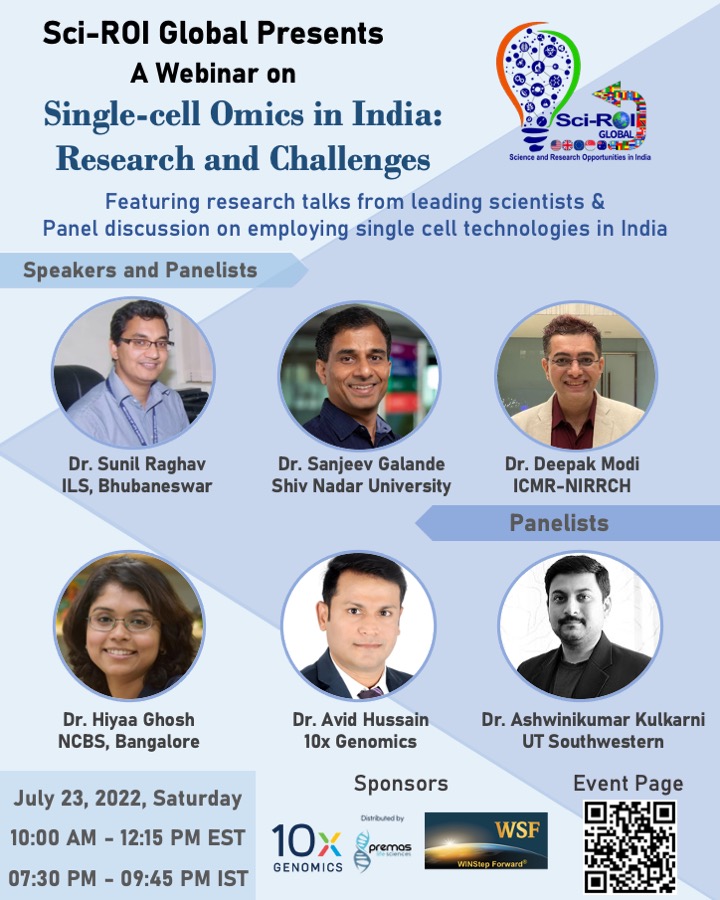
Interested to learn abt single-cell genomics research in India? Join @Sci_ROI's webinar on prospects and challenges of employing sc-omics in India.
July 23rd (Saturday) 10 am to 12:15 pm EDT
More info and registration link here: https://t.co/OycnS8vq6D
RT n spread the word 🙏
I have accepted an offer for an assistant professor position at @Westlake_Uni starting in April 2023. Also, here is a recorded talk for my CoSpar paper in @NatureBiotech on integrating transcriptome and lineage information to learn early cell fate bias https://t.co/4DPbNQbZxS.