@JanueMiret Obligar al médico a hablar en catalán estando muy enfermo significa que el paciente ya estaba (mentalmente) muy enfermo con anterioridad.
Cuánto paleto...
A veure si ens entenem perquè l’escàndol és monumental:
El Govern Illa tenia terror als resultats que obtindria Catalunya a l’Informe PISA i no se’ls va acudir res millor que manipular la mostra eliminant els probables pitjors resultats per mirar d’apujar la mitjana... I sí, són tan absolutament incompetents que els han pescat i han abocat Catalunya al ridícul internacional.
1. Enhorabona als que van pensar que calia aparcar la independència perquè ara tocava ‘bona gestió’ socialista.
2. Com en tots els escàndols d’incompetència d’aquest Govern, Esquerra i Comuns en són directament responsables perquè ho vam avisar.
3. Com en tota crisi important a Catalunya, el president Illa ha marxat de viatge: ara al Vietnam.
4. Es confirma que la via unionista i espanyolista sempre és descrèdit, engany i empobriment: o independència o misèria.
"No sé si a la Sagrada Família li fa falta més propaganda."
Queixes de veïns i restauradors pel pas del Tour de França pel barri https://t.co/o5ihcesQzQ https://t.co/o5ihcesQzQ
�� El retorn d'un nom amb molta història.
L'aparició d'Esquerra Democràtica dins d'ERC té una forta càrrega simbòlica. No és un nom nou: entre 1975 i 1978 ja va existir Esquerra Democràtica de Catalunya (EDC), un partit de centre liberal, catalanista i federalista liderat per Joan Baptista Cendrós.
Aquell projecte va acabar dividint-se en dues direccions. Una part dels seus dirigents, com Ramon Trias Fargas i Macià Alavedra, es van integrar a Convergència Democràtica de Catalunya de Jordi Pujol. Una altra, encapçalada per Josep Pi-Sunyer, acabaria acostant-se a ERC.
Quasi cinquanta anys després, la història presenta una curiosa inversió. El nou corrent Esquerra Democràtica neix ara dins d'ERC, però impulsat principalment per figures procedents de l'espai convergent, com Carles Campuzano o Francesc-Marc Álvaro, després d'anys a CDC i al PDeCAT.
És un moviment que reflecteix fins a quin punt ha canviat el mapa polític català. Durant dècades, ERC i Convergència competien per l'hegemonia del catalanisme. Avui, una part de l'antiga tradició convergent considera que el seu espai polític pot tenir més recorregut dins d'ERC que no pas a Junts.
La història no es repeteix, però sovint rima. Un nom que fa gairebé cinquanta anys va servir de pont cap a Convergència reapareix avui com a porta d'entrada d'antics convergents cap a ERC.
"Language Knowledge and Earnings in Catalonia", Journal of Applied Economics (2012), de Di Paolo i Raymond, dona moltes pistes sobre què influeix més en la integració lingüística dels nouvinguts. Sabeu què determina més el coneixement de català de les primeres i segones generacions d'immigrants? L'ENTORN (variable de "% Speaks and write in Catalan" al barri). No hauria de ser cap sorpresa que les llengües, que serveixen principalment per socialitzar, s'aprenguin en funció de qui són els teus veïns.
Però aquest "paper" mostra una altra fet clau: l'origen de la migració també influeix en l'aprenentatge. A nivell teòric, hi ha dos factors que afecten a l'aprenentatge: (1) la distància lingüística, que determina l'esforç necessari i (2) l'incentiu, real o percebut. Per un parlant nadiu d'una llengua romànica, com el castellà, la distància lingüística és menor que per un ��rab, per exemple. El problema és que l'incentiu d'un castellanoparlant també és menor pel seu privilegi ètnic, i aquest factor acaba prevalent. Com a resultat, observem que els immigrants provinents de Llatinoamèrica són els que tenen menor probabilitat d'aprendre català!
Really cool!
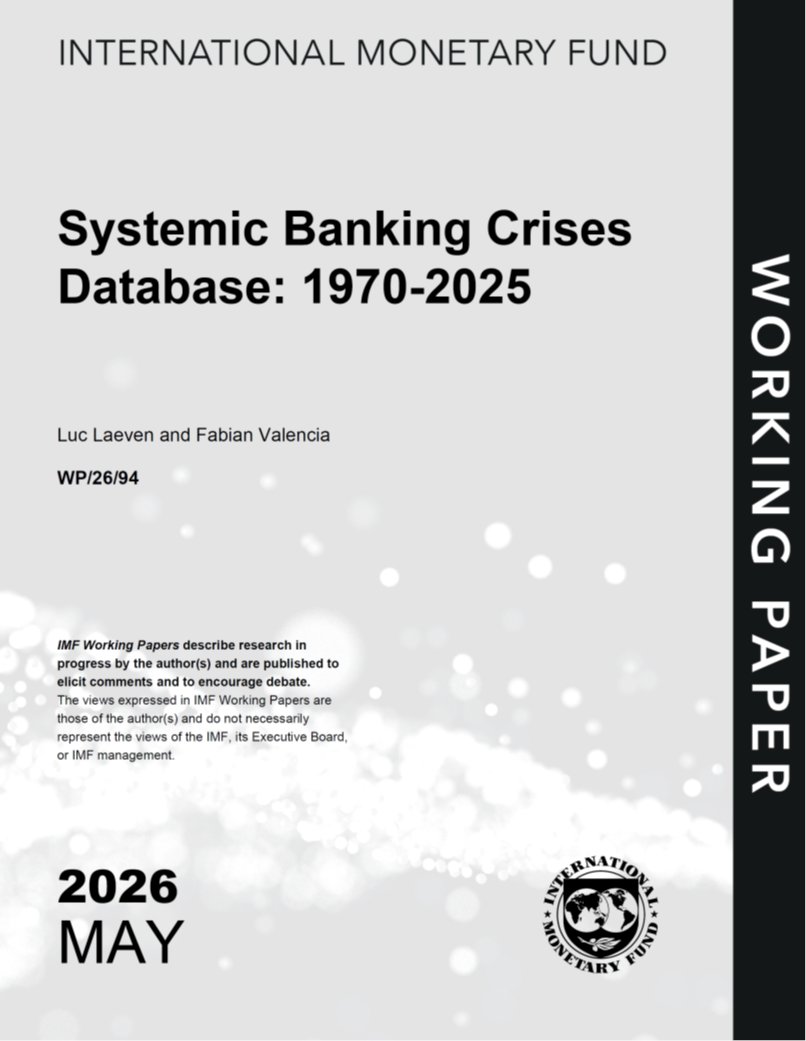
"Systemic Banking Crises Database: 1970-2025" by Luc Laeven and Fabian Valencia.
"This paper presents an updated version of the Laeven and Valencia (2013, 2020) database on systemic banking crises, extending the coverage through 2025. The update incorporates new episodes, while maintaining the definition established in previous editions, which emphasizes both significant signs of financial distress and substantial policy interventions. The update integrates textual tools to screen potential candidates that are then further scrutinized to confirm if our definition is met. The database includes information on banking crises episodes during 1970-2025, including starting dates, policy responses, fiscal costs, and output losses. It offers a comprehensive tool for assessing cross-country vulnerabilities and policies to resolve banking crises."
https://t.co/4nSydVP6lF
@ecorami@tonyannett@LaCamellaFeliz Ritschl, A. (2012). The German transfer problem, 1920–33: a sovereign-debt perspective. European Review of History: Revue Européenne d’histoire, 19(6), 943–964. https://t.co/ZaXO6X3iTi
Quan Jordi Pujol arribi a Madrid per declarar, serà conduït de bon matí sota forta custòdia fins a la plaça major, on s’haurà alçat un cadafal davant de les principals autoritats del regne.
Vestit amb sanbenito i coroza, ornats amb inscripcions relatives als seus presumptes pecats públics, serà exposat a la vista del poble mentre repiquen les campanes i els pregoners convoquen la multitud.
Seguidament, inquisidors i lletrats llegiran un llarg sermó sobre la corrupció, la vanitat i els mals exemples donats als súbdits, després del qual es proclamarà solemnement la sentència.
Si mostra penediment sincer, podrà rebre certa misericòrdia abans de ser lliurat al braç secular; si persevera en el silenci o la defensa, serà entregat sense més dilació a les autoritats civils perquè executin la pena corresponent.
Fonts de palau indiquen que la cerimònia vol servir d’escarment general i restauració de l’ordre moral del regne.
🔔 Avui faig #5cèntims sobre "Règims autoritaris i fragilitat financera: la fallida del Banc de Catalunya".
Moltes gràcies als amics de @5centimscat i @SCE_IEC per convidar-me a compartir els resultats de la meva recerca amb tots vosaltres.💸
https://t.co/ivlAe4xruh
Fins a quin punt és reversible aquesta dinàmica?
Quina política lingüística pot realment fer reviscolar l’ús del català davant un canvi demogràfic tan intens, un marge competencial limitat, i la tendència a parlar la llengua que maximitza la comunicació?
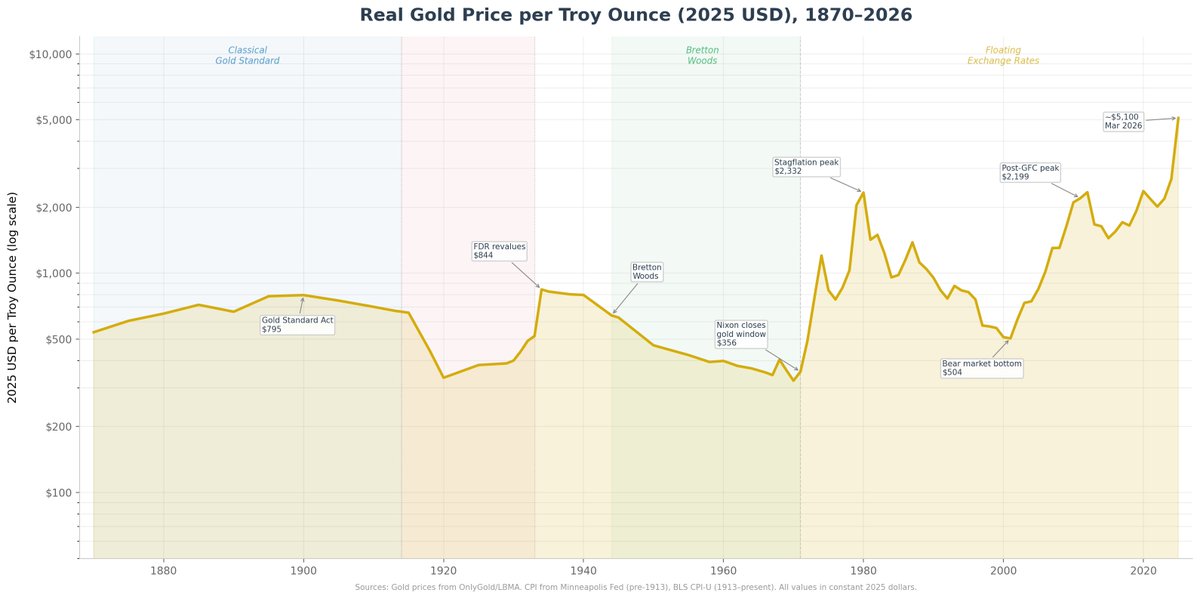
The rally in the price of gold over the last two years or so has been striking: from slightly over $2,000 an ounce at the start of 2024 to nearly $5,100 as I write these lines, a 2.5x multiplier.
To see how unusual this is, I searched the entire historical series for comparable windows of roughly two to three years in which the real price of gold multiplied by at least 2.5.
I first plotted the price of gold per troy ounce in constant 2025 dollars from 1870 to the present, using a logarithmic vertical axis. The nominal price series comes from statutory rates during the gold standard and Bretton Woods eras and from London market prices thereafter. I deflate by the US Consumer Price Index, using Minneapolis Fed estimates for the pre-1913 period and the BLS CPI-U series from 1913 onward, with 2025 as the base year. Expressing the price in real terms tells us the quantity of goods and services that one ounce of gold could purchase at any given moment in time.
In 155 years of data, a real multiplier of 2.5x or more over a two-to-three-year window has happened three times. All three were in the 1970s: from 1971 to 1974 (the Nixon shock and the oil embargo, a 3.4x real multiplier), from 1976 to 1979 (the second oil shock building, 2.7x), and from 1977 to 1980 (the stagflation peak, 2.7x). The last two overlap and are really part of the same episode. For comparison, the FDR revaluation of 1934, a 69% devaluation of the dollar by executive order and the confiscation of privately held gold, produced a real multiplier of only 1.7x.
The figure shows two different regimes: pre-1971 and post-1971. Pre-1971, the nominal gold price was (largely) set by law. When the general price level rose, the real price of gold fell. This is visible in the downward drift from 1870 to 1920, when the statutory price remained at $20.67 while the price level rose by roughly 60%. The same pattern repeats under Bretton Woods: with gold fixed at $35 nominal, the postwar inflation eroded its purchasing power from about $840 in 2025 dollars in 1934 to $356 by 1971. A holder of gold was taxed by inflation for the better part of a century.
Post-1971, three features of the series are worth noting. First, the two previous real peaks, the stagflation episode of 1980 and the aftermath of the global financial crisis in 2011, reached approximately $2,300 in 2025 dollars. Despite occurring three decades apart under very different conditions, they produced nearly identical real prices. This is suggestive of a mean-reverting process around a long-run real value, interrupted by episodic crises.
Second, the bear market trough of 2001, at roughly $500 in real terms, brought gold back to where it stood during the Bretton Woods era. Two decades of credible monetary policy under Volcker and Greenspan, combined with the fiscal consolidation of the 1990s, effectively restored the real price of gold to its previous administered level.
Third, the current level, approximately $5,100, is without historical precedent. It is more than double the previous real peaks. And the speed of the move has no parallel outside the collapse of the Bretton Woods system and the stagflation that followed.
The usual suspects are central bank reserve diversification following the freezing of Russian assets in 2022, persistent fiscal deficits across advanced economies, and declining confidence in the dollar-based international monetary architecture. Whether this represents a new “normal” or an overshoot is an open question, but the magnitude of the departure from historical norms is itself informative.
The broader lesson I get from the figure is simple. The price the market assigns to gold is largely determined by the risk that the institutions that govern fiat money will fail to maintain their credibility. When those institutions are trusted, gold is cheap. When they are not, gold is dear. The graph is, in this sense, a 150-year running scorecard of monetary and fiscal governance.
In my next post, I will examine whether gold serves as a hedge against equity risk. In asset pricing, risk by itself is not what matters. What matters is covariance. So the question is not whether gold is volatile, but whether it tends to rise when everything else falls. The answer turns out to be more interesting than a simple yes-or-no.
P.S. A bit of shameless self-promotion. If you are the kind of person who finds utility in Greek letters, my paper with Daniel Sanches on the working of the gold standard might be of interest:
https://t.co/1JpX6eywOH.
If Greek letters are not your thing, the post above covers the main intuitions just fine.
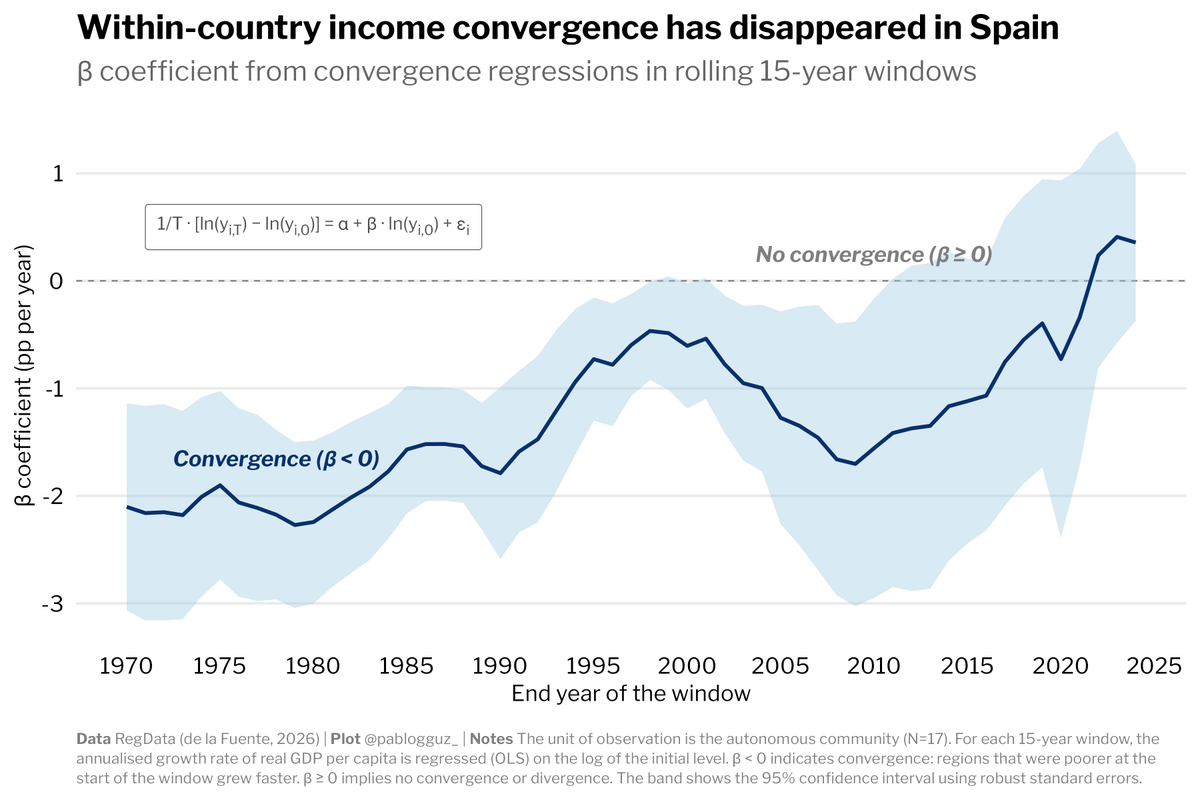
for most of the past century, poorer regions within spain grew faster than richer ones. this is what economists call "β-convergence".
this pattern, however, has been weakening since the 1990s and is now gone: spain's poorer regions are no longer catching up.
but this is not unique to spain. chatterjee et al. (2025) document this pattern for 90+ countries and link it to the rise of high-skill services, which tend to cluster spatially far more than manufacturing or agriculture. as economies shift toward these sectors, regional convergence weakens
link to paper: https://t.co/HVmybdnOzH
Cues al Banc Central de Bolívia per verificar la legalitat dels bitllets: un robatori massiu de 50 milions en una tragèdia aèria provoca el caos a la moneda boliviana https://t.co/ky4T06Odbq https://t.co/ky4T06Odbq
Finlàndia va reduir l’IVA de les perruqueries el 2007 per veure si els preus més baixos augmentaven la demanda i l’ocupació.
Però quan l’impost va baixar 4€, moltes perruqueries van reduir els preus uns 2 € i es van quedar la resta com a marge. Quan l’IVA va tornar a pujar, els preus van augmentar els 4€ complets.
És un exemple d’incidència fiscal. El mateix va succeir aquí amb els cinemes i l'IVA cultural.
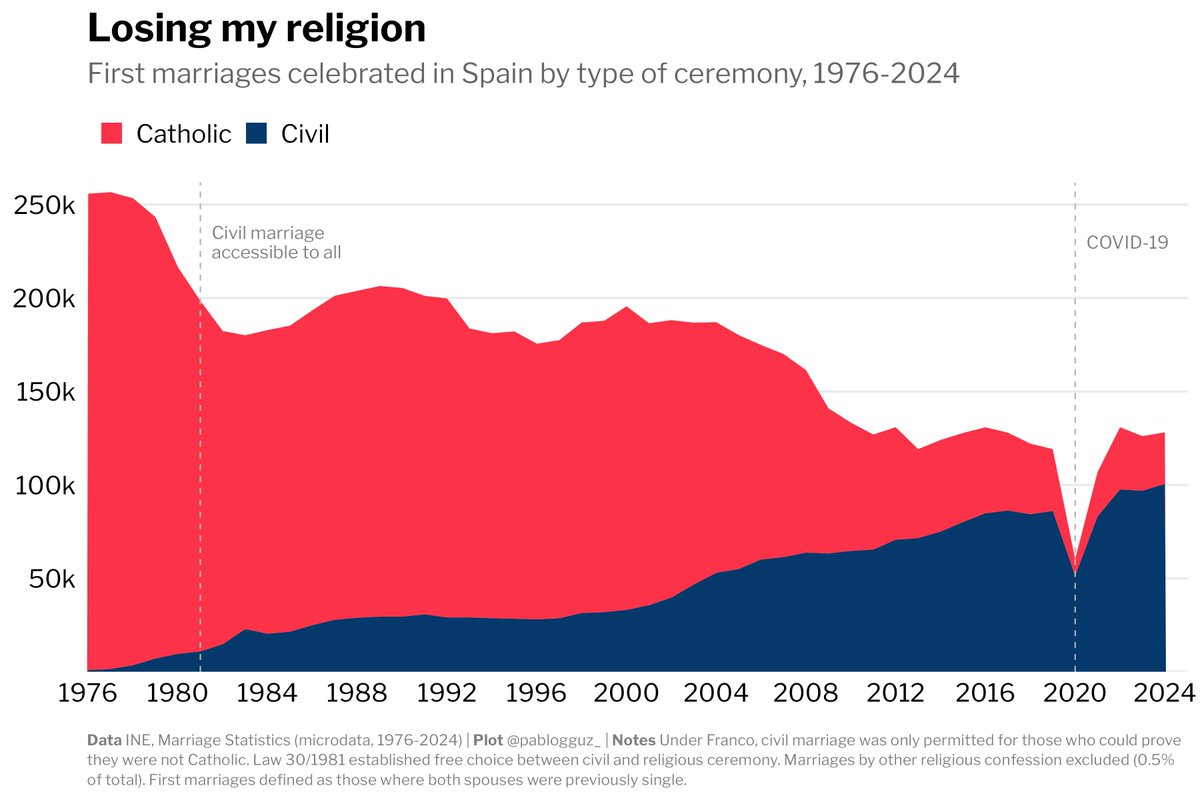
in 1976 spain, over 99% of first marriages were catholic. fast forward to 2024 and almost 4 in 5 are civil. total first marriages have also halved, from 256k to 128k.
half a century of secularisation in one chart: