1/7
The bottleneck in deploying AI agents to production ops isn't intelligence. It's trust.
Everyone's building agents that CAN do things. Almost no one is shipping agents you'd actually let run SRE alongside your team.
We did. Here's what it took. 🧵
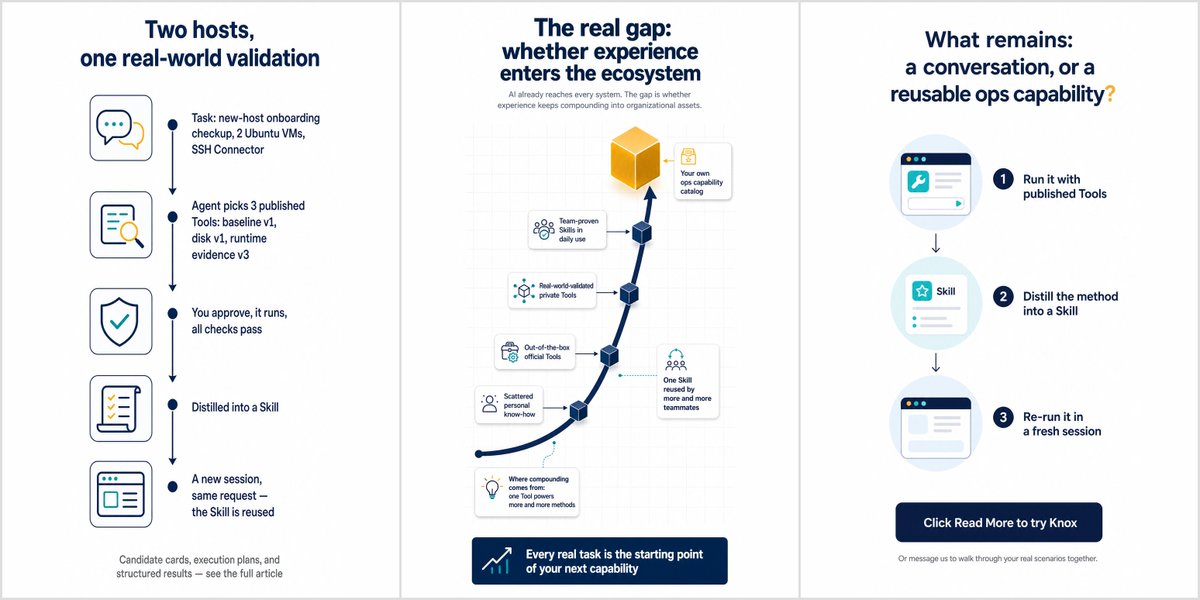
Personal AI skills are powerful, but enterprises need more: proven methods, governed tools, clear permissions, version control, and reusable operational assets.
Knox makes AI-native AIOps enterprise-ready.
#AIOps#DevOps#EnterpriseAI#AIAgents#PlatformEngineering
Couldn't agree more. You really nailed the core design principle here. Every edge in the graph keeps track of where it came from, so you can tell whether it shows up in both config and runtime, whether it's declared but not active right now, or whether it's only there at runtime and still just inferred.
An AI Agent can list EC2 instances and EKS workloads. That doesn’t mean it understands your system.
This article covers how config intent, runtime connections, and human validation can produce an evidence-backed topology for production ops.
#AWS#SRE#AgenticAI
https://t.co/mUlr99S420
The AI ops debate is stuck on "replace everything" vs "chat overlay." Both miss the point.
The real gap isn't reasoning — LLMs can diagnose. The gap is access. Your agent can't SSH to your bastion. Can't query your CloudWatch. Can't pull your PRs.
Connectors solve this without ripping out Prometheus, Zabbix, or your CloudWatch dashboards.
Details in our deep dive 👇
https://t.co/HBSOlWBCai
The instinct when building AI ops teams: mirror your org chart.
DBA Agent for databases, Security Agent for vulns, Monitoring Agent for dashboards.
We tried this. It doesn't work. The right split isn't by job title .
It's by three boundaries: what the agent can call, what it can see, and what it can change.
https://t.co/5gQtRjwTub
@offgridding bounded operating picture, clear runbooks, and a review trail — really well put. on the runbook piece specifically, we've been sharing some hands-on reps recently if you're curious: https://t.co/S9REFfiY6Q
@sv_cloud_expert exactly. the knowledge graph is one layer of the agent constraint model — there's more we've been working on around safety guardrails. more on that soon 👀
@bugops_app also changes how you do postmortems. instead of reconstructing what happened from a dozen tools, you walk the graph backward from the symptom. our incident reviews got way better once we started doing this
If using AI for ops feels like babysitting a new grad who can't be left alone — we hit the same wall.
Sharing what we learned building an ontology-based knowledge graph so the Agent actually understands your infrastructure instead of guessing.
https://t.co/lUkxHcOrSb
The 0.35-scored instance had Redis MASTER, Nacos, Nginx, two Python services, and a Datadog agent stack.
All idling. Zero business traffic.
Scoring tells you "which might be idle."
Deep scan shows you what's actually running.
https://t.co/EsVct06aUq
Scanned my AWS account with AI agents. 2 of 3 EC2 instances were dead weight.
But the agents isolate first, watch for alerts, then ask you — only delete after 4 human checkpoints.
#AWS#CloudCost#AIAgents#FinOps#AgenticOps
We ran the same infrastructure discovery task through Claude Code (Opus) and Knox — a purpose-built AI SRE tool. Same environment, same ask.
Claude: 5 min, solid one-shot scan. Identified services, traced dependencies, flagged 4 real issues.
Knox: 20 min, multi-agent architecture. Visual topology, auto-grouped business islands, severity-ranked findings, persistent graph database, depth-on-demand for any subsystem.
Both useful — different ceiling. Wrote up the full side-by-side comparison:
https://t.co/NSMblgatv0
#agenticops #aiops #devops #aisre
Tried using Claude Code (Opus) for an infra discovery report last week. Gave it SSH access to 3 VMs and a K8s cluster, asked it to map everything — services, dependencies, risks.
5 minutes. Identified all service roles, traced a Redis Sentinel cluster, caught a canary deployment I forgot was still running at 90/10 split. For a quick "what's actually running here" sweep, honestly better than expected.
But it's a snapshot. Next week something changes, I'd run it again and get a different exploration path. No way to diff against last time or track how the topology evolves over time.
For one-off audits this is already good enough. The part I haven't figured out: how do you go from point-in-time AI scans to something that continuously understands your infra topology? Anyone maintaining a living map of their environment with AI in the loop?
Ran Claude Code (Opus) on our infra last week — gave it SSH access to 3 VMs and a K8s cluster, asked it to tell me what's running and what looks risky.
5 minutes later it hands back a markdown report. Identified service roles correctly, traced a Redis Sentinel cluster, found a stale replica on a decomissioned node, even caught a canary deployment I forgot was still split 90/10. Genuinely impressed.
Then reality kicks in. Everything has the same weight. A critical single-point-of-failure sits next to a naming inconsistency. No severity. Close the terminal and the whole thing is gone. Can't say "go deeper on that one cluster."
Works great as a one-shot scan. Falls apart the moment you want structure, persistence, or depth control. Curious where others are drawing the line between "ask the LLM" and "I need actual tooling for this."