“Congratulations to those who leave the world before it deserts them, to those who build their graves before they enter them; and to those who please their Lord before they meet Him.”
Every Nigerian needs to pay very close attention to this official press release by the Finance Minister of Nigeria, Taiwo Oyedele. This serves as the direct response by the Federal Government to the International Monetary Fund 2026 Article IV Concluding Statement on Nigeria.
The recent IMF statement on Nigeria is overflowing with glowing praises for the Tinubu Administration and their supposedly brilliant economic policies.
The IMF is loudly cheering for the reunification of the foreign exchange market because the gap between the official and black market exchange rates has remained below 5%, which is absolutely fantastic for foreign investors since they love predictability, guaranteed margins, and zero currency friction. They also excitedly applaud the fact that Nigeria's foreign reserves have built back up, supposedly providing a comfortable cushion against global economic shocks. Finally, the IMF highly commended the Tinubu government's decisions to eliminate deficit monetization (which stopped the CBN from printing money to fund government projects) and to permanently remove petrol subsidies.
Now, the Tinubu Administration, speaking through the office of the Finance Minister, is proudly parading this IMF report like a shiny gold medal. They are framing this praise as an "independent validation" that their brutally painful economic policies over the past few years are finally yielding positive macroeconomic results. The glaring problem here is that this is not something Nigeria as a sovereign country should be celebrating, and this is entirely because of who the IMF actually works for and who dictates their underlying policies. The G7 nations and Western superpowers entirely control the IMF board, and the institution itself exists strictly to protect the financial interests of international creditor nations, massive global investment banks, ruthless hedge funds, and wealthy foreign bondholders. The primary job of the IMF is merely to ensure that the global financial system remains perfectly stable and that struggling developing nations never default on their massive, crippling debts to foreign creditors. Therefore, the IMF works exclusively for the lenders (the global financial-industrial complex), absolutely not for the bleeding borrowers like Nigeria, Ghana, Kenya, or any other struggling African nation.
To see how bad this is, just observe this currency unification being praised by the IMF as a massive win for the Tinubu Administration. They are celebrating simply because the exchange rate is now mathematically stable and investors are finally happy. This is spectacularly good for foreign speculators, but it is deeply catastrophic for us because the currency stabilized at a spectacularly weaker level of N1,400 per dollar, compared to N770 in the black market and N450 in the official rate before this administration took over.
So yes, the currency is technically unified, but at a permanently crippled level. Since Nigeria is a heavily import-dependent economy, this unified weakness has made the cost of food, life-saving medicines, basic hospital bills, school fees, transportation, building materials, imported spare parts, and daily survival astronomical, thereby permanently destroying the purchasing power of everyday Nigerians.
Furthermore, the IMF congratulating the Tinubu Administration on increasing the country's foreign reserves might sound like brilliant news, until you suddenly realize that it is this exact, deliberate policy that violently crippled our local industries. Most of the money that makes up these bloated new foreign reserves was forcefully squeezed out of the removal of petrol subsidies, a move that has deeply suffocated our local businesses, artisans, manufacturers, and logistics companies who rely entirely on petrol generators to survive. But this is not even the full tragic story. Even the bloody change they violently squeezed out of the dying Nigerian middle class was not enough to impress these foreign investors. To aggressively entice them, the Tinubu Administration spiked the base interest rate from 18% up to a staggering 27%. This was no mistake. In the US, for example, when you lend money to the government by buying Treasury Bills, federal bonds, municipal securities, or index funds, the interest you expect to make per year is at most 5%. But the Nigerian government is desperately signaling to these foreign speculators and international bondholders to come drop their dollars in Nigeria, effectively guaranteeing them a massive 27% interest by the end of the year. This might look like a huge economic win as foreign capital flows into the country, but this hot money never ends up in the pockets of ordinary Nigerians. It is never used to build schools, pay hospital bills, subsidize agriculture, fix dead refineries, or reduce house rents. The money just sits idly in the central bank to impress the IMF and World Bank creditors, proving to them that Nigeria is highly liquid and perfectly safe to lend to.
The absolute worst part of this trap is that it is not just the CBN increasing the base interest rates. The commercial banks are naturally forced to aggressively increase their lending rates even higher. Today, some predatory commercial banks are charging desperate businesses as much as 35% to 40% interest on loans. This financial terrorism has forced countless local businesses to drastically cut down production, lay off massive numbers of staff, and permanently close their branches in remote areas across Nigeria, forcing them to operate strictly within the suffocating limits of their own personal, depleted capital. It is practically mathematically impossible to borrow from a Nigerian bank, scale up production, create actual wealth, and employ the millions of struggling graduates in our society when you first have to pay 40% to the bank. Add that to the reunified currency making imports insanely expensive, meaning businesses still have to pay extra for imported raw materials, clear goods at exorbitant customs duties, pay multiple state taxes, and buy the hyper-expensive fuel that spiked in price due to the celebrated subsidy removal.
It is very possible to analyze this insulting press release further, but there is absolutely no need to waste the time. Clearly, this administration should not be celebrating warm handshakes, pat-on-the-back press releases, and polite diplomatic smiles from foreign creditors and international bondholders. They should be focusing entirely on the bleeding Nigerians who are brutally forced to carry the crushing, suffocating burden of these massive economic miscalculations just to please a comfortable, wealthy board of directors at the World Bank and the IMF.
In 2006, the then EFCC Chairman Nuhu Ribadu came before the Nigerian Senate and listed 5 most corrupt governors. They include:
1. Orji Kalu, Abia State
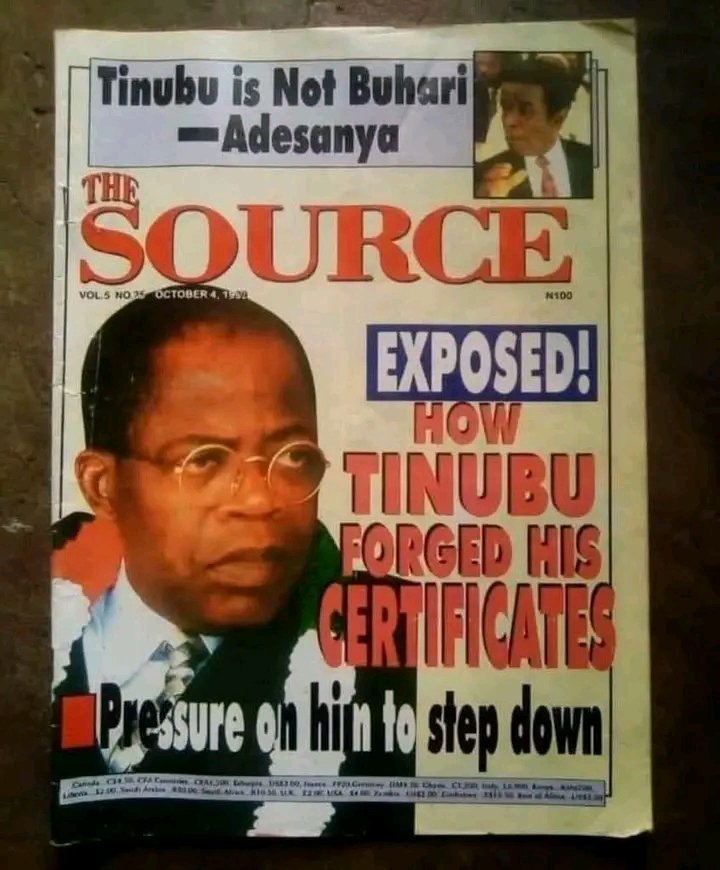
2. Ahmed Bola Tinubu, Lagos State
3. Ahmed Sani yerima, Zamfara State
4 . God'swill Akpabio of Akwa Ibom State
On EFCC watch list
5. George Akume, Benue State
6. Chimaroke Nnamani, Enugu State
Today, in 2026, 20 years after.
1. Orji Kalu = Senator
2. Bola Ahmed Tinubu = President
3. Ahmed Sani Yerima = Senator
4. George Akume = Senator now Appointed by Tinubu as SGF.
5. God'swill Akpabio now Senate President*
6. Chimaroke = Senator
7. The then EFCC Chairman Nuhu Ribadu, who made the list, is now Tinubu's National Security Adviser with those he alleged as worst criminals
Same people, Same circle. Youths are still leaders of tomorrow
—if they explain Nigeria to you and you understand, then your own brain needs to be under studies.
In Nigeria, politics is the new oil well, richer, faster, and with fewer consequences.
No real accountability, just a direct line to the commonwealth.
Why struggle to build a business when the system rewards access over effort?
May God save Nigeria from Nigerians.
Shagari's campaign poster in 1983, Forty-three (43) ago.
Kindly tick✅those ones that have been achieved out of those campaign manifesto.
If you like dey wait for super government. You better multiply your hustle 💪.
Many are still sleeping.
VERIFIED TINUBU LOANS—KEY FACTS & FIGURES
Number 1.
In spite of the massive amount of Internally Generated Revenues from Customs, Immigration, NNPC, FIRS, etc., the favourite pastime of the @officialABAT Cartel, is to mortgage our nation. Here, is a summary of how they have gone about it.
🔥WORLD BANK BORROWING UNDER TINUBU:
Nigeria has borrowed about $9.65 billion from the World Bank under President Bola Ahmed Tinubu.
Nigeria is now said to be:
●The largest IDA borrower in Africa
●The third largest globally
The World Bank accounts for about 41.3% of Nigeria’s total external debt.
🔥2023 BORROWING BREAKDOWN
— $2.7 BILLION
Nigeria borrowed:
●$750 million for renewable energy expansion
●$700 million for adolescent girls’ secondary education
●$500 million for the Nigeria for Women Programme
●$750 million for power sector recovery
Public Questions Being Asked:
■Where are the visible results?
■Why are ordinary Nigerians still struggling with electricity?
■Why are schools still underfunded despite massive education loans?
■How are these loans being monitored and measured?
🔥2024 BORROWING BREAKDOWN
— $4.25 BILLION
Nigeria borrowed another:
●$1.57 billion for:
●Human capital development
●Women and children’s healthcare
●Climate resilience
Additional loans included:
●$357 million
●$57 million
●$86 million
●For rural roads and agricultural marketing projects
●Economic stabilisation
●Resource mobilisation reform
●Primary healthcare
●Dam safety
🔥Concerns Raised by Citizens
Nigerians continue asking:
■Where are the visible infrastructure improvements?
■Why is poverty increasing despite heavy borrowing?
■Why are healthcare and public services still collapsing?
🔥2025 BORROWING BREAKDOWN
— $2.695 BILLION
Nigeria borrowed:
●$500 million for education under the HOPE Education Loan
●$80 million for nutrition programmes
●$253 million and $247 million for ●NG-CARES programmes
●Broadband expansion
●Health security
●Livelihood support
●MSME financing
🔥Public Reaction:
Many Nigerians are demanding:
■Greater transparency
■Clear project tracking
■Public accountability on implementation
🔥OTHER EXTERNAL LOANS MENTIONED
Additional reported borrowings include:
●$500 million for women’s programmes
●$800 million to cushion fuel subsidy removal effects
●$1.5 billion for economic stabilisation
●$500 million from AfDB for electricity reform
●$1 billion UK Export Finance facility for Lagos Port rehabilitation
●$902 million from UK Export Finance
●$5 billion from First Abu Dhabi Bank
●$400 million AfDB loan for agriculture and digital economy
●$2.3 billion approved by the National Assembly in 2025 for budget deficit financing
●~$516 million reportedly approved by Deutsche Bank for the Sokoto–Badagry Super Highway
🔥DOMESTIC BORROWING FIGURES
This poster also highlights major domestic debt accumulation:
●₦22.7 trillion in CBN Ways and Means advances securitised in 2023
●₦9.62 trillion borrowing plan in 2023
●₦7.81 trillion in bonds and treasury bills in 2024
●₦8.54 trillion in bonds and treasury bills in 2025
●₦10.07 trillion projected for 2026
●₦1.15 trillion for budget deficit financing
●₦757 billion bond to clear pension liabilities
●Another ₦1.15 trillion domestic loan request reportedly submitted later in 2025
🔥TOTAL PUBLIC DEBT GROWTH:
Nigeria’s public debt rose from:
●₦87 trillion in 2023 To ₦159 trillion by December 2025
🔥INCREASE:
About ₦72 trillion added in less than 3 years
DEBT SERVICING BURDEN
●Nigeria spent $9.9 billion on external debt servicing between June 2023 and August 2025
Debt servicing costs rose:
To ₦7.8 trillion in 2023
Then to ₦13.12 trillion in 2024
🔥Major Concern:
Over 80% of government revenue is reportedly going into debt servicing and private pockets.
🔥QUESTIONS MANY NIGERIANS ARE ASKING:
See Number 2 for Continuation:
Lauretta Onochie
@Laurestar
🚨🎙️ Thierry Henry was asked:
“Who is the GOAT between Lionel Messi and Cristiano Ronaldo?”
🗣️ Thierry Henry smiled:
“Very difficult question… because people always want a simple answer for something that is not simple at all.”
🗣️ “Whenever this debate starts, fans immediately jump to one side. Either Messi or Ronaldo. But football doesn’t work like that. To truly understand greatness, you have to look at everything — ability, influence, consistency, mentality, trophies, statistics and what a player gives to the game.”
🗣️ “Cristiano Ronaldo is one of the greatest athletes football has ever seen. His mentality is unbelievable. The way he transformed himself over the years, adapted to different leagues, kept scoring goals season after season… that level of consistency is almost impossible.”
🗣️ “Look at his achievements. Premier League titles, Champions Leagues, Ballon d’Ors, European Championship with Portugal, and becoming the highest goalscorer in football history. Those numbers are not normal.”
🗣️ “But Messi… Messi is different.”
🗣️ “Messi doesn’t just score goals. He controls games. He creates, dribbles, assists, scores free-kicks, breaks defensive lines and makes football look easy. Sometimes it feels like he sees football before everyone else on the pitch.”
🗣️ “I played with him at Barcelona, so I saw things people at home could never fully understand. His football IQ, his calmness, his decision-making, the way he reads space… honestly, it was scary sometimes.”
🗣️ “That’s why I always say Ronaldo mastered goalscoring and mentality, while Messi mastered the complete art of football.”
🗣️ “And when we speak about achievements, Messi also completed football. Champions Leagues, league titles, Copa América, the World Cup… he won everything possible while still performing at the highest level individually.”
🗣️ “Cristiano Ronaldo absolutely deserves respect because what he achieved will probably never be repeated. He is a legend of the game forever.”
🗣️ “But if you ask me personally, based on my experience in football and everything I have witnessed over the years… Lionel Messi is the GOAT.”
🗣️ “Not because Ronaldo isn’t incredible. He is. But Messi gives you the feeling that football belongs to him. That’s the difference for me.”
🗣️ “For me, Ronaldo is one of the greatest ever. But Messi is the player who defines greatness itself.”