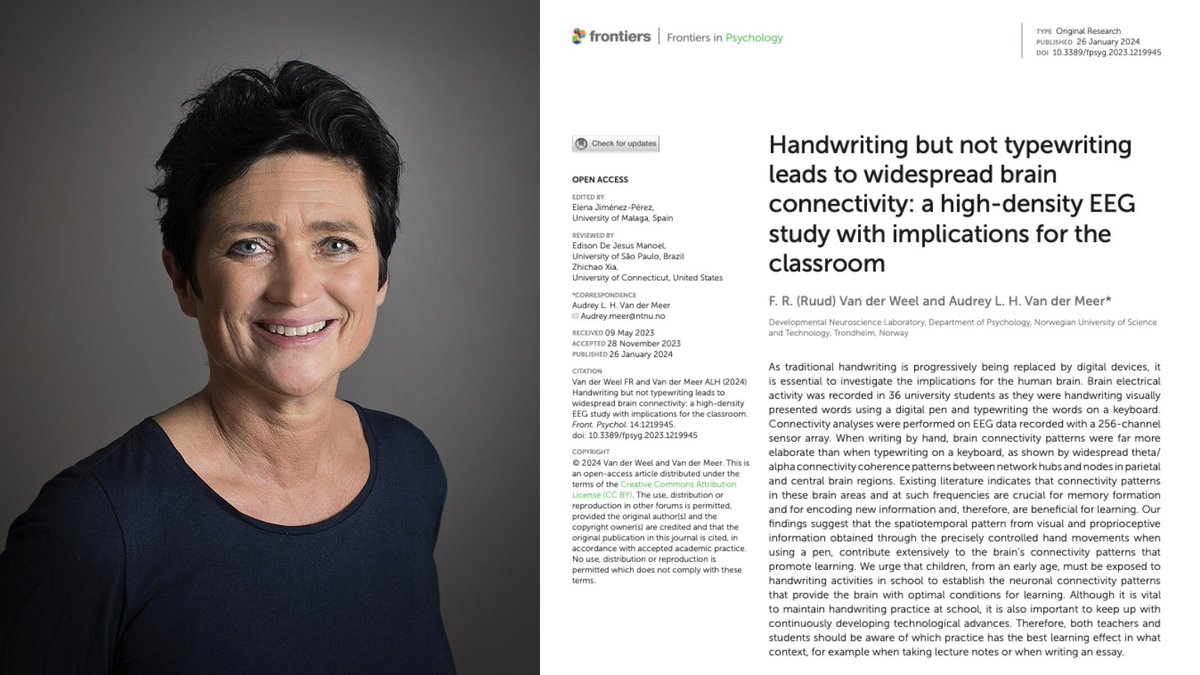
A Norwegian neuroscientist spent 20 years proving that the act of writing by hand changes the human brain in ways typing physically cannot, and almost nobody outside her field has read the paper.
Her name is Audrey van der Meer.
She runs a brain research lab in Trondheim, and the paper that closed the argument was published in 2024 in a journal called Frontiers in Psychology. The finding is brutal enough that it should have changed every classroom on Earth.
The experiment was simple. She recruited 36 university students and put each one in a cap with 256 sensors pressed against their scalp to record brain activity. Words flashed on a screen one at a time.
Sometimes the students wrote the word by hand on a touchscreen using a digital pen, and sometimes they typed the same word on a keyboard. Every neural response was recorded for the full five seconds the word stayed on screen.
Then her team looked at the part of the data most researchers had ignored for years, which is how different parts of the brain were communicating with each other during the task.
When the students wrote by hand, the brain lit up everywhere at once.
The regions responsible for memory, sensory integration, and the encoding of new information were all firing together in a coordinated pattern that spread across the entire cortex. The whole network was awake and connected.
When the same students typed the same word, that pattern collapsed almost completely.
Most of the brain went quiet, and the connections between regions that had been alive seconds earlier were nowhere to be found on the EEG.
Same word, same brain, same person, and two completely different neurological events.
The reason turned out to be something nobody had really paid attention to before her work. Writing by hand is not one motion but a sequence of thousands of tiny micro-movements coordinated with your eyes in real time, where each letter is a different shape that requires the brain to solve a slightly different spatial problem.
Your fingers, wrist, vision, and the parts of your brain that track position in space are all working together to produce one letter, then the next, then the next.
Typing throws all of that away. Every key on a keyboard requires the exact same finger motion regardless of which letter you are pressing, which means the brain has almost nothing to integrate and almost no problem to solve.
Van der Meer said it plainly in her interviews.
Pressing the same key with the same finger over and over does not stimulate the brain in any meaningful way, and she pointed out something that should scare every parent who handed their kid an iPad.
Children who learn to read and write on tablets often cannot tell letters like b and d apart, because they have never physically felt with their bodies what it takes to actually produce those letters on a page.
A decade before her, two researchers at Princeton ran the same fight using a completely different method and ended up at the same answer. Pam Mueller and Daniel Oppenheimer tested 327 students across three experiments, where half took notes on laptops with the internet disabled and half took notes by hand, before testing everyone on what they actually understood from the lectures they had watched.
The handwriting group won by a wide margin on every question that required real understanding rather than surface recall.
The reason was hiding in the transcripts of what the two groups had actually written down.
The laptop students typed almost word for word, capturing more total content but processing almost none of it as they went, while the handwriting students physically could not write fast enough to transcribe a lecture in real time, which forced them to listen carefully, decide what actually mattered, and put it in their own words on the page.
That single act of choosing what to keep was the learning itself, and the keyboard had quietly skipped the choosing and skipped the learning along with it.
Two studies. Two countries. Same answer.
Handwriting makes the brain work. Typing lets it coast.
Every note you have ever typed instead of written went into your brain through a thinner pipe. Every meeting, every book highlight, every idea you captured on your phone instead of on paper was processed at half depth.
You did not forget those things because your memory is bad. You forgot them because typing never woke the part of the brain that would have made them stick.
The fix is the thing your grandmother already knew.
Pick up a pen. Write the thing down. The slower road is the faster one.
Uganda has confirmed a case of #Ebola disease caused by the Bundibugyo species. @WHO is on the ground supporting the Ministry of Health and local authorities to strengthen contact tracing and disease surveillance, preparations for clinical management, risk communication and rapid response operations.
National and district task forces have been activated, with a mobile laboratory dispatched to a high-risk district. WHO is also supporting the response with essential emergency supplies, including PPE, laboratory reagents, sample collection kits, technical guidance and public information materials.
A Harvard professor spent 40 years inside the human brain studying how language works. Wrote 9 books. Taught thousands of students.
And he still thinks most people have no idea why their writing fails.
Steven Pinker stood in front of a room and asked one question. Why is almost all writing academic, corporate, government, even most things you read online so painfully bad to get through?
The room expected him to say laziness. Lack of practice. Poor education.
He said none of those things.
He called it the Curse of Knowledge. And once he explained it, I couldn't unsee it anywhere.
Here's how it works. The moment you understand something deeply, something breaks inside you. You lose access to what it felt like before you knew it. The confusion you once had disappears so completely that you can no longer imagine anyone else feeling it. Your blind spots don't feel like blind spots anymore. They feel like obvious starting points.
He told a story about a molecular biologist presenting at a TED event in front of 400 people. Brilliant man. Spent years on his research. Walked on stage and immediately started speaking in technical language without ever once explaining what problem he was trying to solve or why a single person in that room should care about it. People glazed over within two minutes. He finished his talk having no idea what had just happened. He thought he'd done well.
That is the curse in its purest form. It doesn't announce itself. It disguises itself as competence.
Then Pinker said the thing that stopped me cold.
Bad writing is not about intelligence. It is not about effort. It is a failure of empathy. A writer who cannot imagine what it feels like to not know what they know will always lose their reader. Every time. No exceptions.
His solution was not a writing technique. It was a person.
He gave his drafts to his mother. She was educated, well-read, deeply intelligent. But she was not a cognitive scientist. She had no stake in his field. When she hit a sentence and her eyes slowed down, when she read a paragraph and looked up slightly confused, he didn't think she'd missed something. He went back and fixed the writing. Not her. The writing.
That reframe alone is worth more than most writing advice combined.
Then he moved to the thing almost every writer gets completely wrong.
Words are not the point. Words are just a vehicle. What your reader actually walks away with is not the sentence you wrote. It is the image, the feeling, the physical thing that sentence was supposed to create inside their mind. If no image forms, nothing was communicated. The words passed through and left nothing behind.
He asked his audience what a paradigm looks like. What a framework feels like. What color a concept is.
Total silence.
Because abstractions are invisible. They produce no picture, no texture, no sensation. They are placeholders that feel like meaning but deliver none.
The writers who survived two hundred years did it because they had no choice but to be concrete. There was no jargon to retreat into. So instead of writing about aggression they wrote about the spirit of the hawk tearing into flesh. The reader felt it before they understood it. That is the only writing that actually works.
The last thing he said was about brevity. And he defined it in a way I had never heard before.
Brevity is not a low word count. Brevity is the discipline of cutting every single word that asks something of your reader without giving something back. Every unnecessary word is a small tax. Enough small taxes and the reader stops paying.
He has carried three words with him for forty years. Omit needless words. He said that line does something almost no piece of advice manages to do. It demonstrates what it teaches. It is itself an example of the principle it describes.
The best writing he ever produced came under an 800-word limit an editor refused to negotiate. The pressure of that constraint cut everything that was hiding inside the extra space. It always worked. Without fail.
The Curse of Knowledge will not go away because you are aware of it. Awareness is not enough. The only move that actually works is finding someone outside your world, handing them what you wrote, and watching their face while they read it.
Not reading it for them. Watching them.
The moment their face shows even a flicker of confusion, you have found exactly where your writing failed.
That is the whole masterclass.
Like an appreciation of progress, reading and literacy are among the things that are good but cognitively unnatural. That is, they go against our evolved nature. We didn’t evolve with print; it was a recent invention. Reading, for many of us, has become so second nature that we just assume it’s the most natural way of getting information. But what we’ve seen, especially in the last 10 years, when video has become so cheap because of the cloud computing revolution and the broadband revolution, is that a lot of people, unlike us, much prefer to listen and watch than to read. You just see this: when I go to Google and ask a basic question about how to unstick my printer or solve a problem, I get like five videos. And I just want a paragraph that would solve it. I don’t want to see Seth saying, “Hi, welcome to my show. If you like it, subscribe and give it a like.” So just help me solve the problem. But clearly there’s something unusual about me, because people are going for the video. And the massive availability of video—of TikTok, of YouTube—means that people may not be getting the practice or putting in the effort into literacy, which we have reason to believe was one of the drivers of the Flynn effect and of cognitive sophistication in general.
@HumanProgress
Throughout the 20th century, average IQ scores rose year after year.
In recent decades, that trend appears to have reversed .
@sapinker discusses why on our podcast.
Stop calling your research innovative.
Show me:
• The question nobody answered
• The method nobody tried
• The gap nobody filled
Innovation is demonstrated, not declared.
It's not just phonics: Schools have failed to teach reading because they ignore 50+ years of findings in cognitive psychology that reading depends on general knowledge. ED Hirsch has been banging this drum for a long time but Ed Schools shut their ears because the whole idea was unromantic & had a vaguely right-wing aroma. Now he joins with Dan Willingham to make a strong case that kids can't read if they don't have the background knowledge that makes sense of the rarer vocabulary, allusions, and understandings that allow us to read between the lines - which all reading requires. https://t.co/l1y4nkJfPO
Stupidity is knowing the truth, seeing the truth but still believing the lies.
And that is more infectious than any other disease.
—Professor Richard Feynman