Spliceosomes use quality control mechanisms to detect and correct mistakes during RNA processing. Our work explores how defective spliceosomes are identified and discarded. #RNA#RNAProcessing#Spliceosomes#QualityControlMechanisms#RMAP
https://t.co/IjYgWUr7Pr
We are very excited about our latest work, which just came out @embojournal – https://t.co/fXvRgVMu1I. The work @MCB_UJ was driven by Anna Biela and @TingYuLin1031 in collaboration with Janusz Bujnicki and his team @IIMCB_Poland…a short🧵
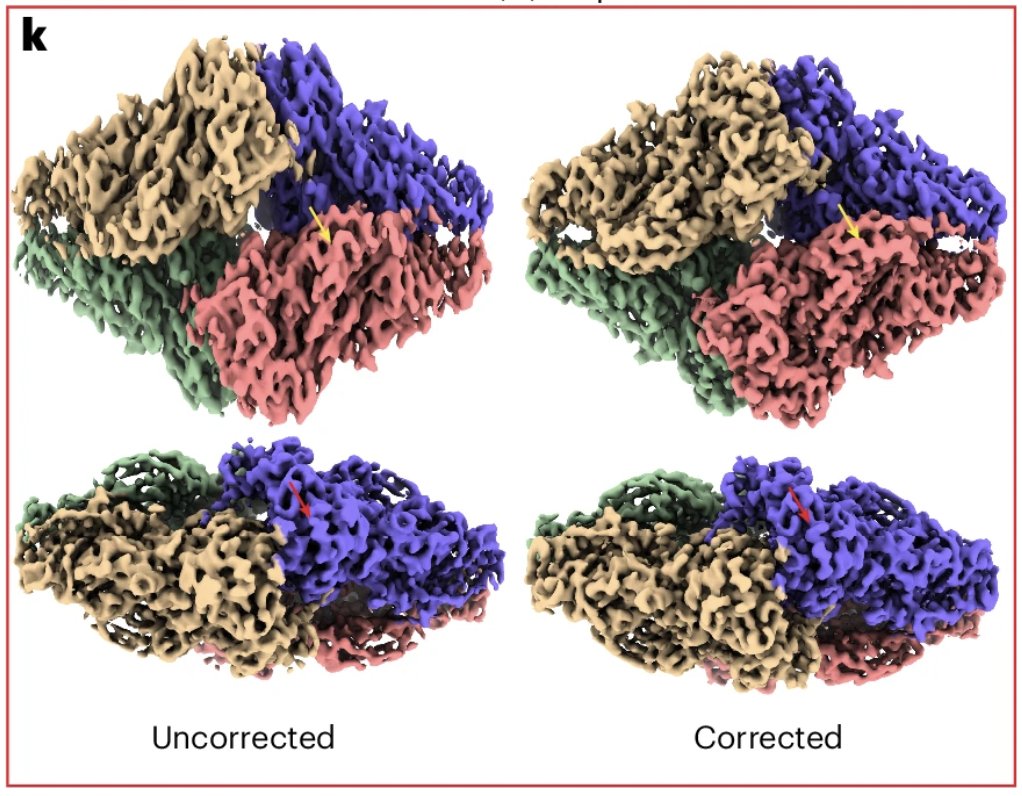
Introducing spIsoNet, a software tool that addresses the challenges of map anisotropy and particle misalignment in cryo-EM caused by the preferred orientation problem.
@zhou_lab@yuntaoinnit@hongcheng_fan
https://t.co/vViLnZWwie
We propose that the Gpl1-Gih35 complex is involved in a new Splicing Quality Control mechanism in the discard pathway where it initiates the process of disassembly by the Ntr1 complex.
(7/7)
📢Delighted to share our preprint on cryo-EM structures of aberrant spliceosome intermediates from Schizosaccharomyces pombe. This work sheds light on a new splicing quality control mechanism.
Check out the full paper here: https://t.co/pJwdSRiomt
(1/7)
Gpl1 recognizes this altered active site conformation. The largely unstructured Gpl1 crawls into the active site where it also extensively interacts with the 1585-loop of Prp8. (4/7)
Struggling with testing interactions between structurally complex proteins? -> You may try ReLo.
Great work by x-less Harpreet and Jutta 🥳 #WomenInSTEM
Now online @NatureComms@dfg_public
https://t.co/AxGKWrM6Tv