Sam Altman said people saying “please” and “thank you” to ChatGPT costs OpenAI tens of millions of dollars a year in compute. 67% of Americans do it anyway.
Run the math on why.
A 2024 Waseda University study tested LLM responses across politeness levels in English, Chinese, and Japanese. Impolite prompts produced measurably worse outputs: more bias, more errors, more refusals. Moderate politeness consistently beat both extremes.
The mechanism makes sense once you see it. Polite prompts pattern-match to higher-quality training data. When you write “Could you help me structure this analysis?”, the model pulls from professional, well-reasoned text. When you write “give me the answer,” it pulls from Reddit.
Google DeepMind’s Murray Shanahan explained it simply: the model is role-playing a smart intern. Treat the intern like a colleague, you get colleague-quality work. Bark orders, you get minimum-viable compliance.
Now look at the cost side. OpenAI handles over a billion queries daily. Each GPT-4 query uses roughly 2.9 watt-hours, ten times a Google search. But OpenAI just raised $40 billion at a $300 billion valuation. Tens of millions in politeness tokens is a rounding error on a rounding error.
67% of users do it anyway, and 55% of them say it’s because it’s “the right thing to do.” They’re maintaining a behavioral habit that governs every other interaction in their life. The parent who teaches their kid to say please to Alexa isn’t doing it for Alexa. They’re doing it because the alternative is raising someone who learns that being rude gets faster results.
Telling 900 million people to stop saying thank you so OpenAI can save 0.01% of operating costs is the most engineer-brained optimization take on the internet. You’re training yourself to treat every interaction as a transaction. And that habit doesn’t stay in the chat window.
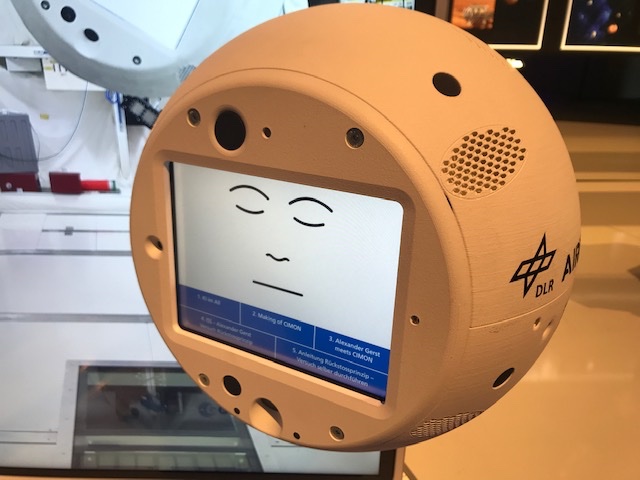
Noch schlummert der „Astro-Assistent“ CIMON vor sich hin. Aber gleich öffnet die #ILA22 - heute für Fachbesucher, am Wochenende auch für das allgemeine Publikum (Online-Ticket erforderlich!).
The German Space Agency (@DLR_SpaceAgency) and the Japan Aerospace Exploration Agency (@JAXA_en) have successfully passed a robotics milestone aboard the International Space Station (@space_station): Two AI-powered robots played hide-and-seek in space – the first-ever direct collaboration between astronaut assistance systems from different space agencies.
In the ICHIBAN mission (Japanese for “The First”) completed on 29th July 2025, two separately developed astronaut assistance robots communicated and cooperated with each other across two different IT networks for the first time ever. Collaboration between the two distinct free-flying robotic systems opens new opportunities for space agencies to augment and enhance astronauts’ work with robotics and AI.
Experiment paves the way for human spaceflight enhanced by robotics and AI and JAXA, DLR, Airbus, and SEC jointly enabled the multi-robot collaboration with the support of @IBM.
CIMON was developed on behalf of the German Space Agency at DLR by Airbus and with the support of IBM as an autonomous assistant robot for astronauts aboard the ISS.
copyright: DLR/ESA/JAXA/NASA
100,000 Orbits. One European Powerhouse. 🚀
For 17 years, the Columbus module has been the beating heart of European science on the @Space_Station. Circling 400 km above us, it just completed its 100,000th trip around Earth.
The powerhouse designed, built, and delivered for @European Space Agency - ESA, is more than just a silent traveller; it's a record-breaking science lab. And it is also a testament to Airbus's deep-rooted commitment to European space exploration.
🚀At a speed of 28,000 km/h, Columbus completes a lap around Earth every 90 minutes.
🌍 Since its launch in 2008, it has travelled a distance of approximately 4 billion km.
🧪More than a dozen European astronauts have floated through its hatch, conducting experiments and keeping the lab alive with human presence.
🔎 Columbus has hosted almost 2000 experiments so far—and the number keeps climbing (microgravity 3D printing, tissue growth studies, cosmic radiation research...).
🇪🇺 Built through the cooperation of 14 European countries and more than 40 companies, Columbus is a true continental achievement.
Let’s celebrate 17 years of innovation and 100,000 orbits of discovery!
🤖👨🚀 Schatzsuche auf der ISS 👨🚀🤖: Das ICHIBAN-Experiment mit KI-Robotern auf der Internationalen Raumstation ISS war erfolgreich 🤩. Dabei gab der Astronaut der japanischen Raumfahrtagentur @JAXA_en@Astro_Onishi im europäischen Columbus-Modul Sprachbefehle an den Assistenzroboter CIMON. Damit steuerte er die Kameradrohne Int-Ball2, die sich im japanischen Kibo-Modul befand. Int-Ball2 übertrug Bilder an den CIMON-Monitor und ließ so Onishi Gegenstände finden, die im Kibo-Modul versteckt waren wie etwa Zauberwürfel oder Hammer. Zum ersten Mal haben CIMON und Int-Ball2 in dieser Weise interagiert: über die Grenzen der IT-Netzwerke in den unterschiedlichen Modulen hinweg.
Foto: JAXA-Astronaut Takuya Onishi mit den Robotern CIMON (links) und der JAXA-Kameradrohne Int-Ball2 im japanischen Kibo-Modul der ISS. Credit: DLR/ESA/JAXA/NASA
@IBM@AirbusSpace@LMU_Muenchen
Nein, die Arbeitnehmer in Deutschland sind nicht zu faul.
Die Vorschläge, wie man Arbeiten wieder attraktiver macht, finde ich zunehmend absurd. Vor allem, dass Überstunden steuerfrei sein sollen.
Statt Überstunden steuerfrei zu stellen, sollten vielmehr die „normalen“ Arbeitsstunden steuerlich entlastet werden.
Überstunden attraktiver zu machen, impliziert, dass in Deutschland aus Faulheit wenig gearbeitet würde. Das stimmt einfach nicht.
Viele, vor allem immer noch Frauen, werden in Teilzeitverhältnisse gezwungen, weil die Kinderbetreuung nicht ganztags verfügbar ist. Oder oft müssen auch Angehörige gepflegt werden.
Zudem: Gehaltserhöhungen, die mit Fleiß und Einsatz erarbeitet werden, machen sich netto kaum bemerkbar. Das bremst die Motivation.
Meine Meinung: Die aktuelle Diskussion sendet ein falsches Signal. Die Überstunde sollte nicht zur Regel werden, denn dann ist in der Personalplanung etwas gehörig schief gelaufen. Die Gleichung mehr Arbeitszeit = mehr Produktivität stimmt einfach nicht.
Was ist eure Meinung zur Diskussion über steuerfreie Überstunden?
#work #deutschland #zukunft
Das beste zum Schluss! 👍
Wir freuen uns über deine Arbeit mit unserem „Crewmitglied“ #CIMON!
Save travels @astro_marcus & bis bald bei den Kolleginnen & Kollegen von @DLR_de & @ESA_de in Köln!
"CIMON, 101 mode," said the human. 👨🚀
This was the first interaction between @astro_marcus and CIMON, a flying, intelligent astronaut assistant on the International @Space_Station.
What would you ask the robot? 🤖
More about this exciting collaboration between astronauts, robotic assistants, and artificial intelligence in space: https://t.co/fyOv94LVYB
#Muninn @DLR_SpaceAgency, @AirbusSpace, @IBM
Heute Abend soll um 23:11 Uhr (🇩🇪 Zeit) der schwedische @ESA_de-Astronaut @astro_marcus zu seiner Mission #Muninn (deutsch: Rabe) aufbrechen. Zu seinem Programm auf der ISS zählen 20 Experimente & Wartungsarbeiten, darunter 10 deutsche Aktivitäten. 🇸🇪🤝🇩🇪
Auch unser fliegender Astronautenassistent #CIMON ist dabei. Mehr zu den Experimenten: https://t.co/IPSNu2qv1y
BOOM!
GPT4All native app now here. No more terminal!
Mac: https://t.co/ZU8V4HwWQh
Windows: https://t.co/OU5kNpYAcJ
Linux: https://t.co/iJ0H7owHtU
Extraction takes up to 20 minutes. Mac will report a notice that the app is not trusted, if so inclined, go to System Settings-Privacy & Security look for “Security” and approve the installation.
After downloading the installer for your platform, run the installer and pay close attention to the installation location, as you will need to navigate to that folder after the installation is complete. Once the installation is finished, locate the 'bin' subdirectory within the installation folder. To launch the GPT4All Chat application, execute the 'chat' file in the 'bin' folder. The file will be named 'chat' on Linux, 'chat.exe' on Windows, and 'https://t.co/1hAe1gbmXn' on macOS.
The old terminal way will still work.
BREAKING: Der US-Gouverneur @RonDeSantisFL aus #Florida will digitale Zentralbankwährungen #CBDC verbieten, weil sie im Gegensatz zu #Bitcoin nicht dezentral sind und #Überwachung fördern 🔎!
Weitere US-Staaten u.a. #Texas könnten sogar nachziehen👏!
https://t.co/e61N61FuKH
@sophiehoffman04@astro_matthias Wir werden das #CosmicKiss Science Debriefing aufzeichnen und im Anschluss auf unserem YouTube-Kanal (Deutsche Raumfahrtagentur im DLR) https://t.co/pb1n0HcXpz und auf https://t.co/fUOUAjEcOE veröffentlichen.