Eroj office velthunte auto anna chepparu valla son Chaitanya hostel lo join chesinappudu relatives andaruu oppose chesaru anta. NIT lo seat vachina kuda ‘dhooram’ ani wife kuda months maatladaledu anta. Ipudu Amazon lo 17.5 LPA offer vachindanta. Full happy face tho offer
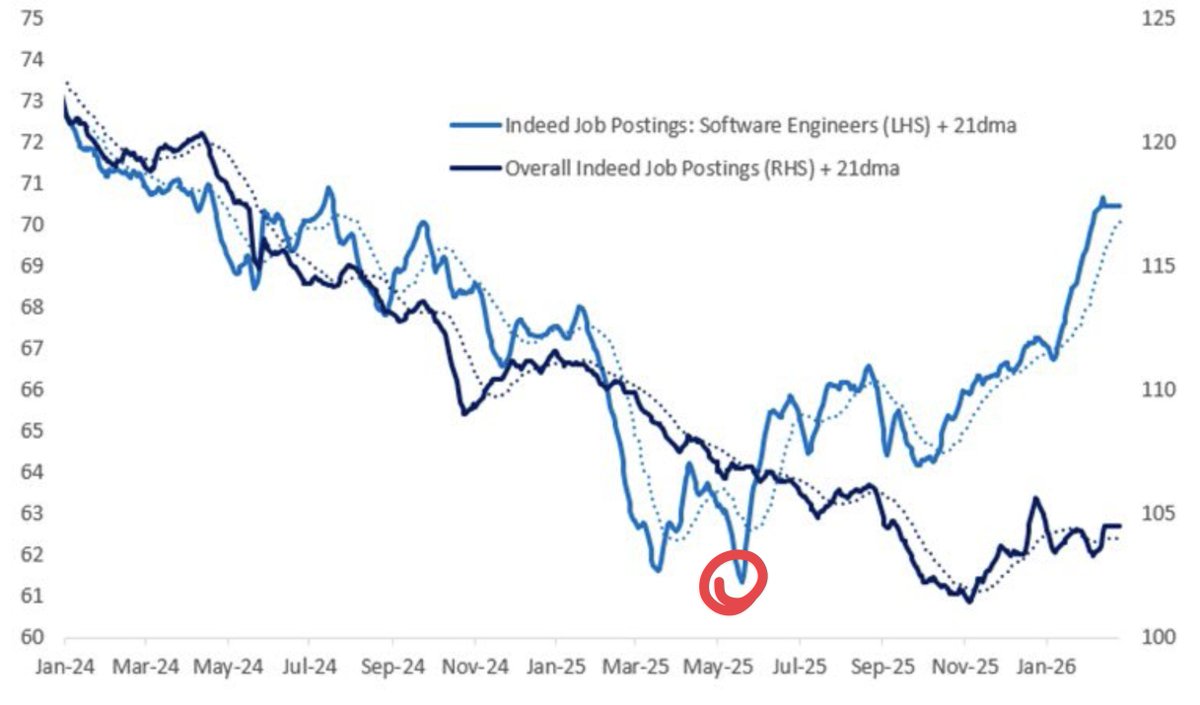
It appears I called the bottom. Software engineer job postings are up massively YoY, while overall job postings went down.
I said it in May 2025 and I'll say it again: I've never been more bullish on software engineering as a profession. But at that time (and still today!), many were saying that this profession was going away.
It was a bad take then and even more bad now.
AI is a tool that amplifies productivity: a lever doesn't move on its own, no matter how good that lever is, whether it's just really good tab completion or a cloud agent. Even agents need to be told what to do.
This industry in aggregate is going to be able to satisfy needs and use cases that have never even been considered due to time or resource constraints.
The future is bright for builders. Probably has never been brighter.
Karpathy is telling you something most product teams haven’t internalized yet.
The new distribution channel for software is agents. Agents don’t browse your marketing site, watch your demo video, or click through your onboarding flow. They call your CLI. They hit your MCP server. They read your docs programmatically. If none of those surface areas exist, your product is invisible to them.
Look at how fast this moved. MCP went from zero to 97 million monthly SDK downloads in twelve months. 10,000+ active servers. OpenAI, Google DeepMind, Microsoft, and Cloudflare all adopted it. By December 2025, Anthropic donated MCP to the Linux Foundation because the standard had already won. Running an MCP server is now compared to running a web server.
That’s the new baseline for product discovery.
85% of enterprises are expected to have AI agents deployed. Those agents need structured, programmatic access to your product. They need CLIs, MCP endpoints, and machine-readable documentation. A beautiful React dashboard is worthless to an agent trying to pull data into a workflow at 3am.
This tells you everything about why Karpathy’s framing of CLIs as “legacy” technology is so precise. Legacy means battle-tested, standardized, universally parseable. stdin/stdout, flags, JSON output. The entire Unix philosophy was accidentally designed for AI agents decades before they existed.
Your competitor ships an MCP server and suddenly every Claude Code user, every Cursor session, every autonomous workflow can discover and use their product. No human ever visits the website. No sales call. No onboarding email. The agent just finds the tool and starts using it.
The companies that win the next 24 months are the ones building agent-accessible surface area right now. The ones that lose are still optimizing their landing page above the fold.
New in Claude Code: Remote Control.
Kick off a task in your terminal and pick it up from your phone while you take a walk or join a meeting.
Claude keeps running on your machine, and you can control the session from the Claude app or https://t.co/er6Blrr63e
@KarthikIndrAnna But acknowledging that these were long-term public infrastructure decisions — not private profit ventures — makes for a more honest debate.
@KarthikIndrAnna If we measure every public infrastructure project only by whether it generates corporate-style profits, most large assets would look “loss-making.” That doesn’t mean the decision to build them was wrong.
Yes, financial discipline, transparency, and optimisation are necessary now.
@KarthikIndrAnna The real discussion is about:
• Cost efficiency
• Operational optimisation
• Transparency
• Long-term sustainability
Public infrastructure is rarely about short-term profits. It’s about long-term capacity building.
@KarthikIndrAnna Irrigation infrastructure works similarly. Its “returns” are indirect — agricultural output, groundwater recharge, rural income, and drought resilience.
So the debate shouldn’t be reduced to “loss-making.”
@KarthikIndrAnna — they are public infrastructure built for long-term urban mobility, reduced congestion, economic activity, and environmental benefits.
@KarthikIndrAnna Metro Rail required viability gap funding, state support, and restructuring discussions. Metro systems worldwide rarely operate as profit-maximising entities
@livingdevops@striver_79 We may be getting credits for everything. These credits can become the universal currency and can provide basic amenities for livelihood. It finally depends on how we use them. UBI and UBS are the path forward in the medium run.
In the long run, humanity might find something.
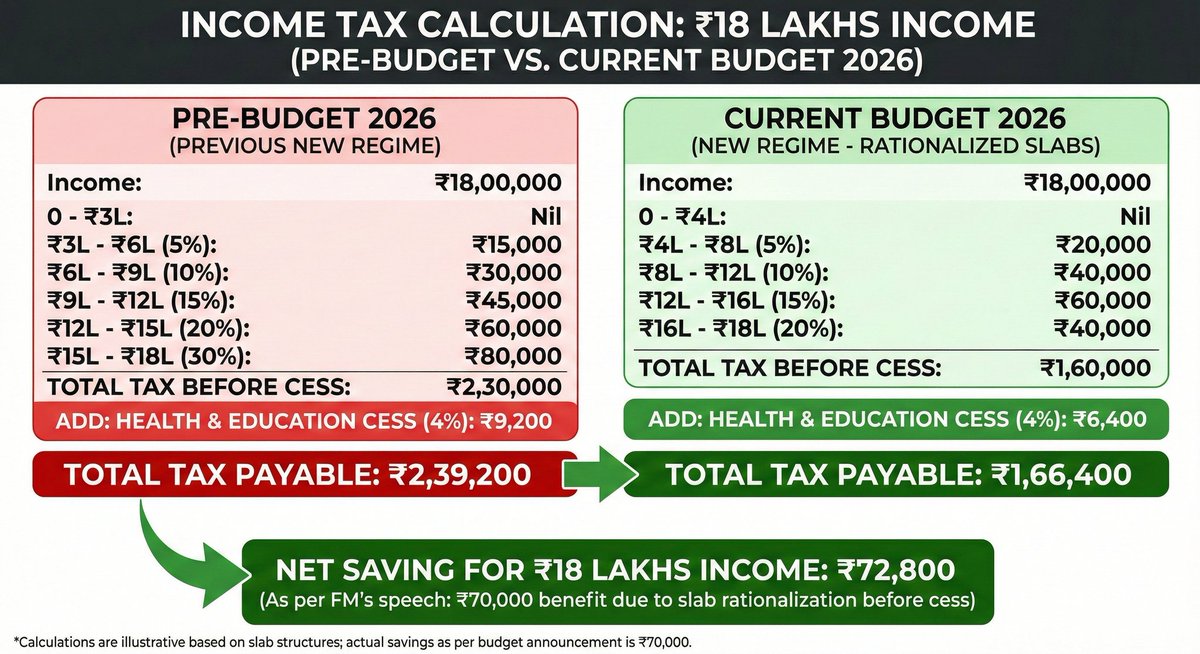
💡 HOW MUCH YOU SAVE (Examples from FM):
1️⃣ Income ₹12 Lakhs: You save ₹80,000 (100% relief!)
2️⃣ Income ₹18 Lakhs: You save ₹70,000
3️⃣ Income ₹25 Lakhs: You save ₹1,10,000
This is a game-changer for the middle class! 🚀
#Budget2026#IncomeTax#TaxRelief#NewTaxRegime#India