We have heard this over and over again, but what are the practical steps beyond despair? I think that while entrepreneurship by a few cannot change Africa, entrepreneurship by many will make an impact.
Industrialization happens because funds are provided from aggregate wealth and savings to the best of us who are willing to take the risk. It still comes down to entrepreneurship, but on a larger scale.
We are still borrowing from people who don't want us to make progress, and they are putting a risk premium on their loans. This is why Afrexim, AFC, AfDB, and other African lending institutions are now very important. We need to take our future into our hands.
We have to produce at scale and also save a lot, and, as rightly said, good public institutions are the catalyst. Great African-owned financial institutions are also very important.
I don't think any magic will suddenly happen in Africa beyond self-realization and gradual collective action.I still have a lot of faith in entrepreneurship, but we need to be better organized, both commercially and politically.
This tweet reminded me today of the late Prof Pius Adesanmi, of blessed memory, a mind Nigeria lost too early.
He often wrote about this in his Facebook posts & books.
He warned that Africa's obsession with "leapfrogging" from the pre-industrial to the Information Age is a delusion. You cannot skip the hard work of building basic infrastructure.
The Information Age is built on top of the Industrial Age. You are not just putting the cart before the horse; you are actively whipping the cart to move forward. 💀
He will say that a society cannot bypass the discipline, chemistry, & logistics needed to manufacture a simple pencil and expect to create iPads. Skipping industrialisation doesn't make us tech innovators—it just makes us tech consumers.
That "leapfrogging" was part of the general political scam in Africa. It allows leaders to skip the "boring," difficult parts of development (power grids, steel mills, railways) so they can chase the "cool" parts (apps, startups, smart cities) that look good on social media.
Trying to run a 4th Industrial Revolution on 17th-century infrastructure is a trap. Without a solid industrial foundation, the digital economy remains fragile, imported, & hollow. True progress requires patient capital and production.
I want to be fair to @PeterPsquare . He is not wrong that French opens doors Igbo does not. He is not wrong that parents get to decide how they raise their own children. But I guess he underestimates the fact that he is not just any parent. P-Square is a name millions of Igbo people grew up admiring, their success made them proud to be who they are. People all over the world sang their songs using Igbo words. So when a voice like that says Igbo is not worth passing on, it does not land like one man’s private choice. It gives permission for a belief a lot of people were already quietly carrying, that English and French, in short anything foreign, sits above Igbo, that their native language is something to graduate out of rather than something to hold onto.
I am not Igbo. I am Swiss. But my husband made it clear from the beginning that our children would speak Igbo, and I have never once seen that as a burden or a complication. Our children speak Swiss German, English, and Igbo at home, German at school, and now French as well, since that is part of their school curriculum too. Five languages, and none of them fighting each other for space. That is the part people forget when they frame this as a choice. Children do not need to pick one language to be strong in. They can navigate several at once, easily.
It is adults who turn language into a competition. Children just absorb what is spoken to them and grow fluent in all of it.
A language is not only a tool for getting ahead. It is also a rooting tool, the place where love, memory, and belonging live. It is the specific way a grandmother scolds you and forgives you in the same breath. It is a joke that only works in the original. Lose the language, and you do not just lose a skill. You lose a room in your own house, one you can still visit as a guest but never quite live in again. That is what worries me most in this conversation. A child who cannot speak their father’s or mother’s language will, at some point, stand in that homeland and feel like a stranger. Not unwelcome, not unloved, just outside something that was supposed to be theirs by birth.
One day, my sons will be handed a kola nut, and in that moment, no one should have to do it for them. They should know how to receive it, how to speak over it, how to break it themselves, not pass it along to someone else because they never learned the words or the meaning behind them. That is such a small moment, and yet it says everything. It is the difference between being someone’s guest and being someone’s own.
So when I hear “Igbo is useless,” what I actually hear is a wound that has not healed.
From the outside, I have watched how often English or French get treated as the languages worth keeping, while Igbo gets treated as the one you can afford to let go of. That preference did not come from nowhere. It is a colonial hierarchy that convinced generations of people that closeness to their own culture was a limitation rather than a foundation. I don’t say this to shame anyone, least of all a man raising his own family the best way he knows how. I say it because the people who shape how we see ourselves carry a weight beyond their own households, whether they asked for it or not.
My hope is simple. That we stop treating our children’s languages as a competition with only one winner. That we let them have both the world and their roots, and trust that they are capable of holding both without ever having to choose.
A few months ago, many people were upset that Google included Yoruba and Hausa in its AI language models while their own language wasn’t included. They argued it was marginalization because they understood that language representation matters.
Yet here we have a prominent celebrity publicly asking, “Who has speaking a Nigerian language helped?” That’s the kind of mindset that accelerates language loss.
Nigeria is a political state created in the 20th century. Yoruba civilization, language, and identity existed for centuries before it. My loyalty to my language isn’t dependent on whatever language the Nigerian government designates as official. Countries rise and fall. Borders change. Governments change. A people’s identity survives only if its people refuse to abandon it.
If the English, French, Chinese, Japanese, or Arabs had adopted this same mentality centuries ago, they wouldn’t have the languages they proudly speak today. Languages don’t survive by accident,they survive because each generation chooses to preserve them.
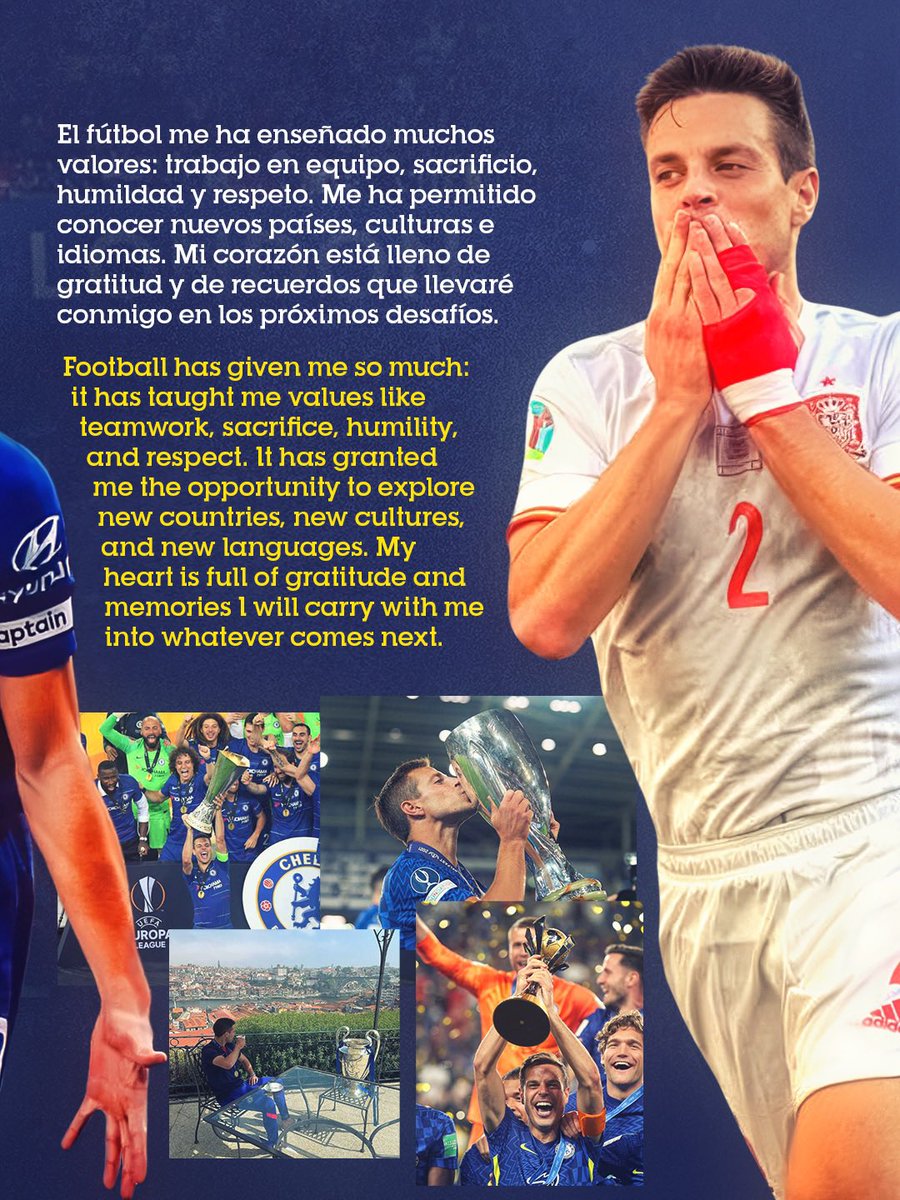
…….To the fans: your passion and support inspired me to give my best every day. Your belief in me, especially during tough times, made the good moments even better. I hope you saw a player who always gave everything for your colours, with pride and heart.
To my family: you have always been by my side and cheered me on through hard times, your love and support mean everything to me. I hope you feel proud. I could not have achieved any of this without you on this journey.
Football has given me so much: it has taught me values like teamwork, sacrifice, humility, and respect.
It has granted me the opportunity to explore new countries, new cultures, and new languages. My heart is full of gratitude and memories I will carry with me into whatever comes next.
With love,
César
This is evangelism in full display. I remember reading an article by Rick Warren when he said a former CEO of Adidas wanted to resign to be a full time evangelist/ministry and he said to him that could he reach more people as a CEO or as a pastor. He advised him to keep his job and influence and draw people to Christ with his role.
Victor Glover is displaying evangelism on a large scale with his work.
I am encouraging every Christian to use their skills/influence to draw people to Christ. Remember do your work as though you are doing it for Christ.
Went down the rabbit hole on this one. The answer is actually wild.
5,000 years ago, Sumerian merchants in modern-day Iraq needed a number that's easy to divide. They picked 60. It has 12 divisors (1, 2, 3, 4, 5, 6, 10, 12, 15, 20, 30, 60). Base-10 only has four. That's 3x as many ways to split something evenly, which matters when you're dividing grain and wages and can't handle repeating decimals.
The counting method is the best part. They used their thumb as a pointer on the three bone segments of each finger. Four fingers, three segments, that's 12 per hand. Track multiples of 12, on the other hand, and you hit 60. No pen needed. Merchants in parts of Asia still count this way today.
The system spread from Sumer to the Babylonians, then eastward to Persia, India, and China, and westward to Egypt and Rome. By 1800 BC, Babylonian students were using base-60 to calculate the square root of 2 to six decimal places on clay tablets. One student's homework from 4,000 years ago, now at Yale, holds the most accurate computation found anywhere in the ancient world. The Greeks adopted it for astronomy, which locked it into navigation, cartography, and eventually clocks in the 14th century.
People have tried to kill it. During the French Revolution in 1793, France mandated decimal time: 10 hours per day, 100 minutes per hour, 100 seconds per minute. New clocks, new laws, the whole thing. Lasted 17 months. Workers hated getting one day off every ten days instead of one every seven. They tried again in 1897. Scrapped by 1900. The metric system replaced feet and pounds across most of the world. But 60 minutes in an hour? Untouchable.
60 is just too good at being divided. You can split an hour into halves, thirds, quarters, fifths, sixths, tenths, twelfths, or twentieths and land on a whole number every time. Try that with 100, and you get ugly decimals for thirds, sixths, and most common splits. 5,000 years of civilizations looked at that math and came to the same conclusion: 60 wins.
Nobody warns you that in Nigeria, talent is not the main problem, exposure is.
You can study hard, graduate top of your class, and still be confused because nobody ever showed you how your course connects to the real world. No industry mapping. No tools. No career pathways. Just vibes and “you go figure am.”
While students in other countries are doing internships, research, projects and using industry software, many Nigerian students are fighting for WiFi at night, sharing laptops, and learning theory without context. Same brains. Different systems.
Then after graduation, the same country turns around and says “graduates are not employable.” How? You trained people without infrastructure, without guidance, without access, then blamed them for not flying.
Add gatekeeping on top. The few people who break into industries now decide who enters next. They don’t build ladders, they build fences. So even the motivated ones get tired and look outside the country.
That’s why when you explain someone’s course properly, they’re grateful. Not because you’re doing magic but because nobody ever explained it to them before.
Nigeria doesn’t lack smart people. It lacks structure, openness and intentional development.
Clarity changes lives. Access changes outcomes.
One of the understated tragedies of contemporary #Nigeria is that predominantly, if your kids attend the same schools that you attended, primary and secondary especially, then it means that you have been a failure in life.
Fear of Missing Out (FOMO)
I remember when I was younger, I usually bore thoughts of opportunities ending. Then, in my first year in college, I'd pray severally, "God, please don't let them stop this opportunity before it reaches my turn!"
But over time, what I've come to realize is opportunities don’t just vanish; they evolve. There will always be a market for talent because the world will always make room for people who show promise. Those who keep showing up and improving.
So now, instead of stressing about what others are doing or what you might be “missing out on,” focus on how much better you're getting day by day. The habits you build, the books you read, and the skills you sharpen, those are the real investments.
Your worst fear should not be the parties you missed out on attending , the trendy clothes you missed out on buying, or the newly launched phones you can't buy.
Your worst fear should be you missing out on your own growth.
The Gospel in church this morning was ❤️❤️❤️
Jesus said to his disciples:
“Amen, I say to you, it will be hard for one who is rich to enter the Kingdom of heaven. Again I say to you, it is easier for a camel to pass through the eye of a needle than for one who is rich to enter the Kingdom of God.” When the disciples heard this, they were greatly astonished and said, “Who then can be saved?”
Jesus looked at them and said, “For men this is impossible, but for God all things are possible.”
That last paragraph gave me so much joy this morning. I have been hearing or reading this portion of the Bible for decades but missed this part.
Jesus was indeed not man and wiser than mortals. The Bible is like a legal document with loopholes that people do not easily see. This is why Pope Benedict once argued against literalism in Christianity. Not everything is black or white. The Bible is much deeper than shallow interpretations.
God didn’t say we shouldn’t be rich and be poor always. God can make us rich but also use that wealth for great good.
As I type this, I look up to the hills in front of my home and I remember Psalm 50:9-10 reads, "I will not accept a bull from your house, nor goats from your folds. For every animal of the forest is mine, and the cattle on a thousand hills."
How can you be bargaining with the owner of all creation? The best prayers and those that are answered involve full submission to the will of God.
Whatever your field is, try to build out some proof of work that demonstrates it eg a product, a project, some kind of demo.
Truth is, clients, employers, investors, don't care as much about potential or credentials, just what you have produced already without help.
Nigerians are building their own affordable localized alternatives to cloud services like AWS, Microsoft Azure, and Google Cloud
https://t.co/xpmck35oVF
You start out reading your parents' books on the massive shelf in the house, then you switch to the ones they got you, then the maps of Nigeria, Africa and the World - the only meaningful decoration (ex pictures) in the children's room. Then the newspapers and magazines...
As someone who has been in the same vehicle with my dad to witness this, that accident will still happen even if all of you disembark.
It is a false sense of control and something science still has to unravel.
My father sensed an accident and his caution caused the accident.